Paid social media advertising places sponsored content in front of audiences on platforms such as Facebook, Instagram, TikTok and Pinterest. Advertisers can pay for clicks, impressions or conversions, while targeting helps reach people more likely to be interested in the offer.
More exposure alone does not make advertising profitable. Its value depends on reaching relevant prospects and measuring whether that attention leads to website visits, purchases or other business outcomes.
This article explains how audience targeting and retargeting work, what paid social can contribute, and how campaign goals and performance measures shape a strategy. It also covers why platform choice, creative and ongoing optimization matter. The goal is not simply to buy reach, but to understand how paid social supports growth and how to measure its contribution.
Key Takeaways
- Set a measurable campaign objective before allocating budget, then assess performance against KPIs tied to that goal.
- Use audience signals such as interests and behaviors to reach relevant prospects, and retarget people who have shown purchase intent.
- Paid campaigns can extend reach beyond organic content and help reconnect with potential customers who haven’t converted yet.
- Choose platforms based on where your audience is active, then refine creative and campaign decisions using performance data.
What is Paid Social Advertising?
Paid social advertising uses sponsored content across social platforms to support a defined business objective. Advertisers can pay for clicks, impressions or conversions, then assess performance against relevant key performance indicators.
Budget decisions should reflect the platform, competition, buying behavior and campaign duration. Measurement should connect spend to business outcomes, rather than treating exposure as the end goal.
Campaign Budgeting and Payment Models
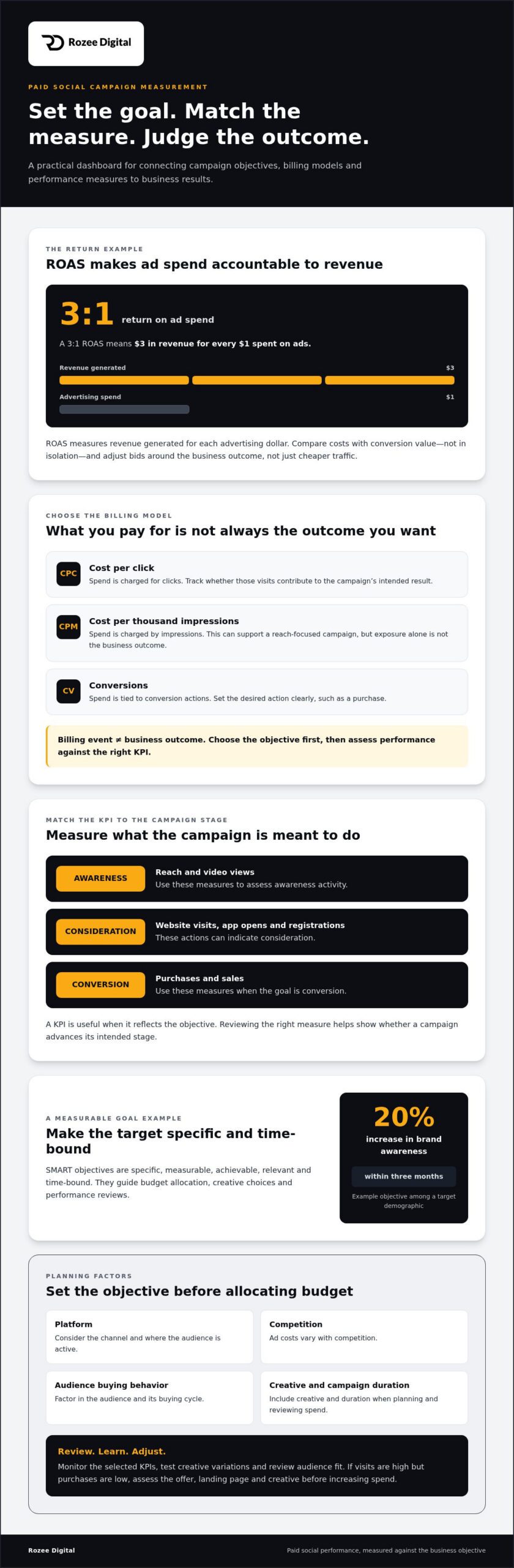
A campaign budget sets the amount allocated to advertising. The payment model determines whether that spend is charged for clicks, impressions or conversions. The distinction matters because the billing event and the business outcome are not always the same.
For example, an impression-based campaign can build reach, while a conversion-focused campaign prioritizes actions such as purchases. It can help to consider the channel, audience buying cycle and campaign duration when planning a budget. Set the objective first, then allocate funds to match it.
Bid Management and Ad Costs
Bid management determines how bids compete for ad placements and how spend is directed toward the selected objective. CPC means cost per click; CPM means cost per thousand impressions. There is no single typical CPC, CPM or conversion rate: results vary with the platform, competition, audience, creative and campaign objective.
Compare those costs with conversion value, not in isolation. ROAS, or return on ad spend, measures revenue generated for each advertising dollar. A 3:1 ROAS means $3 in revenue for every $1 spent on ads. Review performance regularly and adjust bids against the business outcome, not just cheaper traffic.
Campaign Goals and KPIs
SMART goals make campaign objectives specific, measurable, achievable, relevant and time-bound. They matter because a clear target guides budget allocation, creative choices and performance reviews.
For example, a business could aim to increase brand awareness by 20% among a target demographic within three months. Match KPIs to the goal: reach and video views suit awareness, while purchases and sales measure conversion. Website visits, app opens and registrations can indicate consideration. These measures show whether the campaign advances its intended stage.
Paid Media Strategies and Campaigns
A paid media strategy connects audience, platform, creative, budget and measurement across campaigns. It matters because isolated ads can generate activity without supporting a coherent business objective.
For example, a TikTok campaign might measure video views to assess awareness, or purchases if conversion is the goal. Common pitfalls include choosing a platform without considering audience fit, setting vague objectives and failing to review results or refresh creative. Test creative variations, monitor the chosen KPIs and adjust when performance suggests a mismatch.
Audience targeting and retargeting
Audience targeting defines who should see an ad, using signals such as demographics, interests and behaviors. Social platforms also use algorithms to deliver ads to people who may be interested. This can make a campaign more relevant than broad, untargeted distribution.
For example, an ecommerce brand could target people interested in a product category, then compare engagement and purchases across audience groups. First-party data, such as customer or site-visitor information collected by the business, can help shape audience segments. Contextual targeting works differently: it aligns an ad with the content or environment where it appears, rather than relying only on an individual’s profile.
Retargeting reconnects with people who have shown intent, such as visitors who viewed a product page but did not purchase. A brand can tailor a follow-up message to this group and exclude recent purchasers when the offer is intended for new customers. This ties audience selection to customer actions instead of treating every visitor alike.
LinkedIn can suit B2B and professional services campaigns. Its targeting can focus on professional audiences, while campaign formats help deliver content in the platform environment. Choose LinkedIn when the audience and business objective fit; platform presence alone is not a reason to spend.
In the United States, make ad disclosures and audience-data practices clear and responsible. Follow applicable federal and state requirements, as well as each platform’s advertising and data-use policies.
Assess audience performance against the campaign goal. If a segment generates website visits but few purchases, review the offer, landing page and creative before increasing spend. If an audience converts, test whether similar targeting can reach more prospects without reducing efficiency. Facebook and Instagram offer targeted advertising capabilities, but the right audience still depends on the product and buying context.
Align audience selection, creative and measurement so paid social decisions support the campaign objective.
Benefits of social media advertising
Sponsored campaigns can extend a brand’s reach when organic social performance plateaus. Instead of relying on existing followers to see a post, a business can use platforms such as Facebook, Instagram or Pinterest to put relevant content in front of additional audiences. The value is access to new prospects, not reach for its own sake.
Paid distribution can also give proven creative a wider audience. For example, a LinkedIn post that already earns strong engagement can be promoted to extend its reach. This builds on an existing signal instead of treating every campaign as an untested idea. Keep the promoted message relevant to the audience and the action you want them to take.
Social platforms can support different stages of the customer journey. A sponsored video can introduce a product, while a product-focused ad can direct interested viewers toward a purchase. For ecommerce teams, this connects awareness activity with site visits and sales. Measure each campaign against its intended outcome instead of judging every format by immediate revenue.
Creative testing helps brands compare product images, messages or calls to action and use the results to shape the next iteration. For example, an apparel retailer might test a lifestyle image against a close-up product view. The findings can inform future ads without assuming one creative direction works for every platform or audience.
Pinterest can suit products that lend themselves to visual discovery. A homewares brand, for instance, could show a product in a room setting rather than rely on a standalone catalog image. Choose platforms based on the product, audience and campaign objective. A strong channel fit makes the message more useful; a weak fit can consume budget without advancing the customer’s decision.
These benefits depend on disciplined measurement. Track the intended action, assess traffic quality and compare campaign contribution with business outcomes. Paid social can expand reach and sharpen creative decisions, but impressions alone do not establish commercial value. The key question is whether the campaign advances a defined growth objective.
Which social media platforms offer paid advertising in the United States?
In the United States, paid advertising is available on Facebook, Instagram, LinkedIn, Twitter, TikTok and Pinterest. YouTube and Snapchat are also used for paid social campaigns. The right mix depends on the audience and the role each campaign should play. A channel’s availability does not establish whether it fits a brand’s commercial goals.
Compare platforms against the same business objective. For an ecommerce launch, decide whether the priority is product discovery, site visits or purchases, then assess each channel using the corresponding measure. Keep the offer and destination page consistent during comparisons so you are evaluating the platform against the same customer proposition.
Creative should suit its placement. A vertical video and a product image create different experiences, so consider how each ad will appear in its platform environment. Prepare versions for the intended placements, then assess response using relevant campaign outcomes rather than impressions alone.
For a practical comparison, start with the channels your customers already use. Set a clear objective for each selected platform and separate results by channel. If one generates traffic but few orders, investigate the audience, creative and landing-page experience before shifting more budget. This helps distinguish a channel-fit problem from an execution issue.
Review performance in the context of the wider business. Platform reporting shows activity within a channel, while ecommerce outcomes reveal whether that activity contributes to sales. Use both perspectives to decide whether to keep testing, refine the approach or reallocate investment.
Rozee Digital: Ecommerce ads agency
Rozee Digital is an ecommerce ads agency for brands seeking disciplined paid media management tied to commercial outcomes. Its paid social work can help connect audience strategy, campaign execution and performance measurement, while Facebook Ads support can focus activity on a relevant platform.
Consider growth support when your internal team needs a stronger connection between paid social, creative testing and ecommerce performance. The priority is not simply increasing ad delivery, but making decisions around business measures such as customer acquisition cost, revenue, contribution margin and lifetime value. Rozee Digital’s Growth Accountability™ model takes ownership of growth rather than managing campaigns.
For brands managing several paid channels, Rozee Digital also offers PPC advertising support. Contact Rozee Digital to discuss your paid media needs, or visit rozeedigital.com.
Build a More Accountable Growth Engine
Connect channel decisions to your business economics before expanding paid social media advertising. Define how customer acquisition cost (CAC), the cost of acquiring a customer, and lifetime value (LTV), the revenue a customer generates over time, relate to your margin targets and wider media mix. This helps distinguish growth that supports the business from activity that merely increases reporting volume.
Rozee Digital brings ecommerce advertising together with Google Ads and paid social. For brands evaluating these channels together, the opportunity is to build a coordinated growth approach around clear commercial priorities, rather than treating each platform as a separate operating silo.
Discuss your growth priorities with Rozee Digital. A focused conversation can help clarify where paid media fits your business plan. Make the next decision with intent and keep your growth strategy accountable to the outcomes that matter.
Frequently Asked Questions
What is paid media?
Paid media is promotion a business purchases to reach audiences beyond its owned channels. Examples include sponsored social posts, search ads and display placements. A retailer might pay to feature a product in Instagram feeds or appear in Google search results. Unlike organic content, paid placement uses an advertising budget, so assess its performance against the business objective.
What is paid social media advertising and how does it work?
Paid social media advertising uses sponsored placements on social platforms to reach selected audiences. A business chooses a campaign objective, audience, creative and budget, then the platform delivers ads through its auction and delivery systems. For example, a retailer can promote a new product to prospective customers and measure whether the campaign drives product-page visits or orders.
How much does social media advertising cost by platform in 2026?
There is no universal 2026 price for advertising on Facebook, Instagram, TikTok, Pinterest or LinkedIn. Actual spend depends on the bidding model, campaign objective, audience competition, creative format and delivery period. Compare platform costs using your own campaign data and a consistent outcome, such as qualified visits or purchases. Industry averages alone may not predict your account’s results.
How do paid social advertising costs compare across platforms?
Platform costs are not directly comparable unless campaigns pursue similar goals and audiences. A TikTok video-view campaign and an Instagram purchase campaign optimize for different actions, so their cost metrics answer different questions. Compare each channel’s cost per desired outcome with the resulting customer value. For ecommerce, assess whether acquired customers generate enough revenue and margin to support continued investment.
How do I create and launch a paid social media campaign?
Start with one business objective, such as generating product sales or building awareness for a launch. Define the audience and offer, prepare creative suited to the platform, and set a budget aligned with the test. Before launch, make sure the destination page delivers on the ad’s promise. Once delivery begins, review results against the objective and adjust the creative or audience.
How should I target audiences and choose ad placements for paid social?
Build audience segments around customer relevance, such as product interest, past site activity or existing customer relationships. Then choose placements suited to the creative: vertical video may fit mobile-first environments, while product imagery may suit visual discovery. Where practical, test audiences and placements separately. This makes it easier to identify whether performance changes stem from the people reached or the ad environment.