Lifecycle email marketing means sending automated emails triggered by what a customer does, or fails to do, at each stage: signup, first purchase, repeat purchase, lapse. For an established ecommerce brand, it is the cheapest way to turn customers you already paid for into repeat revenue. This guide covers the stages, the flows worth building first, how to segment and time them, and the metrics that show whether retention is improving profit or only activity.
TL;DR
- Lifecycle email is behavior-triggered automation across the journey: welcome, cart recovery, post-purchase, replenishment, win-back and loyalty. It is not a calendar of newsletters.
- Build in order of revenue impact: welcome, cart and checkout abandonment, post-purchase, then win-back and VIP flows.
- Segment by behavior and purchase history, and judge success by repeat purchase rate, LTV and profit per send, not open rates.
- Retention email lowers the blended cost of growth: the more revenue returning customers produce, the less pressure you put on paid acquisition and CAC.
- Deliverability rules from Gmail and US law apply to every flow, so build compliance in from day one.
Table of Contents
- What lifecycle email marketing is, and what it is not
- Why lifecycle email matters when acquisition costs rise
- The lifecycle stages and the emails that fit each
- The flows to build first, in order
- How to automate it without building a mess
- Segmentation, timing and personalization
- Subscription brands: using email to cut cancellations
- Metrics: how to tell if it is working
- Deliverability and compliance are part of the program
- Our perspective on retention email
- When it makes sense to bring in an agency
- FAQ
- Sources
What lifecycle email marketing is, and what it is not
A newsletter goes to everyone on a schedule you choose. A lifecycle email goes to one person because of something they did: they joined your list, left a cart, received an order, or went quiet for 90 days. Shopify’s 2026 guide to ecommerce email automation defines these workflows as emails sent automatically after actions such as signup, cart abandonment or purchase, using store data like purchase history, browsing activity, opens and clicks.
The same guide splits automations into two jobs. Growth automations move a prospect toward a first purchase. Retention automations encourage repeat purchases and long-term loyalty. That split is a useful way to organize your program, because the two jobs have different goals, different offers and different success metrics.
Lifecycle marketing is the strategy and email is the main channel for it. SMS, paid retargeting and on-site messaging can carry the same logic, but email is usually where a brand owns the data, controls the cost and can test fastest.
Why lifecycle email matters when acquisition costs rise
A few terms first, since the rest of the article leans on them:
- CAC (customer acquisition cost): total sales and marketing spend divided by new customers won in the same period.
- ROAS (return on ad spend): revenue attributed to ads divided by ad spend. A 3.0 ROAS means $3 of revenue per $1 of ads. It ignores margin and returning-customer revenue.
- MER (marketing efficiency ratio): total revenue divided by total marketing spend, across all channels. It is harder to game than platform ROAS because it does not depend on attribution.
- LTV (customer lifetime value): the gross profit, or revenue if you state it that way, a customer produces over their relationship with you. Use one definition consistently.
When CAC climbs, a brand has two levers: acquire more cheaply or earn more from each customer. Shopify’s lifecycle marketing guide argues that focusing only on acquisition misses repeat business, and that tailoring messages to the stage a customer is in can improve engagement, retention, lifetime value and return on investment. Email is the cheapest place to pull that second lever, because the marginal cost of one more send to an existing customer is close to zero compared with winning a new one.
Here is a hypothetical example, labeled as such. A brand spends $60 to acquire a customer who buys once for $80 at a 50% gross margin. That first order earns $40 and loses $20. If lifecycle flows bring 25 of every 100 customers back for a second $80 order, the average customer adds $10 of gross profit, and the payback gap narrows. The numbers are illustrative, but the logic is why retention email shows up in the MER, not just in an email dashboard.
The lifecycle stages and the emails that fit each
Sources group the stages differently. Shopify’s customer journey guide uses awareness, consideration, purchase, retention and advocacy. Other frameworks split out activation or win-back. For an ecommerce brand, a practical working version looks like this:
| Stage | Goal | Typical emails |
|---|---|---|
| Awareness | Turn a visitor into a subscriber | Opt-in confirmation, welcome, brand story |
| Consideration | Build trust before the first order | Product education, social proof, browse abandonment |
| Purchase | Close the sale | Cart and checkout abandonment, back-in-stock |
| Retention | Earn the second order | Order confirmation, usage tips, cross-sell, replenishment |
| Advocacy | Turn happy customers into demand | Review requests, referral invitations, VIP perks |
| Win-back | Reactivate or retire lapsed contacts | Win-back offers, last-chance, sunset |
Shopify’s journey guide lists welcome and brand-story messages for awareness, personalized education and social proof for consideration, abandoned-cart recovery at purchase, product-use and referral messages for retention, and review or referral requests for advocacy. The table adds win-back as its own row because lapsed customers need different treatment from active ones.
The flows to build first, in order
If you are starting from a thin program, do not build everything at once. Sequence by how directly each flow produces revenue.
1. Welcome series
This is the first impression and usually the highest-engagement email you will send. Litmus’s 2025 ecommerce playbook recommends a welcome series of three to five emails over seven to ten days, covering brand introduction, product education, social proof and a first-purchase incentive. Treat that as a starting structure to test, not a rule. Brands with strong margins on a hero product sometimes do better leading with education and holding the incentive back for non-buyers.
2. Cart, checkout and browse abandonment
These flows recover intent that already exists. They also respond to behavior, which is why they usually beat broadcast campaigns per send. We cover the mechanics, including timing and what to leave out of the first message, in our guide to abandoned cart emails that actually convert. The short version: send the first reminder within hours, lead with the product rather than a discount, and reserve incentives for the second or third message.
3. Post-purchase
This is the most neglected flow and the one most tied to retention. After the order confirmation, help the customer get value from what they bought: setup instructions, care tips, tutorials, a short note from the team. Shopify’s journey guide points to product tips and tutorials as a retention tactic, with upsell, cross-sell and referral messages following once the customer has had time to use the product. A customer who understands the product returns less and reorders more.
4. Replenishment and cross-sell
If your product runs out, such as skincare, supplements, pet food or coffee, time a reorder email to the typical usage window rather than a fixed number of days for everyone. Use your own order data to find the median gap between first and second purchase, then send slightly before it. For non-consumable products, trigger cross-sell based on what was bought, not on what you want to clear.
5. Win-back and sunset
When a customer passes their usual reorder window without buying, a win-back sequence tries to restart the relationship. If they still do not engage, a sunset flow removes them from your active sends. That protects deliverability, which matters more than it used to (see below).
6. VIP and loyalty
Your top decile of customers by spend deserves its own treatment: early access, a thank-you, a direct line to support. For ideas on extending retention into rewards, reviews and referrals, this walkthrough of customer loyalty step by step is a useful companion to the email work.
How to automate it without building a mess
The setup is less complicated than the planning. Connect your email platform to your store so it receives orders, products, customer profiles and browsing events. Define triggers: subscribed, started checkout, placed order, no order after N days. Then build each flow with entry conditions, exit conditions and filters so one person is never in three flows at once.
Shopify’s email sequence guide notes that sequences can branch on behavior: a click can trigger related follow-up content, while non-engagement can trigger a different offer. That branching is what separates a lifecycle program from a drip. A fixed three-email series treats the person who clicked twice and the person who ignored everything the same way.
Two habits keep a program healthy as it grows. First, add flow priority rules: a customer who just bought should leave the cart flow and any promotional campaign for a set window. Second, document every trigger, delay and filter in one place. Teams that map their behavior-triggered workflow automation on paper first find overlaps and dead ends before customers do.
If you want the deeper build on this, our breakdown of ecommerce email automation flows that drive revenue and our broader ecommerce email marketing strategy guide go flow by flow.
Segmentation, timing and personalization
Personalization that matters is mostly about picking the right message, not inserting a first name. Useful segmentation inputs fall into three groups:
- Behavioral: pages browsed, products viewed, emails clicked, cart contents.
- Transactional: number of orders, average order value, total spend, product category purchased, days since last order.
- Declared: preferences, size, skin type, gift versus self, opt-ins collected in forms or a quiz.
A new subscriber, a first-time buyer, a repeat customer and a lapsed one are different people. Sending them the same 15% off blast wastes relevance and teaches your best customers to wait for a discount.
For timing, let behavior set the clock. A cart email an hour after abandonment, a product-use tip a few days after delivery (not after the order), a replenishment nudge ahead of the typical reorder window. Calendar-only sending is the fallback, not the plan.
Lead with the customer’s next decision, not your revenue target. If the email helps them make the next step easier, whether that is understanding a product or finding the right size, revenue tends to follow. If it exists only to hit a number, readers notice.
Subscription brands: using email to cut cancellations
Subscription ecommerce has a distinct retention problem: customers can leave at every billing cycle. Email helps most before the cancellation moment, not during it.
There is academic evidence that engagement matters. A 2022 field experiment in Manufacturing & Service Operations Management, run on a US car-wash subscription service, found that one month of engagement with two emails raised the likelihood of retention by 7.4% five months later, cut churn odds by 26.3% over five months and increased per-period service use by 7.0%. The authors caution that profitability depended on which subscriber segments received the emails. That is a car-wash business, not a box of razors, so treat it as a signal and not a forecast. The takeaway is segmentation: aim retention email at the subscribers where it changes behavior.
For subscription brands, the flows that matter are onboarding for the first box or first month, a usage and value reminder before the second renewal, a skip-or-swap option ahead of billing, a payment-failure sequence, and a pause offer before a cancel. Our subscription ecommerce email retention playbook covers each in detail.
Metrics: how to tell if it is working
Open rates are a weak signal now, since mail privacy features inflate them. Put these in front of the team instead:
- Revenue and profit per recipient by flow, and flow share of total email revenue.
- Repeat purchase rate within 60, 90 and 180 days of first order, by acquisition cohort.
- LTV by cohort, compared before and after you launched or rebuilt flows.
- Cart recovery rate and win-back reactivation rate.
- MER and blended CAC payback, because retention should show up in the efficiency of total spend, not only in email reports.
- Unsubscribe and complaint rates, as health checks.
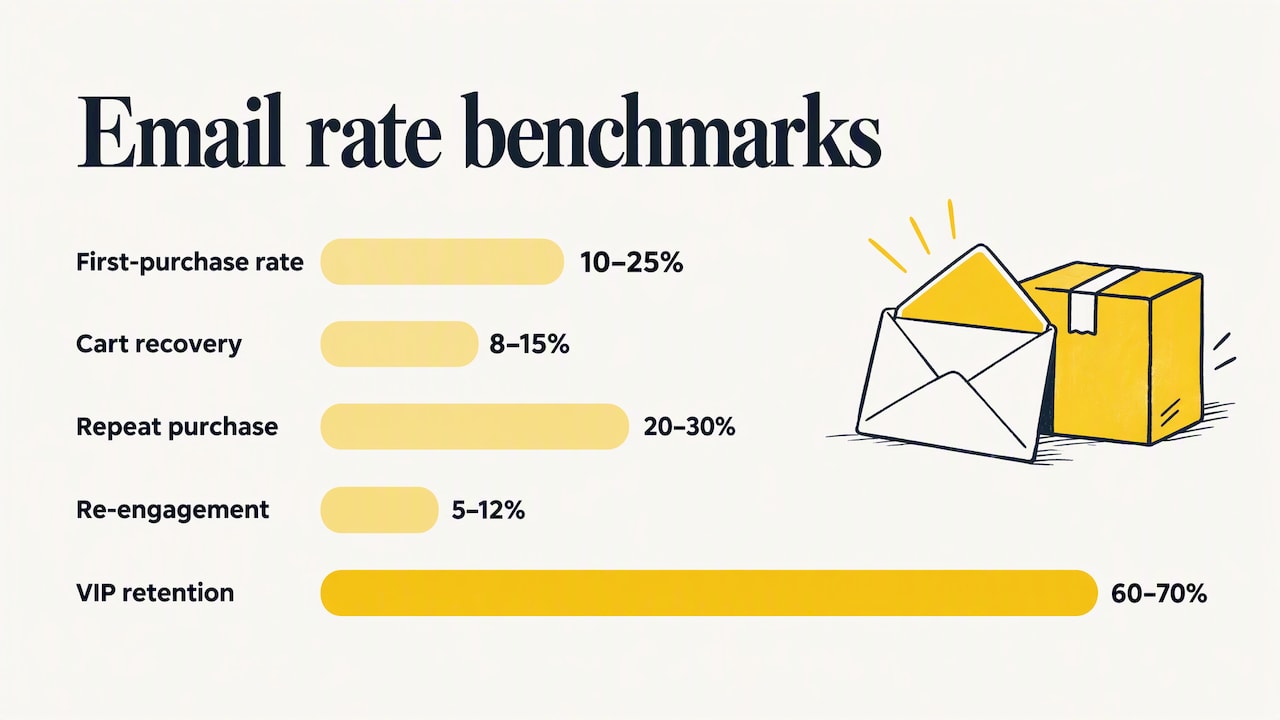
For rough reference, Litmus’s playbook offers indicative targets: a 10 to 25% first-purchase rate, 8 to 15% cart recovery, 20 to 30% repeat purchase, 5 to 12% re-engagement and 60 to 70% VIP retention. These are guide benchmarks, not universal standards, and your category, price point and definitions will move them. Your best benchmark is your own cohort history.
One caution on attribution. Email platforms often credit a sale to the last email clicked, even when the customer was already returning. Use holdout tests, where a random share of eligible customers does not receive a flow, to measure what the flow actually adds.
Deliverability and compliance are part of the program
A flow that lands in spam produces nothing. Google’s Gmail sender guidelines require authentication with SPF and DKIM, and for bulk senders DMARC as well. They ask you to keep spam rates in Postmaster Tools below 0.3%, and say marketing messages must support one-click unsubscribe with a clearly visible unsubscribe link in the body. Sunset flows and engagement-based segmentation help you stay under that spam threshold.
In the US, the FTC’s CAN-SPAM compliance guide notes the law covers all commercial email, with no exception for business-to-business messages. Among its requirements: no false or misleading header information, and honoring opt-out requests. Transactional messages have different treatment from promotional ones, so ask your counsel how to classify a post-purchase email that includes a cross-sell. If you sell to customers in other countries, additional rules such as GDPR in the EU may apply.
Our perspective on retention email
Most brands we talk to treat email as a discount delivery channel. The calendar fills with promotions, the flows were set up once at launch and never revisited, and the team reads results from open rates. Meanwhile paid media gets all the attention because it is where the budget goes.
We think that has the order backwards. Rozee Digital works on acquisition, conversion and retention as one system, which we call the Ecommerce Acceleration System™, because a retention flow that makes the second order more likely directly changes how much you can afford to pay for the first. Our team is led by senior strategists and we keep our client roster small, so the person who designs your flow architecture is also the person looking at your cohort data.
Our advice is simple. Audit the five core flows before launching another campaign. Measure profit per recipient, not clicks. Talk to the paid team and the email team in the same meeting, since the offer in an ad and the offer in the welcome series should not contradict each other. And when a flow underperforms, check the segment and the timing before rewriting the copy.
— Tom
When it makes sense to bring in an agency
Many teams can build a welcome series and an abandoned cart flow in-house. Outside help earns its fee when you have a large list and flat repeat rates, when flows have not been audited in over a year, when your paid team and email team do not share data, or when the brand is scaling spend and CAC is rising faster than LTV.
Rozee Digital supports established Shopify, WooCommerce and Magento brands with Klaviyo setup and optimization, alongside paid media, creative and conversion work, so retention email is planned with the acquisition engine rather than beside it. [CTA placeholder follows.]
If you are weighing options, our notes on what to look for in an ecommerce email marketing agency lay out the criteria, and you can see how we work with ecommerce founders before getting in touch.
FAQ
What is the difference between lifecycle email marketing and regular email marketing?
Regular email marketing usually means campaigns: one message sent to a list at a time you choose. Lifecycle email marketing is triggered by individual behavior, such as signing up, abandoning a cart or going quiet. Most strong programs use both, with automated flows as the foundation and campaigns layered on top.
Which lifecycle email should an ecommerce brand build first?
Start with the welcome series, then cart and checkout abandonment, because both act on clear intent. Next add post-purchase, which is where retention begins. Win-back and VIP flows come after the core is stable and you have enough order history to time them well.
How long does it take to see retention improve?
Cart and welcome flows can show results within weeks, because they act on recent behavior. Repeat purchase and LTV take longer, since you need to follow cohorts through your typical reorder window. Track by cohort rather than by week to avoid being misled by seasonal swings.
How many emails should a welcome series have?
There is no single right number. One published ecommerce playbook suggests three to five emails over seven to ten days, which is a reasonable starting point. Test length against your own data, and exit buyers from the series once they purchase.
Sources
- Shopify: Ecommerce Email Automation Types, Examples, and Tips (2026)
- Shopify: Lifecycle Marketing: Stages, Benefits, and Strategies
- Shopify: Email Marketing Customer Journey: A Guide
- Shopify: Email Sequence Guide: Types, Examples, and Tips
- Litmus: Retail and Ecommerce Email Marketing Playbook 2025
- Manufacturing & Service Operations Management: Does Customer Email Engagement Improve Profitability?
- Gmail Help: Email sender guidelines
- FTC: CAN-SPAM Act: A Compliance Guide for Business