Ecommerce customer acquisition is everything that moves a stranger to a first order: how they find your brand, why they trust it, and what gets them to check out. Done well, it is not about buying the most customers. It is about buying customers who return more in margin over time than they cost you. This guide shows how to build a strategy around that idea, which channels to use, how to calculate the numbers, and where retention fits.
TL;DR
- Acquisition covers discovery, consideration and the first purchase, and buyers often take several visits and weeks to convert, so measure the whole journey, not one ad.
- Start with profit math: blended CAC, margin per order and lifetime value tell you how much you can afford to pay for a customer.
- Split budget between proven channels, scaling bets and tests, then move money based on results, not habit.
- Rising ad costs are easier to absorb when retention lifts lifetime value, so acquisition and retention should be planned together.
- Brands past the early stage usually gain most from tightening tracking, creative and conversion before adding spend.
Table of Contents
- What ecommerce customer acquisition actually includes
- The metrics to define before you spend
- Is your acquisition profitable? Use LTV to CAC
- Build the strategy around goals and customers
- Channels that bring in new ecommerce customers
- How to split and test your budget
- When ad costs rise, raise the value of each customer
- Our perspective
- Work with Rozee Digital on profitable acquisition
- FAQ
- Sources
What ecommerce customer acquisition actually includes
A common definition is the process of identifying, attracting and converting interested prospects into paying customers through marketing and sales activity, as Salesforce describes it. For an online store, that spans how people discover the brand, what persuades them to consider the products, and what makes them complete a first purchase, according to Mailchimp.
Two points matter in practice.
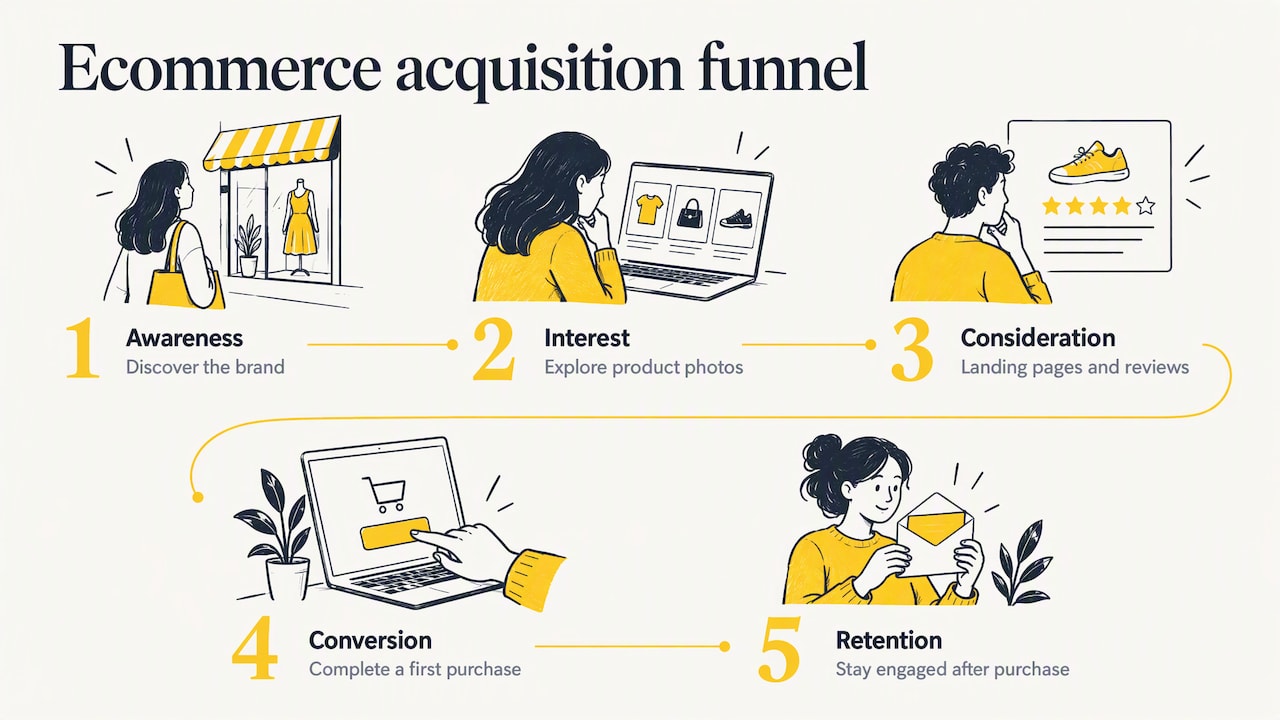
First, acquisition is broader than an ad. Zapier frames it as a funnel running from awareness through interest, consideration and conversion, with retention at the end because a customer’s value depends on whether they stay engaged. Product photos, landing pages, email capture and reviews all belong to acquisition.
Second, journeys are rarely linear. Mailchimp notes that a shopper may see an ad, visit later and buy weeks afterward. If your reporting credits only the last click, you will undervalue the channels that start the journey and overvalue the ones that finish it.
The market behind this is large and still growing. The U.S. Census Bureau estimated that e-commerce made up 17.1 percent of total U.S. retail sales in the second quarter of 2026 on a seasonally adjusted basis, up 12.2 percent from a year earlier. More demand online also means more brands bidding for the same shoppers, which is why efficiency matters more than reach.
The metrics to define before you spend
A strategy built on feelings about “good traffic” breaks down quickly. These are the numbers we put in front of a team before touching a budget.
| Metric | What it means | Why it matters |
|---|---|---|
| CAC (customer acquisition cost) | Acquisition spend divided by new customers won | Tells you what a first order really costs |
| ROAS (return on ad spend) | Revenue attributed to an ad channel divided by spend on it | Fast channel-level read, but depends on attribution |
| MER (marketing efficiency ratio) | Total revenue divided by total marketing spend | Blended view that ignores attribution disputes |
| LTV (lifetime value) | Revenue or gross profit a customer generates over their relationship with you | Sets the ceiling on what you can pay to acquire them |
| Contribution margin | Revenue minus product, shipping, fulfillment and marketing costs | The profit left after the order is actually served |
ROAS and MER answer different questions. ROAS is reported by each platform and counts only what that platform claims credit for, so the sum of platform ROAS figures often exceeds what your store actually earned. MER uses your real revenue and your real total spend, so it is harder to game. We look at both: platform ROAS for day-to-day optimization, MER for whether the business is healthy.
How to calculate CAC properly
The basic formula is total acquisition spend divided by the number of new customers in the same period, as Shopify lays out. The cost side should be complete: ad spend, agency fees, creative production, software and the share of salaries tied to acquisition. Leaving out creative and fees is the most common reason a brand thinks its CAC is lower than it is.
Two refinements help:
- Separate new from returning customers. If 35 percent of your ad-attributed orders come from existing customers, your true new-customer CAC is higher than the dashboard suggests.
- Track blended and channel CAC. Blended shows the business; channel CAC shows where to move money.
For deeper walk-throughs, see our customer acquisition cost formula and our guide to CAC metrics for ecommerce.
A hypothetical worked example
This example is illustrative, not a client result. A brand sells a product at a $60 average order value with a 55 percent gross margin, so each order leaves $33 before shipping and marketing. It spends $20,000 a month on acquisition and wins 400 new customers: a CAC of $50.
On the first order the brand loses about $17 per customer. If the average customer buys 2.5 times in 12 months, gross margin per customer is about $82.50, leaving roughly $32.50 after CAC. The business is profitable, but only because of repeat orders. That is why the first-order number alone is a poor guide to whether a channel works.
Shopify makes the same point with a different example: a customer with a $25 average order value and a 50 percent gross margin only becomes profitable on the fourth purchase when CAC is $50.
Is your acquisition profitable? Use LTV to CAC
The usual yardstick is the ratio of customer lifetime value to CAC. Shopify’s guidance treats 3:1 as the benchmark for healthy growth, 1:1 or lower as overspending, and above 5:1 as a sign you may be underinvesting. Klaviyo reports the same 3:1 benchmark.
Treat these as starting points, not laws. Three things change the right target for your brand:
- Cash position. A 3:1 ratio that takes 18 months to pay back is a cash problem even if it looks healthy on paper.
- Margin structure. Calculate LTV on gross margin, not revenue, or the ratio flatters you.
- Repeat rate. Consumables behave differently from furniture. Use your own cohort data, not an industry average.
If you want to compare your numbers with others, our pages on CAC benchmarks and what an average CAC looks like explain what drives the differences by category.
Build the strategy around goals and customers
A workable acquisition model has a few parts, per Shopify’s model for growth: acquisition goals, buyer personas and ideal customer profiles, a value proposition, channels, and tools to measure performance, with touchpoints mapped from first contact to conversion. Ahrefs adds that it starts with identifying ideal customers and where they spend time, then setting specific, measurable and time-bound objectives.
In practice, that means working through four steps.
Step 1: Describe your best customers with data
Pull the top 20 percent of customers by repeat purchases and gross margin. Look at what they bought first, which channel brought them in, which offer they used and how long they took to reorder. Omniconvert recommends using customer data to find prospects who resemble your best customers, and that is exactly how lookalike and customer-list audiences work on the major ad platforms. Our guide to targeting your ecommerce marketing audience goes further.
Step 2: Set a CAC ceiling
Work backward from margin. If a customer yields $90 in gross profit across 12 months and you want a 3:1 ratio, your target CAC is $30. If cash is tight, set a payback rule instead, such as recovering CAC within 60 days on first and second orders combined.
Step 3: Choose channels where those customers already are
Channel choice should follow customer behavior, not trends. Someone searching for a specific product is a different prospect from someone scrolling a feed, and the creative, offer and landing page should reflect that.
Step 4: Decide what you will measure and how
Decide in advance which numbers rule: new-customer CAC, MER, contribution margin and 90-day repeat rate. Without agreed definitions, every report becomes an argument.
Channels that bring in new ecommerce customers
Shopify’s channel overview groups options into paid, organic, owned and partner channels. Here is how we think about each for an established brand.
| Channel type | Examples | Best for | Watch out for |
|---|---|---|---|
| Paid search and shopping | Google search, Shopping and Performance Max | Capturing existing demand | Branded search can inflate ROAS |
| Paid social | Meta, TikTok, Pinterest | Creating demand and reaching new audiences | Creative fatigue, attribution gaps |
| Organic | SEO, content, social, PR | Compounding, lower marginal cost | Slow to start, harder to attribute |
| Owned | Email, SMS, loyalty, referrals | Converting visitors, lifting repeat rate | List growth depends on traffic |
| Partner | Affiliates, marketplaces, retail media, wholesale | Borrowed audiences | Margin sharing, less data |
Paid search and shopping
Search captures people who already want what you sell. It tends to be the most efficient paid source for new customers, but it has a ceiling set by search volume. Shopping and product feeds are a major lever for catalog brands. If you need help here, our paid search services and Google Shopping ads pages explain how we approach it.
Paid social
Meta, TikTok and Pinterest create demand rather than capturing it. Results depend heavily on creative: the hook, the proof and the offer. Plan for a steady pipeline of new static and video concepts, because performance decays as audiences see the same ad. Our paid social campaign management page covers how we structure testing, and the piece on optimizing online advertising covers the fundamentals.
Owned channels
Email and SMS rarely get the credit in acquisition reports, yet they convert the first-time visitors who did not buy on visit one. A welcome series, browse and cart flows and a clear first-order incentive can lower effective CAC without extra ad spend. Remarketing plays the same role on paid channels.
Partner and wholesale channels
Some brands add wholesale or retail partners as an acquisition path, where each retailer brings its own customers. A case on building a wholesale buyer pipeline shows how one consumer brand grew its retailer base through targeted outreach. Whether this fits depends on your margins and how much brand control you want to keep.
Creative and product video
Every paid channel runs on creative. Short product video is now a standard format for social and shopping placements, and tooling for producing it has become easier to use. A roundup of AI video tools for ecommerce is a starting point if your team is deciding how to produce more variants on a limited budget. Tools speed up production, but the concept and the offer still decide whether the ad works.
How to split and test your budget
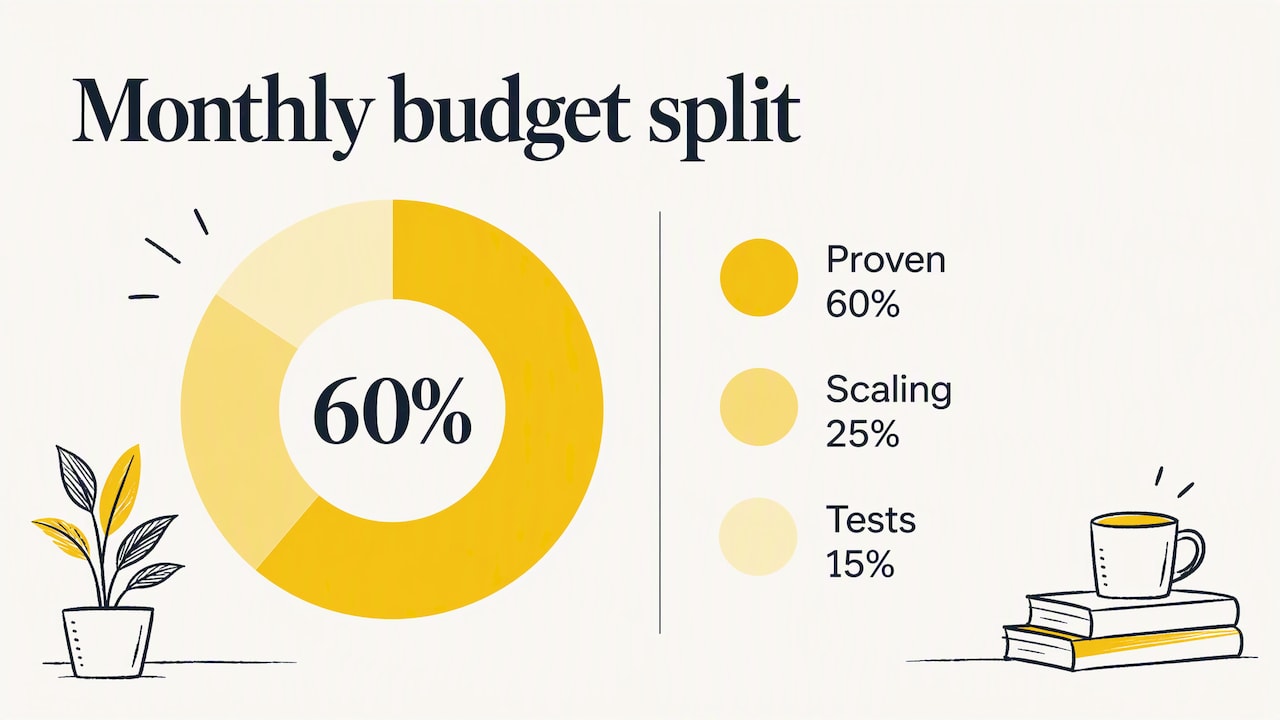
A simple framework is the 60-25-15 rule described by Omnisend: 60 percent of resources to proven channels, 25 percent to scaling opportunities and 15 percent to new tests, with budget reassigned as results come in.
Here is how that might look on a hypothetical $50,000 monthly budget:
- $30,000 (60%) on channels with stable CAC, such as branded and non-branded search and your best-performing Meta campaigns.
- $12,500 (25%) on channels showing promise, such as TikTok or Pinterest with winning creative, scaled in steps.
- $7,500 (15%) on tests: new audiences, new offers, new formats.
Some rules that keep tests honest:
- Change one variable at a time where you can, and define success before launch.
- Give each test enough spend and time to reach a meaningful number of conversions.
- Judge by new-customer CAC and downstream repeat rate, not clicks.
- Kill losing tests quickly and write down what you learned.
Neil Hoyne of Google, quoted in Shopify’s channel guide, advises emphasizing the channels that attract loyal customers who stay longer rather than those with the lowest immediate cost. Cohort reports by acquisition channel make that visible.
When ad costs rise, raise the value of each customer
Most established brands feel the same squeeze: more competition in the auctions, higher CPMs and CPCs, and a smaller share of purchases that platforms can trace. The response that holds up is to increase what each acquired customer is worth, so you can afford a higher CAC than competitors.
Klaviyo’s 2026 guidance calls retention a counterweight that stabilizes revenue against expensive paid-media markets, pointing to loyalty and referral programs, post-purchase experience and data used to target repeat purchases. Its separate advice on customer value is to raise profit per customer first so margins can support scaling.
Practical levers, in the order we usually look at them:
- Conversion rate. A product page, offer or checkout fix that lifts conversion by 10 percent lowers CAC by roughly the same proportion at the same spend, because you get more orders from the same traffic.
- Average order value. Bundles, thresholds for free shipping and relevant add-ons lift margin per order.
- Second-order rate. A post-purchase flow timed to the product’s natural replenishment window is often the most profitable email you will send.
- Loyalty and referrals. These add value after the first order and bring in new customers at a cost you control.
More examples are in our posts on CAC examples, ecommerce marketing tactics and ecommerce marketing strategies.
Our perspective
Most acquisition problems we see are not traffic problems. A brand spends on ads, watches platform ROAS, and never connects the dots between first-order CAC, conversion rate and what customers are worth six months later.
At Rozee Digital we plan acquisition, conversion and retention as one system, which is the idea behind our Ecommerce Acceleration System™. A channel that looks expensive on the first order can be your best source of customers if those buyers come back. A cheap channel can be a trap if they never do.
We also keep our client roster deliberately small and have senior strategists lead the work, because this kind of joined-up thinking takes time with the data. Our view: set the CAC ceiling from margin and LTV first, then build channels, creative and email flows to meet it.
Tom
Work with Rozee Digital on profitable acquisition
If you run an established Shopify, WooCommerce or Magento brand and your acquisition costs are climbing, Rozee Digital can look at the full picture: paid media, creative, landing pages and email and SMS. Our services include Google Ads, Meta Ads, Pinterest Ads, TikTok Ads and more, and our Klaviyo setup and optimization work focuses on lifetime value. To see how we approach new-customer growth specifically, read about our customer generation services.

The next step is simple: gather your last 12 months of spend, new customers and repeat rates, and talk with us about where the profit is leaking.
FAQ
What is the difference between customer acquisition and retention?
Acquisition turns prospects into first-time buyers. Retention encourages those buyers to purchase again, as Omniconvert distinguishes them. Brands need both, because the value of an acquired customer depends on whether they come back.
What is a good customer acquisition cost for ecommerce?
There is no single good number. A good CAC is one your margin and repeat rate can support. A common benchmark is an LTV to CAC ratio of about 3:1, but your payback period and cash position matter just as much.
Which acquisition channel should I start with?
Start where your best customers already are. For many brands, that means search and shopping to capture existing demand, plus one paid social channel with strong creative to build new demand. Add email and SMS from the start so first-time visitors have a second chance to convert.
How long does it take to see results from new acquisition channels?
It depends on spend, creative and your sales cycle. Because shoppers may visit several times before buying, give tests enough time and conversions to read reliably, and judge them on new-customer CAC and repeat rate rather than first-week clicks.
When should an ecommerce brand hire an agency?
When spend is meaningful, costs are rising and your team lacks time or senior expertise to test channels, creative and retention together. Ask any agency how it calculates new-customer CAC and who actually runs your account.
Sources
- Census Bureau: Quarterly Retail E-Commerce Sales
- Salesforce: Customer Acquisition Guide
- Mailchimp: Ecommerce Customer Acquisition
- Zapier: Customer acquisition strategy
- Shopify: Ecommerce Customer Acquisition
- Shopify: Ecommerce Growth Guide
- Shopify: Customer Acquisition Model for Growth
- Klaviyo: Customer Value Optimization
- Klaviyo: Retention marketing strategies
- Ahrefs: The Essential Guide to Customer Acquisition
- Omniconvert: Customer acquisition strategy
- Omnisend: Customer Acquisition Strategies
- Wholesale buyer pipeline case study
- AI video tools for ecommerce