The channel closest to a purchase isn’t always the one that creates the next one. Paid social builds awareness and demand by reaching people through audience signals; paid search captures existing demand when shoppers search for products. For ecommerce, paid social versus paid search isn’t an either-or decision. The right mix depends on whether you need to create demand, capture it, or do both.
Both channels can support profitable growth, but they work differently. Paid social uses audience targeting and visual formats to introduce products; paid search responds to keyword intent and puts relevant offers in front of active searchers. Their costs and bidding mechanics also shape how you allocate budget and assess performance.
This guide explains how to choose based on your products, customer demand, and commercial priorities. You’ll learn how the channels differ, how their cost models and bidding work, and when combining them makes sense. The goal is a deliberate media mix measured against business outcomes, not a channel choice made by habit.
Key Takeaways
- Match channel choice to the demand you need to capture or create, then assess whether your products and creative support that role.
- Understand how click-based costs and auction bids shape paid search spend before setting targets or reallocating budget.
- Use paid search and paid social as complementary parts of a media mix, not competing line items.
- Review performance against business outcomes and adjust investment as campaign priorities change.
Choosing between paid search and paid social
Paid social reaches people through audience signals; paid search responds to shoppers’ queries. For ecommerce, choose based on whether growth requires product discovery, demand capture, or both.
Product Fit and Buying Journeys
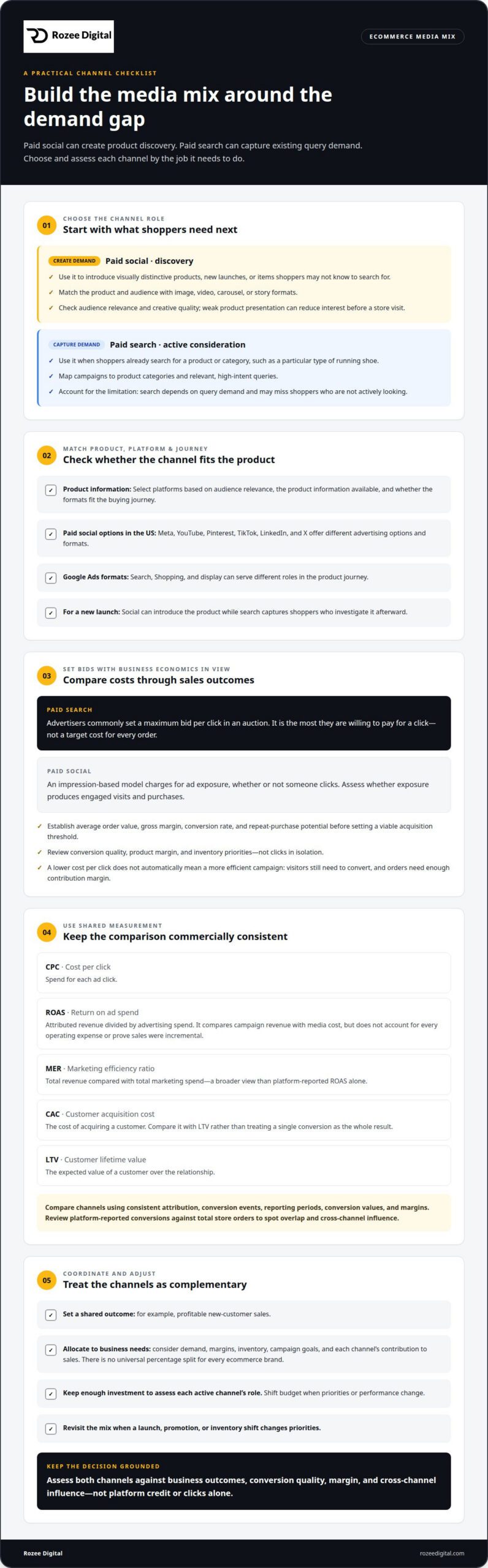
Paid social can introduce visually distinctive products, new launches, or items shoppers may not know to search for. Image, video, carousel, and story ads let brands present products during discovery. Paid search suits established products with clear query demand, such as a particular type of running shoe. Search terms reveal expressed intent and can inform the path from product information to purchase.
Conversion Rates and Return on Ad Spend
Neither channel has a fixed conversion-rate or ROAS advantage across ecommerce categories. Search may capture shoppers closer to purchase, while social can influence earlier discovery. Compare results using consistent attribution, conversion values, margins, and reporting periods. A paid social versus paid search comparison is useful when both channels are assessed against the same commercial criteria, not when each platform’s reported performance is judged differently.
Ecommerce Advertising Platforms
In the US, paid social options include Meta, YouTube, Pinterest, TikTok, LinkedIn, and X. Each platform offers different advertising options and formats. Google Ads includes search, Shopping, and display formats. Select platforms based on audience relevance, product information, and whether the available creative formats fit the buying journey.
Channel Risks and Limitations
Paid social relies on audience relevance and creative quality; weak product presentation can reduce interest before a store visit. Paid search depends on query demand, so it may miss shoppers who aren’t actively looking. Both channels can overstate their contribution if reporting overlooks cross-channel influence or repeat orders. Assess conversion quality and product margin before increasing spend.
| Option | Demand stage | Useful for | Key limitation |
|---|---|---|---|
| Paid social | Discovery | Audience and creative reach | Needs relevant creative |
| Paid search | Active consideration | Capturing query intent | Depends on search demand |
Choose the channel that addresses your demand gap, then assess it against margin and conversion quality.
Cost models and bidding strategies
Paid search commonly uses an auction in which advertisers set a maximum bid per click. That maximum is the most they’re willing to pay for a click, not a target cost for every order. Paid social may charge based on impressions instead. Because these models measure different events, compare them through the sales outcomes they support.
Cost per click (CPC) measures spend for each ad click. An impression-based model charges for ad exposure, whether or not someone clicks. A lower CPC doesn’t automatically mean a more efficient campaign: visitors still need to convert, and orders need to generate enough contribution margin.
Before setting bids, establish the economics of the product or category. Use average order value, gross margin, conversion rate, and repeat-purchase potential to set a viable acquisition threshold. Customer acquisition cost (CAC) is the cost of acquiring a customer. Compare CAC with customer lifetime value (LTV), the expected value of that customer over the relationship, rather than treating a single conversion as the whole result.
- For Google search, set a maximum click bid that reflects the value of qualified traffic.
- For paid social, assess whether impression-based exposure produces engaged visits and purchases.
- For both channels, compare attributed revenue with spend and product margin.
ROAS, or return on ad spend, is attributed revenue divided by advertising spend. It helps compare campaign revenue with media cost, but it doesn’t account for every operating expense or prove that sales were incremental. MER, or marketing efficiency ratio, compares total revenue with total marketing spend, giving leaders a broader view than platform-reported ROAS alone.
Review bids and budget against conversion quality, margin, and inventory priorities, not clicks in isolation. For a structured view of paid media economics, review paid media management as part of your channel planning.
Cross-channel advertising strategy
Set the budget according to business needs, not a default channel split. Paid social can create demand; paid search can capture it as shoppers look for products.
Start with the constraint. If a product has little search demand, prioritize social creative that introduces its use and value. If shoppers already search for the product category, protect search coverage for relevant queries. For a new launch, social can build awareness while search captures shoppers who investigate the product afterward.
There’s no universal percentage that suits every ecommerce brand. Allocate according to demand, margins, inventory, campaign goals, and each channel’s contribution to sales. Keep enough investment in each active channel to assess its role, then shift budget as business priorities or performance change. For fashion brands planning Meta spend, this Facebook ads strategy for fashion brands explains how to start with a test budget and adjust based on purchase data.
- Map search campaigns to product categories and high-intent queries.
- Use social campaigns to introduce products and reach relevant audiences.
- Set a shared outcome, such as profitable new-customer sales.
- Adjust spend when a launch, promotion, or inventory shift changes priorities.
Measure both channels using consistent conversion events, reporting periods, and attribution settings. Compare platform-reported conversions with total store orders. This can reveal overlap, such as a customer seeing a social ad before converting through a search ad. Review ROAS alongside MER, CAC, and order profitability, rather than treating any single platform’s credit as the full result.
Separate leading indicators from business outcomes. Paid social impressions, reach, and engagement show exposure and interaction; paid search clicks and cost per conversion show responses to queries. Neither set alone proves incremental revenue. Use the same reporting window across channels, then examine whether changes in investment correspond with changes in total sales.
Review budgets at least monthly, and more frequently during product launches, promotions, or other high-stakes campaigns. Record each allocation change and its rationale. This creates a practical comparison across campaign periods, helping teams distinguish a genuine shift in channel contribution from normal demand fluctuations.
Benefits of paid search
Paid search puts an offer in front of shoppers expressing intent through a query. That makes it useful for established ecommerce products with clear category demand. For example, a shopper searching for “flexible hiking boots” signals a more immediate product need than someone encountering an unfamiliar brand in a social feed.
Search terms also give marketers practical insight into customer priorities. A query can reveal product type, intended use, brand preference, or a specific feature. Use that language to organize campaigns and write ads that match the shopper’s stated need. Then send each click to a relevant product or category page, not a generic storefront.
Google search campaigns can support sales for products customers already know how to describe. Shopping placements can show product imagery, while text ads address queries with direct messaging. The format matters less than alignment: the ad, search term, and landing page should answer the same buying need.
- Group queries by product category, use case, or purchase intent.
- Match ad copy to the specific language shoppers use.
- Route a product-specific query to its relevant product page.
- Review clicks, click-through rate, cost per conversion, and ROAS together.
Paid search also makes demand easier to diagnose. If a category receives relevant clicks but few purchases, inspect the product page, offer, and checkout experience. If clicks are weak, compare the query with the ad’s promise. This separates traffic quality from conversion friction and helps teams identify where the customer journey breaks.
Search has a clear boundary: it captures demand expressed in queries. It won’t create the same discovery opportunity for a product shoppers don’t yet know to search for. For established products, however, query intent can help shape campaign structure and measure response against sales outcomes.
Use paid search when your product has identifiable search demand and your store can convert that intent. A disciplined paid search strategy connects query relevance, product-page experience, and commercial performance.
Rozee Digital: Ecommerce ads agency
Rozee Digital is an ecommerce ads agency for brands assessing how paid search and paid social support profitable growth. Its approach centers on ownership of growth, not campaign management.
For established ecommerce and DTC brands, the decision is not simply where to spend. It’s how advertising supports customer acquisition, contribution margin, and sustainable scale. Rozee Digital’s senior-only team brings that commercial focus to its paid media services.
When your business is evaluating its advertising strategy, contact Rozee Digital to discuss your priorities.
Make the next media decision commercially accountable
The next step is to turn channel choice into an operating decision. Set a clear business objective, define the margin or acquisition threshold that matters, and assign each campaign a role your team can evaluate. That creates a stronger basis for budget decisions than optimizing toward platform activity alone.
For paid social versus paid search ecommerce planning, the advantage comes from a measurement framework that connects advertising to the wider business. Rozee Digital provides ecommerce advertising services, including Google Ads and Meta Ads, for brands assessing how those channels fit their growth priorities.
Bring your current channel mix, campaign objectives, and performance measures into the discussion. Contact Rozee Digital about your ad strategy to identify a practical next step. A disciplined decision today gives your team a clearer foundation for profitable growth.
Frequently Asked Questions
Paid social vs paid search: what’s the difference?
The practical difference is where shoppers encounter the ad and what marketers need to prepare. Social creative must earn attention in a feed, while search copy must closely match the language and offer behind a query. For a product launch, prepare social assets that communicate the product visually; for search, build ad copy around clear product attributes and relevant landing pages.
What is the difference between paid social and paid search for ecommerce?
For an online store, each channel places different demands on merchandising preparation. A social launch needs product imagery and messaging that make the item understandable without prior product knowledge. Search campaigns benefit from clear product names, category organization, and landing pages that answer the shopper’s query. For a seasonal collection, prepare those assets before launch so ads and store content stay aligned.
How do paid social and paid search compare in cost per click and cost per acquisition for ecommerce?
Neither channel has a dependable cost advantage across all stores and product categories. Competition for an audience or query can affect click costs, while checkout performance, order value, and product margin shape acquisition economics. Compare campaigns using the same customer definition and attribution period. Then assess whether acquired customers generate enough contribution to support repeat purchases and sustainable growth.
How do targeting and audience options differ between ecommerce paid social and paid search?
Build social audiences around customer groups your creative can address with a relevant message. For search, organize query coverage around product categories and separate brand searches from broader category demand. Review actual query reports to identify irrelevant terms and refine coverage. For example, a store selling formal shoes can distinguish searches for formal styles from unrelated footwear queries.
How can ecommerce businesses combine paid social and paid search in one marketing strategy?
Use each channel’s signals to improve the other’s messaging. Social engagement can reveal which product benefits attract attention, giving search copy sharper language. Search queries can uncover customer questions that future social creative should answer. For a product launch, document these findings alongside campaign changes, then use them to refine the next creative and copy iteration without assuming one platform deserves full credit for the sale.