
An ecommerce advertising agency should do more than buy clicks. It plans and manages paid campaigns for online brands, connecting channel choices, bidding, and budget decisions to commercial goals. For D2C businesses, that means evaluating performance against more than traffic or platform-reported returns.
It’s reasonable to expect clear answers about where your spend goes, what an agency specializes in, and how it measures performance. This article explains what ecommerce advertising agencies typically handle, how to assess their fit for a product-based brand, and what disciplined PPC, bidding, and budget planning involve.
You’ll also learn how to distinguish channel expertise from a broader ecommerce strategy, which questions reveal an agency’s approach, and when specialist paid media support makes sense. The goal is to help you make an informed decision based on how campaigns are managed and their contribution to business performance.
Key Takeaways
- Assess an agency by its paid media expertise and measurement approach, not platform familiarity alone.
- Match its specialization to your business model, growth stage, product range, and channel priorities.
- Look for campaign management that connects targeting, bidding, and budget decisions to business performance.
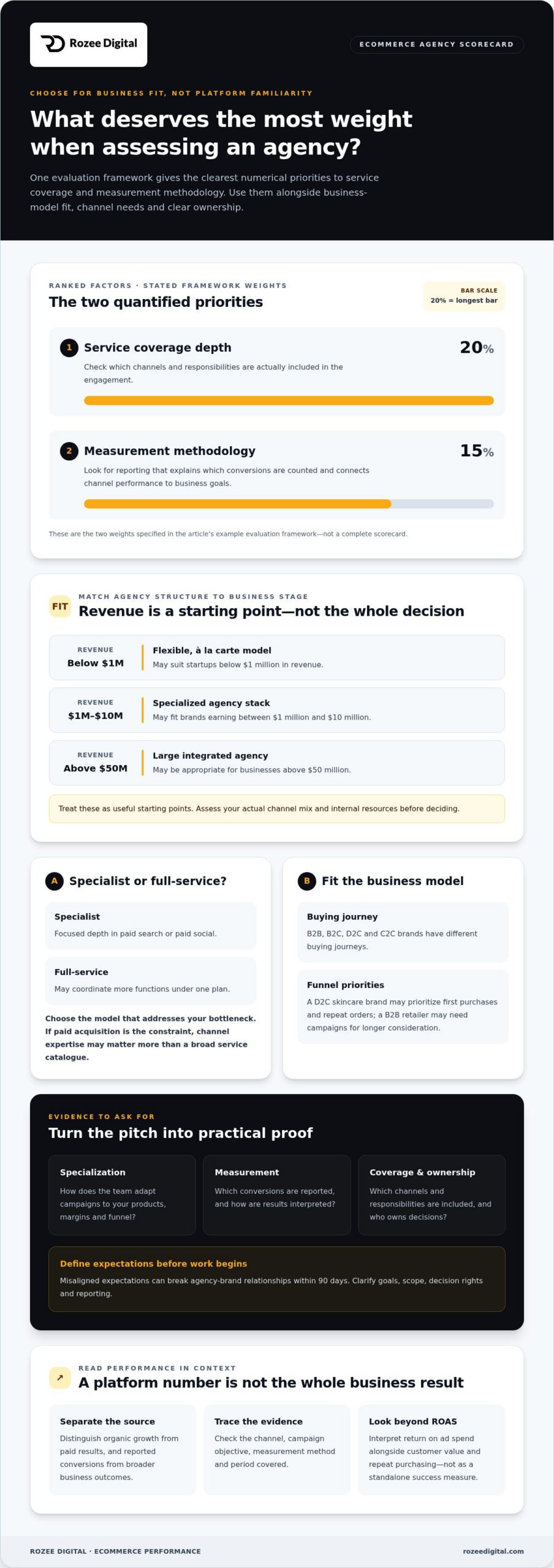
- Interpret return on ad spend alongside customer value and repeat purchasing, not as a standalone success measure.
- Focused support across Google Ads, Facebook Ads, and PPC can help product-based brands align campaign execution with their goals.
Want expert feedback on your ecommerce marketing?
Leading agencies report case-study outcomes across distinct marketing channels. Growth Marketing Pro reports one client’s organic visitor count rose from 130,000 to 161,000 over six months, while KOHA’s organic traffic increased by 823% within 12 months. These are organic growth results, not paid media benchmarks.
For paid campaigns, look for evidence that connects spend to sales quality, not just clicks or platform-reported conversions. An ecommerce advertising agency should explain which campaign decisions contributed to a result and what business metric changed.
Ecommerce PPC and Paid Media
Ecommerce PPC and paid media services can include campaign planning, account management, audience targeting, creative testing, bid adjustments, and performance reporting. The right mix depends on your products, customer demand, and sales goals. Assess how an agency connects these elements across commerce channels instead of presenting isolated platform metrics as the whole picture.
Use a product example to assess an agency’s method: a brand with seasonal inventory needs campaigns that account for stock, margins, and changing demand. Ask how the team would prioritize products, structure tests, and report results. Clear answers should identify the decisions involved and the measures used to evaluate them.
Google Ads and Paid Search
Google Ads and paid search can capture shoppers actively looking for a product or category. Campaign work may include search terms, product-focused ads, audience signals, and landing-page alignment. Assess whether the strategy separates high-intent searches from broad traffic and explains how spend and performance are reviewed across product groups.
A retailer selling several product lines, for example, needs more than one generic search campaign. A useful review shows how search queries map to products and how irrelevant searches are excluded. Ask to see how conversions and revenue are reported, and how those results inform campaign adjustments.
Paid Social Campaigns
Paid social campaigns reach potential buyers on platforms such as Facebook, TikTok, Pinterest, and Snapchat. They use audience targeting and creative to attract attention before a shopper searches for a product. Review how the agency tests messaging, formats, and audience segments, then uses the results to refine future campaigns.
Creative matters as much as media buying. A fashion brand, for instance, may need product imagery and messages designed to support discovery, while a practical household item may benefit from demonstrations. Ask how each creative test supports a campaign objective and what evidence determines whether an ad stays in rotation.
Agency experience also reflects the channels that shaped its capabilities. Many agencies built their reputations on Meta ads and Google performance marketing during 2020-2024. That history can inform execution, but it doesn’t replace a current plan for your products, margins, and customer journey.
To assess a case study, trace the results back to their context: the channel, campaign objective, measurement method, and period covered. Distinguish organic growth from paid results, and reported conversions from broader business outcomes. This helps you evaluate agency claims and connect channel performance to commercial priorities.
Agency selection criteria and specializations
Choose a marketing agency that fits your business model, growth stage, and channel priorities. An ecommerce advertising agency should explain how its specialization supports your objectives, not simply list familiar platforms.
The key risks include misaligned expectations, unclear ownership, and reporting that measures activity rather than business outcomes. Misaligned expectations can break agency-brand relationships within 90 days, so define goals, scope, decision rights, and reporting before work begins. If the relationship no longer fits, consider how to switch ecommerce marketing agency partners with a clear transition plan.
Start with the model. Business-to-business, business-to-consumer, direct-to-consumer, and consumer-to-consumer brands have different buying journeys. A D2C skincare brand may prioritize first purchases and repeat orders, while a B2B retailer may need campaigns built around longer consideration. The right specialist understands how its channel choices serve that funnel.
Then match the agency’s structure to your operating stage. Startups below $1 million in revenue may suit a flexible, à la carte model. Brands earning $1 million to $10 million may need a specialized agency stack. Businesses above $50 million may require a large integrated agency. These are useful starting points, not substitutes for assessing your actual channel mix and internal resources.
The choice between a specialist and a full-service agency comes down to ownership. A specialist can offer focused depth in paid search or paid social, while a full-service agency may coordinate more functions under one plan. Choose the model that addresses your bottleneck. If paid acquisition is the constraint, channel expertise may matter more than a broad service catalogue.
Use a defined scorecard rather than an impressive pitch deck. One agency evaluation framework assigns service coverage depth a weight of 20% and measurement methodology a weight of 15%. Translate those criteria into practical evidence: sample reporting, campaign decision rationale, and clear links between channel performance and business goals.
- Specialization: Ask how the team adapts campaigns to your products, margins, and funnel.
- Measurement: Identify the conversions reported and how results are interpreted.
- Coverage: Confirm which channels and responsibilities sit within the engagement.
Team structure matters, too. Ecommerce agencies commonly assign account managers as client points of contact. Establish who owns strategy, platform execution, creative feedback, and performance reviews. A small team can work effectively when responsibilities are clear; a larger roster adds little if decisions remain fragmented.
Use these criteria to assess whether a focused paid media approach fits your needs. Compare the proposed channel expertise with the work your team needs owned, then align success measures before campaigns launch.
What does an ecommerce digital marketing agency do?
An ecommerce marketing agency coordinates services that help online stores attract shoppers, convert demand, and retain customers. Its scope may include paid media, ecommerce SEO, creative, email marketing, analytics, and marketplace coordination. Each service should connect to a defined business objective.
For a U.S. retailer, options include paid media specialists, SEO-focused teams, and broader full-service firms. Compare their channel expertise, ecommerce experience, and ability to measure commercial outcomes. The right fit depends on the capabilities your team needs and the level of strategic ownership it expects.
Services across Google, Meta, TikTok, and Amazon may include paid search, social campaigns, creative testing, performance measurement, and marketplace advertising. Map the platforms you need against the agency’s scope. For example, a brand selling through its own store and Amazon needs campaign planning that accounts for both channels.
In-house teams retain direct control and product knowledge, while agencies bring channel specialists and established workflows. Freelancers can handle a focused task, such as managing Google Ads. A retailer with limited internal capacity may value agency coordination; a team with experienced channel leads may prefer targeted outside support.
Specialization shapes execution. A paid search specialist can focus on query intent, campaign structure, and budget allocation. A broader team may coordinate acquisition with retention marketing. First, identify your constraint: if organic product discovery is weak, SEO may be more relevant than adding another paid channel.
Ecommerce SEO services often cover keyword research, technical reviews, category-page structure, product-page optimization, and content planning. Stores with extensive product ranges may need to target a broader set of keywords. Prioritize SEO work based on product value, search intent, and the pages most important for discovery.
- Paid media: Campaign setup, audience targeting, creative testing, and optimization across selected platforms.
- SEO: Technical improvements, product and category page structure, and search-focused content planning.
- Measurement: Analytics reports that connect channel activity to conversions and business goals.
- Coordination: Marketplace and sales-channel integration, including synchronized inventory and marketing strategies.
Ask how each proposed service connects to the next. Agencies use regular strategy sessions and analytics reports to review performance, market changes, and strategic adjustments. If your store is adding a product category, those reviews should clarify which channel supports discovery, how campaigns align with inventory, and which performance signals guide the next decision.
Prioritize accountable marketing services over an expansive menu. A clear scope defines the channels managed, the work delivered, and how optimization decisions are reported. This structure helps ecommerce operators compare agency support with in-house ownership or a freelancer’s focused execution.
PPC advertising, bidding, and budget planning
Strong PPC management connects ad spend and bidding decisions to conversion quality. Separate the media budget from agency fees, then assess both against your commercial objectives.
Monthly and Project Budgets
Minimum monthly budgets and minimum project budgets serve different purposes. A monthly budget supports ongoing campaign management and optimization; a project budget can cover a defined setup or audit. Clarify whether each figure refers to media spend or agency fees, and what work it includes.
Set your working budget based on product margins, demand, channel count, and available conversion data. A Google Ads campaign across several product categories requires different allocation decisions from a focused test for one product line. A clear plan explains which campaigns receive spend, what signals trigger changes, and how results are reviewed.
Agency pricing models may use retainers, project scopes, or a share of managed spend. Compare the work covered, reporting cadence, and decision ownership, not just the pricing model. If a digital marketing scope includes content marketing and paid media, define which deliverables belong to each.
ROAS, CAC, and Customer Lifetime Value
Agencies calculate return on ad spend (ROAS) by comparing attributed revenue with advertising spend, and customer acquisition cost (CAC) by relating acquisition investment to new customers. Customer lifetime value (CLV) estimates the value a customer contributes through repeat purchases. Review these metrics together: a strong first-order ROAS can mask weak retention.
Assess CLV over 6, 12, or 24 months, and compare it with acquisition cost. A 3:1 lifetime-value-to-customer-acquisition-cost ratio is one example metric for assessing agency performance. Treat it as a decision signal, not a universal target; margins and repeat-purchase patterns shape its meaning.
A reported 5x ROAS can mislead if campaigns attract low-value customers who don’t return. Ask how attribution is handled, which conversions count, and whether refunds or repeat purchases enter the analysis. Those choices can change the story behind the same platform dashboard.
Bidding should follow the objective and the quality of available signals. Automated, AI-assisted media buying can adjust bids and budgets in real time, 24 hours a day, seven days a week. Human oversight still matters: teams set targets, assess product priorities, and respond when margin or inventory changes.
Use a practical review sequence: confirm the conversion definition, compare campaign spend with attributed revenue, then examine CAC and customer value. If a website converts at 1%, for example, optimization may focus on the buying journey as well as bids. That separates media efficiency from weaknesses in the storefront or offer.
Agency focus on product-based D2C and ecommerce brands
For Shopify, Amazon, or D2C brands, look for an agency whose demonstrated focus matches the sales model and channels involved. Platform familiarity alone isn’t specialization: the strategy must account for product economics, inventory, customer acquisition, and repeat purchasing.
Product businesses need advertising decisions that reflect what they can sell profitably. A campaign for a high-margin hero product may call for a different approach from one promoting a seasonal item with limited stock. An ecommerce marketing agency should understand how product margins, stock availability, and demand shape campaign priorities.
That operating context also shapes creative strategy. A new product may need campaigns that explain its value, while a familiar category may benefit from comparisons or customer-focused messaging. Assess whether the marketing strategy connects each creative test to a product and commercial objective, rather than treating every item as interchangeable.
Channel fit depends on where customers discover and buy. A D2C brand may prioritize its own storefront, while a marketplace seller also needs to account for Amazon. Amazon represents over 40% of US ecommerce transactions, so its role in a brand’s sales mix can affect how advertising priorities are set. The agency should distinguish marketplace demand from sales through the brand’s own channels.
Shopify and Amazon expertise are not the same capability. For Shopify-focused support, assess how campaigns connect to the brand’s direct sales goals and product assortment. For Amazon-focused support, look for experience with marketplace advertising and coordination with product availability. For D2C brands, examine whether the strategy links acquisition activity with customer retention and repeat-purchase goals.
Use a product-level review to assess the depth of an agency’s approach:
- Assortment: Identify which products lead, support, or should be excluded from campaigns.
- Economics: Compare product margins and customer value before shifting spend.
- Operations: Align campaign priorities with stock and seasonal demand.
- Channels: Separate direct-store performance from marketplace outcomes.
These distinctions matter for ecommerce brands expanding into new categories or sales channels. An international retailer, for example, must coordinate campaign plans with localization, currency fluctuations, tax regulations, and logistics. Advertising cannot resolve an operational constraint, so the strategy should reflect the markets and products the business can support.
A focused agency should make those trade-offs visible in its campaign plan and reporting. Seek a strategy that connects product decisions, channel roles, and customer value, rather than optimizing for platform activity alone. Discuss a D2C paid media strategy when your next decision involves aligning paid campaigns with product and channel priorities.
Look for agencies with demonstrated experience in the specific model and channels: Shopify agencies should connect campaigns to direct-store sales goals and product assortment, Amazon agencies should understand marketplace advertising and product availability, and D2C agencies should link acquisition with retention and repeat purchases. Shopify and Amazon expertise are distinct, so match the agency’s capabilities to your sales mix.
Rozee Digital: Ecommerce ads agency
Rozee Digital helps D2C and ecommerce brands manage paid media through its ecommerce advertising, Google Ads, Facebook Ads, and PPC services. Turn to the team when campaigns need focused management across paid search or social, or when you need a clearer link between ad decisions and business performance.
The right engagement starts with your commercial priorities: which products to promote, which channels matter, and how to assess campaign results. This keeps paid media decisions tied to your business, not platform activity alone.
For a discussion about your ecommerce advertising needs, contact Rozee Digital.
Make your next growth decision with discipline
The next step is to turn your marketing priorities into a decision framework your team can use. Define what your business needs from paid acquisition, which outcomes matter beyond platform metrics, and where specialist support can take ownership. This makes an ecommerce advertising agency easier to assess and keeps the engagement focused on commercial priorities.
Rozee Digital offers ecommerce advertising, Google Ads, and Facebook Ads services for brands seeking focused paid media support. Consider whether these capabilities match the work your team needs managed, then bring your priorities to the conversation.
Contact Rozee Digital today to discuss your ecommerce advertising needs. A clear next step can bring greater focus to your campaign decisions and help your team move forward with confidence.
Frequently Asked Questions
The 2026 Shift: What Separates a Good Agency from a Great One?
A great agency connects execution quality with measurement, creative production, and visibility beyond conventional search. One 2026 evaluation framework assigns service coverage depth 20%, measurement methodology 15%, creative production velocity 12%, and retention infrastructure 10%. A separate ranking methodology assigns 60% weighting to AI visibility and tracks 200 prompts. These measures signal a broader standard: assess how an ecommerce advertising agency supports discovery and sustained customer value, not just campaign activity.
What does an ecommerce ad agency do?
An ecommerce advertising agency plans and manages paid campaigns to help online retailers reach shoppers and generate sales. Its work can include account structure, audience targeting, ad creative, bidding, and performance analysis. For example, a retailer launching a product line may need campaigns organized around distinct product groups and purchase intent. The agency turns those priorities into coordinated advertising decisions and explains how results inform the next move.
How much do ecommerce advertising agencies charge?
Pricing depends on the scope and is provided after a quote request. Cost factors include the channels managed, campaign complexity, account condition, reporting needs, and ongoing work. Google Ads management alone has a different scope from coordinated paid search and social campaigns. Compare proposals by deliverables and ownership, rather than treating the fee structure as a complete measure of value.
How do I choose the best ecommerce advertising agency?
Choose an agency that can translate your business priorities into a clear operating plan. Give each candidate the same scenario, such as launching a product while protecting an established product line. Compare how each explains channel roles, creative needs, measurement, and decision-making. Strong responses identify trade-offs and show how evidence informs campaign changes. This exercise reveals strategic judgment more clearly than a general capabilities presentation.
What contract terms, fees, and minimum budgets should I expect?
Expect a written scope that separates agency work from media spend and defines responsibilities, reporting, approvals, and termination terms. Monthly budgets and project minimums vary with campaign scope, channel requirements, and the work involved. Before signing with an ecommerce advertising agency, map the proposed budget to campaign coverage, management tasks, and planned measurement. This helps reveal excluded work, unclear ownership, or spending commitments that don’t match your priorities.
What questions should I ask before hiring an ecommerce advertising agency?
Ask who will manage day-to-day decisions, what information they need from your team, and how they handle changes in product availability or business priorities. Request a sample report and ask which metrics support each recommendation. Clarify creative approvals and account access. If you’re a seasonal retailer, ask how the team would respond if demand shifts before a planned promotion, and who would make the campaign adjustments.