Hiring an agency is worth it when the expertise and execution it adds match the work your business needs. To choose a D2C advertising agency, assess more than channel skills: look for alignment with your brand, relevant experience, clear communication, and a scope tied to measurable business goals. If those pieces don’t fit, adding an agency may add cost without solving the right problem.
You already know that performance matters. But efficient growth depends on more than campaign metrics; it also requires a partner who understands your customers, commercial priorities, and brand standards. The right fit should strengthen your team’s capabilities, not force your business into a standard playbook.
This guide shows you how to define your needs, assess an agency’s fit and track record, evaluate communication and scope, and decide whether outside support makes sense. You’ll have a practical framework for choosing based on business alignment, not sales promises.
Key Takeaways
- Match an agency’s channel capabilities to your growth priorities, and assess how it connects strategy, creative work, and performance insights.
- Evaluate relevant industry experience, proactive communication, transparent reporting, and direct access to performance dashboards.
- Compare the proposed scope and total cost with the resources required to manage the same work in-house.
- Define measurable goals, audience, budget, timeline, and account ownership before agreeing on the engagement.
- Prioritize a partner that understands your brand values and customer expectations, not just your category or campaign targets.
What to look for when choosing a marketing agency?
Ask who will lead your account, what evidence supports the channel plan, and how progress will be reported. Red flags include guaranteed results, unexplained channel recommendations, and proposed work that does not address a defined business problem.
-
Match Agency Expertise to Marketing Bottlenecks
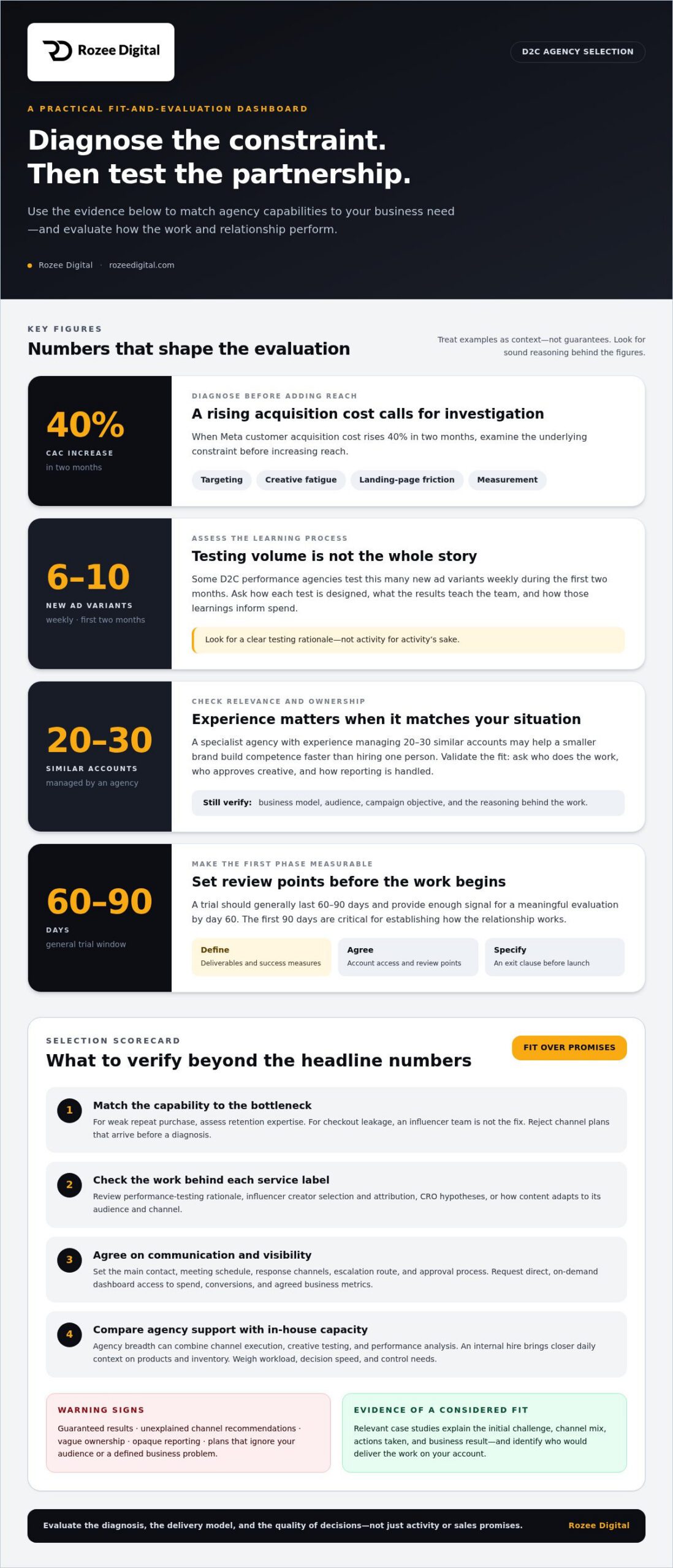
Map the business bottleneck to the capability that can address it. If Meta customer acquisition cost rises 40% in two months, examine targeting, creative fatigue, landing-page friction, and measurement before buying more reach. A performance specialist may fit that problem; an influencer team won’t fix checkout leakage. For weak repeat purchase, assess retention expertise. Reject proposals that lead with channels before diagnosing the constraint.
-
Assess Agency Marketing Capabilities
Review the work behind each capability, not just the service label. For performance marketing, request a testing rationale and learn how results inform spend. For influencer work, assess creator selection, usage rights, and attribution. For CRO, look for hypotheses covering product pages, checkout, and mobile flow. For content, examine how concepts adapt to each audience and channel. Some D2C performance agencies test 6-10 new ad variants weekly during the first two months; judge the learning process, not volume alone.
-
Evaluate Agency Fit and Hiring Risks
Compare the delivery model with your team’s capacity and campaign complexity. Smaller brands may gain faster competence from a specialist agency than from hiring one person, particularly when that agency has managed 20-30 similar accounts. Ask who executes, who approves creative, and how reporting works. A small company may need work equivalent to three employees; a complex operation may need narrower specialist support. Red flags include vague ownership, opaque reporting, and plans that ignore your audience.
- Write a concise brief before meeting agencies. Include your current constraint, audience, product economics, priority channels, and desired outcome. For example, distinguish a conversion problem from an acquisition problem: the first may call for conversion rate optimization, while the second calls for campaign diagnosis. Note what your team can handle internally, so an agency can scope work around a real operating gap instead of selling a generic marketing package.
- Compare agency support with the capacity you need to build in-house. An agency can bring together channel execution, creative testing, and performance analysis; an internal hire offers closer daily context on products and inventory. Choose based on workload, decision speed, and control needs. If one specialist would leave important skills uncovered, agency breadth may be a better fit. If the work depends on constant cross-functional decisions, internal ownership may matter more.
Checking agency fit, communication, and track record
Assess the people, reporting practices, and evidence behind the proposed partnership. Set expectations before launch, then use the first 90 days to evaluate how the working relationship operates.
- Review case studies that resemble your business model, audience, and campaign objective. Look beyond headline growth: identify the initial challenge, channel mix, actions taken, and reported business result. A paid social case study, for example, should explain how creative testing shaped campaign decisions. Ask who delivered the work and whether those team members would manage your account. Similar experience is useful only when the underlying reasoning applies to your situation.
- Set communication expectations before work begins. Agree on the main contact, meeting schedule, response channels, escalation route, and who approves campaign changes. For example, decide whether urgent budget shifts need your approval or fall within agreed limits. Use a recurring agenda covering results, decisions, blockers, and next steps. Clear ownership keeps routine questions from delaying execution or creating conflicting instructions.
- Request direct, on-demand access to performance dashboards. You should be able to understand campaign spend, conversions, and agreed business metrics without waiting for a presentation. Ask how reports distinguish observed results from interpretation and explain attribution limits. A useful report links a change, such as new creative, to its measured effect and the next decision. Screenshots or selective summaries are not substitutes for shared visibility.
- Test the agency’s response to a realistic business scenario. Present a performance shift, inventory constraint, or seasonal trend, then ask what information it would examine before recommending action. Strong answers identify relevant data, trade-offs, and decision-makers. Weak answers jump straight to higher spend or a familiar tactic. Use the discussion to assess whether the team listens, challenges assumptions constructively, and adapts its analysis to your operating context.
- Make the first phase measurable and reversible. A trial should generally last 60-90 days, include defined deliverables, and provide enough signal for a meaningful evaluation by day 60. Specify success measures, account access, review points, and an exit clause before launch. The first 90 days are critical to establishing the relationship, so assess both campaign execution and collaboration. For a specialist discussion of ecommerce advertising strategy, focus on how reporting and decisions connect.
Is it worth it to hire a marketing agency?
Agency support is worth considering when it fills a capability gap your team cannot cover efficiently. Compare the full scope with the resources and decisions needed to deliver the work internally.
-
Compare Pricing Models and Proposals
Compare proposals by deliverables, accountable roles, and channels, not just the headline fee. A retainer covers an agreed scope over an ongoing relationship; project pricing covers a defined assignment, while performance-based pricing links compensation to an agreed outcome or spend. Each model shifts planning and financial risk differently. Check that the proposed creative, campaign management, and reporting match the work your team needs.
Request the same scope from each prospective agency. Separate strategy, execution, creative production, and measurement so omissions are easy to spot. A proposal covering paid search cannot be compared fairly with one covering paid social and email. For performance-based terms, define the calculation, attribution method, and treatment of refunds before signing. Avoid a model that rewards increased spend without reflecting the business outcome you value.
-
Clarify Additional Costs and Budget Considerations
Ask for a detailed cost breakdown and identify expenses outside the stated fee. Separate agency work from ad spend, creator payments, production, software, and other third-party charges. Pricing depends on the case and is provided after a quote request; scope, channels, creative requirements, and ad spend shape the proposal. Confirm who approves each expense and how scope changes affect billing.
Compare the full engagement with the cost of doing the same work in-house. Include management time, specialist hiring, creative coordination, and the effort of covering multiple channels. A low retainer may leave out essential execution; an extensive package may duplicate your team’s capacity. Assess the actual workload and expertise required before deciding which option is more efficient.
- Test the pricing model against your cash flow and measurement cycle. A performance fee can be difficult to evaluate when conversion tracking, attribution, or margin data is unreliable. A retainer provides a more predictable fee structure, but only when the scope and reporting schedule are explicit. Project pricing suits a contained deliverable, such as a campaign audit, rather than ongoing optimization. Match the contract structure to the work’s duration and your ability to assess its contribution.
- Set decision rules before committing. Define the outcomes that matter, how they will be reported, and when the scope should change. For example, distinguish media efficiency from contribution margin, then clarify how inventory constraints affect campaign decisions. Keep ad spend separate from agency fees in internal forecasts. This makes budget ownership clear and prevents a proposal from looking affordable only because significant delivery costs sit outside its headline scope.
- Choose agency support when specialist execution or coordinated channel management exceeds your team’s capacity. Keep work in-house when your team can deliver it effectively and needs close daily control. The decision is not agency versus in-house by default. Choose the operating model that funds the right capabilities, makes responsibilities clear, and gives leadership a sound basis for evaluating performance.
Defining business needs, goals, and scope of work
Build your brief around business priorities, not a wish list of channels. Clear goals help you judge whether an agency’s proposed work supports growth.
ROAS compares attributed revenue with advertising spend; CAC compares acquisition costs with new customers. Customer lifetime value estimates the revenue or value a customer generates over the relationship. Define the measurement window and data source before comparing results.
- Document the business challenge before discussing tactics. Identify whether the constraint is customer acquisition, conversion, repeat purchase, or another operating issue. Add context such as audience, product margins, inventory, and current marketing activity. For example, a brand seeking profitable new-customer growth needs a different scope from one focused on repeat purchases. This brief gives every prospective agency the same starting point.
- Translate the challenge into measurable goals and KPIs. Define the primary outcome, supporting indicators, reporting source, and review period. If the goal is efficient acquisition, specify how you’ll assess CAC alongside ROAS and customer lifetime value. Use accurate data and distinguish observed results from assumptions. Shared definitions prevent the agency and leadership team from measuring success in different ways.
- Describe how you expect marketing to support the business over the next three to five years. Name priorities such as reaching a new audience segment, strengthening retention, or expanding channel contribution. Separate near-term campaign targets from long-term business outcomes. This helps an agency recommend work that supports your intended direction instead of optimizing isolated metrics without regard to future plans.
- Specify the scope, owners, and access needed to deliver the work. List channels, campaign responsibilities, creative requirements, analytics, and approval steps. Confirm who owns advertising accounts and customer data, and arrange direct access to performance dashboards. Define how the team will report business-focused results, not just clicks or impressions. For example, reports can connect spend and conversions to agreed acquisition or retention goals.
- Set rules for scope changes before signing. State how added channels, new campaigns, or extra creative requests will be assessed, approved, and reflected in the engagement. Identify the decision-maker on each side and the information needed to evaluate a change. A written process helps prevent unplanned work from displacing priorities and gives the agency a clear way to recommend adjustments when business needs shift.
Agency alignment with brand values and industry
Brand alignment is about more than matching colors or category labels. Assess whether an agency can protect customer trust while supporting commercial growth and conversion.
- Turn your brand values into observable campaign decisions. Name the principles that shape pricing, claims, customer service, and creative. A premium skincare brand may avoid discount-led messaging; a value-focused household brand may lead with practical savings. Ask prospective teams to explain how those positions would shape audience targeting and advertising language. Real alignment shows up in consistent decisions, not a presentation that merely repeats your brand statement.
- Review examples from your industry or a genuinely comparable category. Look at the messaging, imagery, offer, and customer journey together. For a fashion label, consider whether the agency understands product drops, seasonal demand, and visual consistency. For a specialist food brand, assess how it communicates ingredients and product use. Relevant experience matters when the agency can explain why its approach suited that audience, not simply show attractive creative.
- Test how the team handles a brand tension. Present a realistic scenario, such as pursuing short-term conversions without weakening a premium position. Ask what it would preserve, what it might test, and how it would assess the results. A capable partner can explain trade-offs between reach, offer strength, and customer expectations. Be wary of proposals that treat every brand as interchangeable or recommend aggressive promotions without considering their effect on positioning.
- Compare the agency’s working style with your internal decision process. Identify who owns brand guidelines, approves claims, and resolves disagreements between growth targets and creative standards. For example, if a founder protects a restrained visual identity, determine how campaign iterations can remain recognizable while testing new concepts. Clear roles make feedback actionable and prevent brand alignment from becoming a subjective debate after launch.
- Connect industry fit to customer understanding. Ask the team to describe customers’ purchase barriers, comparison habits, and reasons for returning. Someone assessing product quality for the first time may need different proof from an existing customer considering a replenishment. Check whether the proposed message addresses those needs at each stage of the customer journey. The right agency strengthens your brand’s existing value proposition instead of replacing it with generic performance language.
- Use the evaluation to set a practical standard for collaboration: require each campaign concept to link a brand principle, audience insight, and business objective. That simple test exposes work built only for clicks. If your growth plan depends on paid media that respects brand positioning, discuss your D2C advertising goals with a team focused on ecommerce advertising.
Rozee Digital: Ecommerce ads agency
Rozee Digital is an ecommerce ads agency for D2C brands seeking focused paid media management. Its Google Ads, Facebook Ads, and PPC services fit businesses that need dedicated support across paid search or paid social campaigns.
Turn to an agency when your goals, audience, and priority channels are clear, but your team needs specialist campaign execution. If the main constraint lies elsewhere, such as website development or platform selection, an advertising agency is not the right solution for that work. Keep the engagement focused on the paid media your business needs.
Share your growth priorities and advertising goals with Rozee Digital to discuss whether its ecommerce advertising support fits your needs.
Turn the Agency Decision Into a Growth Plan
The decision to choose a D2C advertising agency should move your business toward a defined commercial outcome. Treat the partnership as an operating decision, not a shortcut around internal priorities. Set the business objective, assign decision ownership, and make sure the work supports the customer experience you want to build.
For brands seeking specialist ecommerce advertising, Rozee Digital provides ecommerce ads, Google Ads, and Facebook Ads services. These capabilities support businesses that need focused paid media execution across search or social. Start a conversation with Rozee Digital about your goals, channel priorities, and the work your team needs delivered.
Contact Rozee Digital to discuss your goals. Bring a clear view of the growth challenge and the outcome you want marketing to support. A focused discussion can help you determine whether the fit is right for your next stage.
Frequently Asked Questions
How Much Will It Cost?
Cost depends on the scope, channels, creative requirements, and advertising spend. Request a quote that separates agency fees from media budget and third-party expenses. Managing paid search alone, for example, differs from coordinating search, social campaigns, and email marketing. Compare the work included, not just the fee. A clear proposal should connect each cost to a defined responsibility and deliverable.
The Critical Factor: Are They Truly Data-Driven?
A data-driven agency can explain how evidence shapes its decisions, not just show charts. Ask it to trace a campaign adjustment from the original signal through the action taken and the outcome assessed. For example, a drop in purchases might prompt a review of product availability, landing-page behavior, and traffic quality before any budget changes. Look for direct dashboard access and clear explanations of attribution limits.
What Are the Benefits of an Agency vs In-house?
An agency can provide coordinated specialist execution when internal capacity is limited; an in-house team offers closer daily access to product, inventory, and customer-service context. A seasonal campaign, for example, may require quick coordination between merchandising and media. Decide which model gives your business better access to the skills and decisions it needs. A hybrid structure can keep strategic ownership in-house while delegating defined execution.
What services should a D2C advertising agency provide?
Services should match the business need rather than follow a fixed checklist. A D2C advertising agency may manage paid search, PPC, and paid social campaigns, while some providers also handle email marketing. Rozee Digital focuses on ecommerce advertising, including Google Ads, Facebook, TikTok, Pinterest, and Snapchat campaigns, plus email marketing. Website development and ecommerce software are separate needs, not advertising services.
How do I evaluate an agency’s D2C experience and case studies?
Assess whether the case study explains the business context behind its outcome. Ask what the brand sold, which audience it targeted, what challenge it faced, and which work the agency controlled. Then examine whether the reported result reflects revenue, acquisition efficiency, or another metric relevant to your goals. When you choose a D2C advertising agency, prioritize transferable reasoning over impressive-looking results without context.
Which advertising channels should a D2C agency specialize in?
Channel expertise should reflect customer behavior and the purchase journey. Google Ads and paid search can capture active product searches; Facebook, TikTok, Pinterest, and Snapchat offer paid social options. The right mix depends on where your audience discovers products, evaluates alternatives, and returns to buy. Prioritize channels tied to your growth constraint instead of paying for broad coverage without a clear purpose.
How much do D2C advertising agencies charge in the United States?
There is no single fee that applies to every United States D2C engagement. The total depends on the channels managed, campaign complexity, creative workload, reporting requirements, and advertising budget. Request a written quote that distinguishes management work from media spend and other expenses. Compare proposals with the same deliverables and assumptions. That makes differences in scope visible before you assess the overall investment.
What agency pricing models and contract terms are common?
Common pricing structures include a flat retainer, project pricing, and performance-based compensation. Contract terms should state deliverables, payment basis, account ownership, scope-change rules, review points, and exit conditions. A trial can generally run 60-90 days with a defined exit clause; a 30-day notice period is considered reasonable. Avoid committing to a 12-month retainer after only an initial conversation.