The right ecommerce agency fits your growth model, channel priorities, and need for control. When you switch ecommerce marketing agency partners, retain ownership of your advertising accounts and choose a team that explains performance, not just reports it.
Changing agencies can reset a weak working relationship, but it won’t automatically fix poor tracking, a low-converting storefront, or a business issue outside the ad account. Before making the move, identify what’s driving results, what your current team has done about it, and what you need the next team to own.
This guide will help you choose an ecommerce agency, compare agency, freelancer, and in-house options, and protect access to the accounts and data your marketing depends on. You’ll also find practical questions to ask your current agency before you leave, including how to clarify the transition plan and preserve continuity. The goal is a deliberate change, with clear accountability and control from the start.
Key Takeaways
- Separate agency execution issues from tracking, website, and wider business problems before deciding to move on.
- Choose an agency, freelancer, or in-house team based on the expertise, oversight, and internal capacity your business needs.
- Keep administrative control of advertising accounts and plan channel access changes before the handover.
- Match a full-service or specialist agency to the scope of work that needs clear ownership and accountability.
- Ask your current agency for the contract end date, transition plan, and a practical roadmap for the next 30 to 90 days.
1. Which Ecommerce Agency Is Right for You?
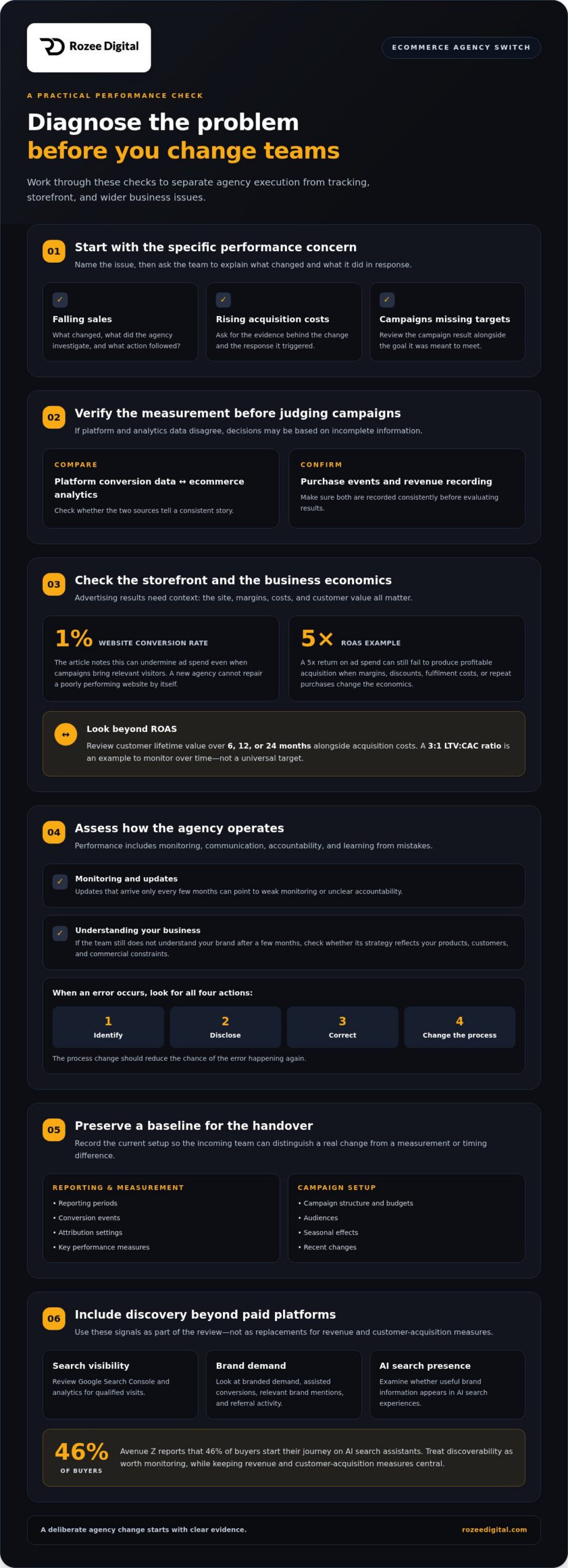
Poor results don’t automatically mean an agency failed. Before you switch your ecommerce marketing agency, separate its execution from issues with tracking, your storefront, or the wider business. Start with a specific problem, such as falling sales, rising acquisition costs, or a campaign that no longer meets its target. Then ask the agency to show what changed, what it investigated, and what action followed.
Check tracking before judging performance. Compare platform conversion data with your ecommerce analytics, and confirm that purchase events and revenue are recorded consistently. If the numbers diverge, campaign decisions may be based on incomplete information. Next, examine the storefront. A website conversion rate of 1% can undermine advertising spend, even when campaigns attract relevant visitors. A new agency can improve media management, but it can’t repair a poorly performing website by itself.
ROAS is a signal, not a profit statement. A 5x return on ad spend can still fail to produce profitable customer acquisition when margins, discounts, fulfilment costs, or repeat purchases change the economics. Review customer lifetime value over 6, 12, or 24 months, alongside acquisition costs. A 3:1 LTV:CAC ratio is one example of a relationship to monitor over time, not a universal target. Ask for results by channel and campaign, then compare them with contribution margin and new-customer quality.
Judge agency performance by the quality of its operating discipline. Updates that arrive only every few months can point to weak monitoring or unclear accountability. If the team still doesn’t understand your brand after a few months, assess whether its strategy reflects your products, customers, and commercial constraints. When an error occurs, look for four actions: identification, disclosure, correction, and a process change to reduce the chance of recurrence.
Preserve a useful baseline before the handover. Record reporting periods, campaign structure, budgets, audiences, conversion events, attribution settings, and the key performance measures used by the current team. Note seasonal effects and recent changes so the incoming team can distinguish a real shift from a measurement or timing difference. A shared baseline makes the transition measurable without treating every early fluctuation as proof of success or failure.
Performance also includes discovery beyond paid platforms. Review Google Search Console for search visibility and analytics for qualified visits, branded demand, and assisted conversions. Assess performance PR by tracking relevant brand mentions and referral activity, then examine whether useful brand information appears in AI search experiences. Avenue Z reports that 46% of buyers start their journey on AI search assistants. That makes discoverability worth monitoring, but it doesn’t replace reliable revenue and customer-acquisition measures.
2. Choosing between an agency, freelancer, and in-house team
Choose the operating model that matches your workload, expertise gaps, and management capacity. An agency can coordinate several digital marketing channels and campaigns. A freelancer can provide focused execution in one discipline. An in-house team gives you direct control but requires internal hiring, management, and continuity. The best fit depends on the work you need done, not the label attached to the team.
A freelancer may suit a defined need, such as managing Google Ads while your team handles creative and reporting. That arrangement works when priorities are narrow and an internal lead can set direction. It gets harder when campaigns rely on coordinated paid search, paid social, analytics, and email. One specialist may not cover every channel, leaving your business responsible for integration.
An in-house team makes sense when digital marketing is an ongoing function and the business can support its management. Internal staff can work closely with merchandising, finance, and customer teams, connecting campaigns to inventory, promotions, and margin decisions. The trade-off is that expertise depends on the people you hire, while recruitment and oversight remain your responsibility.
An agency can coordinate channel execution without requiring you to hire every specialist internally. Evaluate the actual account team, not just the sales presentation. Ask who will lead strategy, manage campaigns, analyze performance, and communicate with your team. Review a sample report and a relevant ecommerce case. Strong answers connect channel decisions to business priorities, explain trade-offs, and identify what the agency needs from you.
Set the evaluation period around the work. There is no universal 30-, 60-, or 90-day rule for judging an agency. Paid campaigns depend on spend, conversion volume, sales cycle, and seasonality. Broad SEO terms and new content initiatives can take months to produce results; allow two or three months before treating disappointing early outcomes as abnormal. Assess the activity and leading indicators during that time, then judge outcomes against the agreed objective.
Before choosing, write a short scope that defines channels, decision rights, reporting cadence, and internal responsibilities. For example, specify who approves creative and who manages product-feed changes. Compare each team option against the same scope. This prevents you from comparing a low-cost freelancer, a large agency, and an internal hire on incompatible deliverables.
If your priority is coordinated ecommerce advertising across paid channels, explore specialized ecommerce advertising support as one possible operating model.
3. Advertising account ownership when changing agencies
Keep your business in control of its advertising accounts before changing agency access. Retain ownership or full administrative access to Google Ads rather than relying on an agency login. This protects campaign history, billing visibility, conversion settings, and your ability to assign the next team. Account access is an operating requirement, not a courtesy granted during the handover.
Build an inventory before changing permissions. Record the account owner, administrators, linked platforms, active campaigns, conversion actions, audiences, and billing arrangements. For Meta, gather the ad accounts, Pages, pixels, and catalogs used by campaigns. Note which business assets connect to each account. This technical map helps identify dependencies before access changes affect live advertising.
Google Ads manager links need particular care. Unlinking a manager can make its shared remarketing lists unavailable to campaigns that depend on them. It can also stop that manager’s cross-account conversion tag from recording conversions for later clicks. Identify these dependencies first, then agree on replacement audiences or conversion tracking before unlinking. Otherwise, the transition can disrupt measurement as well as campaign delivery.
Separate the contractual end date from the operational handover date and the access-removal date. Each serves a different purpose. The contract defines when the engagement ends; the handover sets when campaign responsibility changes; access removal follows after required work and dependencies transfer. Put each date in writing and assign an owner to every task. Don’t remove permissions before the incoming team can access essential assets.
Use a cutover checklist for each channel. Before responsibility changes, confirm that the incoming team can access the account, review active campaigns, verify conversion events, and identify shared assets. Capture campaign settings and current reporting definitions. Preserve creative files, naming conventions, and change history where available. The new team can then distinguish inherited setup from changes made after taking control.
- Confirm business ownership and administrator access for every advertising account.
- List connected assets, including Meta Pages, pixels, catalogs, and Google Ads manager dependencies.
- Document conversion actions, tags, audiences, campaign settings, and reporting definitions.
- Set separate contractual, operational handover, and access-removal dates.
- Test the new team’s access and measurement before removing the former agency.
Keep a record of who approved each change and when. If conversion reporting shifts after cutover, that record helps pinpoint the cause. Treat ownership, access, and measurement as a single transition control, not separate administrative tasks. A clean handover protects continuity and gives the next team clear responsibility for the account.
As part of an agency transfer, gather your business’s Meta ad accounts, Pages, pixels, and catalogs. Verify that the business retains account control and resolve relevant dependencies before removing agency access. Make the access decision only after completing these checks, so permission changes follow the control and dependency review.
The transition lead should use a cutover checklist for each channel before responsibility changes. Apply it to the channel being handed over and confirm that control and dependency checks are complete before responsibility shifts. This keeps the checklist tied to each channel’s transfer rather than treating agency access removal as a single step.
4. Full-service versus specialized agencies
A full-service agency can coordinate several marketing functions under one strategy. A specialist agency focuses on a defined channel or business problem. Neither model is automatically stronger. The right choice depends on which decisions need to connect, where execution is weak, and whether your team can manage gaps between providers. For example, paid search and paid social may need shared revenue targets, while one underperforming channel may call for deeper specialist focus.
Business scale can help narrow the choice. A startup below $1 million in revenue may benefit from an à la carte agency, purchasing only the capabilities it needs. A brand above $50 million in revenue may need a large, integrated agency to coordinate broader operations. These are useful considerations, not fixed thresholds. Internal expertise, channel complexity, and the number of teams involved also shape the decision.
Evaluate the operating model before comparing agency labels. Ask each candidate to explain how its strategy connects channel targets to business outcomes. Request an example of campaign changes tied to margin, inventory, customer acquisition, or repeat purchases. A specialist should explain its boundaries and how its work fits your wider plan. A full-service team should show who owns each function and how decisions move between specialists.
Use a practical scope to uncover coverage gaps. List the required work, then assign one accountable owner to each task. Include campaign planning, creative production, analytics, reporting, and coordination with internal teams. If two agencies each assume the other owns conversion tracking, the gap will surface after launch. If your team must approve every change, confirm that the proposed model supports that level of control.
- Choose a specialist when one channel has a clear performance problem or requires focused expertise.
- Choose broader integration when multiple channels must follow one commercial strategy.
- Choose à la carte support when your internal team can manage coordination and needs only selected capabilities.
- Clarify ownership for creative, analytics, reporting, and cross-team decisions before work begins.
Then compare coordination costs, not just the number of providers. Separate specialists can deliver focused work, but your business must connect plans, reporting, and priorities. A full-service team can centralize coordination, but breadth alone doesn’t prove depth in every channel. Ask for named responsibilities, sample reporting, and a clear escalation path. The strongest choice fits your revenue model and gives every important decision an accountable owner.
5. Questions to ask the current agency before switching
Use the final agency conversation to secure facts, documents, and a workable handover. Focus on the agreement, account access, measurement, and next actions. A professional relationship can end without losing useful context. Ask for written answers, assign an internal owner, and save each response in one transition record.
Start with the contract. Ask, “What is our contractual end date under the signed agreement, and what notice or handover steps does it require?” Compare the answer with the agreement, including renewal terms and responsibilities at termination. Then ask who will complete each transition task and by what operational date. Keep the contractual end date separate from the date campaign management changes.
Request a forward plan, even if you expect to leave. Ask, “What would your plan for the next 30 to 90 days include?” The response can reveal the agency’s current priorities, assumptions, and view of growth. Request the actions, owners, and measures behind the plan. A clear roadmap gives your team useful context; a list of broad promises does not.
- “Which campaigns or account changes need attention before handover, and why?”
- “What tags, pixels, and conversion actions are active across Google Ads and other platforms?”
- “Can you provide documentation explaining what each tag does and where it fires?”
- “Which audiences, shared assets, or manager links depend on your accounts?”
- “What records, reports, creative files, and account history will transfer to us?”
Ask for documentation, not just verbal explanations. Tag records should identify each tag’s purpose and function. Account records should show campaign structure, conversion definitions, audience dependencies, and recent changes. For Google Ads, confirm business administrative access and any manager-account dependencies before changing access. For Meta, include relevant ad accounts, Pages, pixels, and catalogs in the transfer record.
Close by clarifying what the agency believes caused performance issues. Ask which actions it took, what changed, and what remains unresolved. Request campaign or reporting examples rather than general assurances. Record the answers alongside the incoming team’s responsibilities. This creates a practical handover brief and reduces the risk of losing important context during the change.
If you’re preparing a transition and want a focused discussion about your ecommerce advertising needs, set out your channel priorities and account requirements clearly.
Before agreeing on the final handover, confirm the contractual end date against the actual agreement rather than relying on a verbal summary or assumed timetable. Keep the relevant agreement details with the transition record and note any unanswered questions for follow-up. This gives the outgoing and incoming teams a shared reference when planning the change in responsibilities.
When transferring tag management, obtain documentation explaining what each tag does. Ask the outgoing team to identify each tag’s purpose and where it is used, then compare the records with the active setup before access or ownership changes. If an explanation is missing or unclear, record the gap and agree who will resolve it. Clear documentation gives the next team a stronger basis for maintaining measurement and continuing campaign work without relying on memory.
Rozee Digital: Ecommerce ads agency
Rozee Digital is an ecommerce ads agency for brands seeking focused paid media management. Turn to the team for Google Ads, Facebook Ads, or PPC campaign support aligned with your ecommerce growth priorities. A clear brief on your business goals, account ownership, and current campaign structure can establish a productive starting point.
Rozee Digital focuses on advertising, not website development or ecommerce software. If your storefront needs work, address that separately while setting campaign priorities. For ecommerce advertising support, contact Rozee Digital to discuss your requirements.
Make the Next Move on Your Terms
Changing agencies should create a stronger working relationship, not another cycle of unclear ownership. Before committing, define the decisions you expect the next team to own and the information your leadership needs to guide growth. That gives the transition a commercial purpose beyond replacing a name on an invoice.
If you decide to switch ecommerce marketing agencies, set the standard before the first campaign begins. Align on the business objective, decision rights, and how results will guide future investment. Rozee Digital provides ecommerce advertising, including Google Ads and Facebook Ads management, for brands seeking focused paid media support. Start with a direct discussion of your priorities, account structure, and growth goals.
Discuss your ecommerce advertising options with Rozee Digital, and move forward with a clearer mandate for your marketing investment.
Frequently Asked Questions
Which Ecommerce Agency Is Right for You?
The right agency can explain how its work supports your business model and priorities. Before choosing one, write down the outcomes that matter most, such as efficient new-customer acquisition or stronger repeat purchasing. Then assess whether the team’s expertise and working style fit those needs. For example, a brand with frequent product launches may need close coordination between campaign planning and merchandising.
How do you choose so you never have to switch again?
You can’t guarantee you’ll never need to change agencies, because business priorities and capabilities evolve. Reduce avoidable disruption by agreeing on decision rights, communication expectations, and how scope changes will be handled. Schedule regular business reviews to surface mismatched expectations early. If a new product line becomes a priority, discuss how strategy, resources, and measurement should change before the work shifts.
What are the real reasons to switch marketing agency?
Switch when persistent problems undermine the work or the relationship. Examples include recurring missed commitments, unclear decision ownership, advice that no longer fits your business direction, or a team unable to explain its recommendations. A change in company priorities can also create a mismatch, even if the agency performed well under the previous strategy. Identify the specific gap before ending the engagement so the next arrangement addresses it.