Author: Tom Rozee, Founder
Tom Rozee has run paid media since 2016. He has helped ecommerce brands generate over $500M in client revenue and managed more than $100M in ad spend.
Introduction
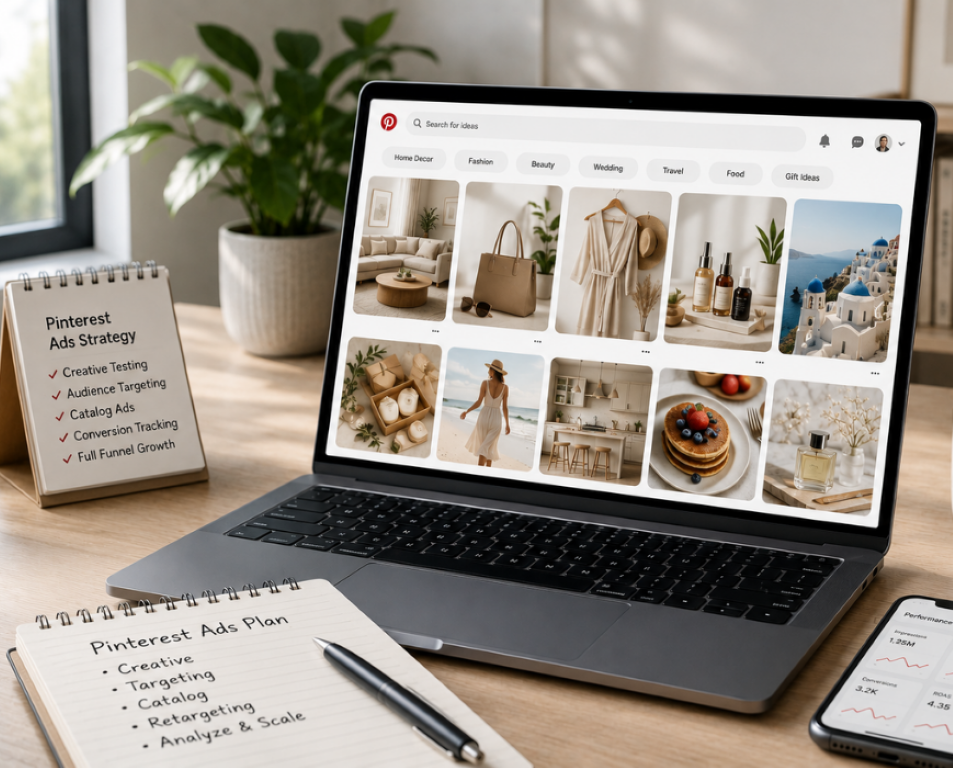
Pinterest can help ecommerce brands reach shoppers before they buy. People use the platform to plan trips, outfits, rooms, meals, gifts, and more. They save ideas and return to them later. This creates a strong setting for product discovery.
But Pinterest ads do not work because a product looks good. A weak offer can waste strong traffic. Poor creativity can stop people from clicking. Bad product data can limit visibility. A weak product page can lose the sale.
That is why a Pinterest ads agency should look beyond campaign settings. The right partner connects creative, product feeds, targeting, landing pages, customer acquisition, and retention.
This guide explains how Pinterest ads work for ecommerce brands. You will learn about campaign types, creative testing, catalogue ads, retargeting, budgets, measurement, and agency selection.
You will also see practical examples and real proof points. The goal is simple. You should know where Pinterest fits, what good management looks like, and when outside support makes sense.
What Does a Pinterest Ads Agency Do?
A Pinterest ads agency plans, launches, manages, tests, and improves paid Pinterest campaigns. For ecommerce brands, that work should connect media buying with products, offers, creative, conversion, and customer value.
Common services can include:
- Campaign setup and planning
- Audience research
- Pinterest creative strategy
- Product feed setup
- Catalogue campaign management
- Retargeting
- Budget planning
- Conversion tracking
- Creative testing
- Campaign analysis
- Landing page reviews
- Performance reporting
The goal is not to buy cheap traffic. The goal is to turn useful attention into profitable customer growth.
A strong team also looks beyond platform numbers. It asks if customers are new. It checks if orders have healthy margins. It tracks whether buyers return.
That wider view matters. A campaign can show good revenue while the business still makes weak profit.
Why Pinterest Works Differently for Ecommerce
Pinterest sits between search and social. People browse visual content, but many visits start with an idea or plan.
Think about someone planning a wedding. They may search for dresses, flowers, invitations, gifts, and hairstyles.
A home shopper may save room ideas before buying furniture.
A beauty shopper may research a new routine before choosing products.
This behaviour creates a useful journey:
Inspiration → Research → Save → Click → Purchase → Repeat
The shopper may not buy during the first visit. That does not make the visit worthless.
Your strategy should account for the buying cycle.
Pinterest Is About Intent, Not Just Attention
Someone looking for a product idea behaves differently from someone scrolling for entertainment.
That does not mean every Pinterest user wants to buy. It means the platform can work well for products linked to clear needs, plans, and visual ideas.
Useful categories often include:
- Fashion
- Beauty
- Home
- Food
- Travel
- Gifts
- Lifestyle
- Weddings
- Fitness
The product still needs a clear reason to matter.
What Types of Pinterest Ads Matter?
Your campaign mix should match your product and buying journey.
| Campaign Type | Best Use | Main Goal |
| Standard ads | Product discovery | Drive qualified traffic |
| Video ads | Product education | Build interest |
| Catalog ads | Large product ranges | Promote products at scale |
| Retargeting | Past visitors | Recover demand |
| Shopping campaigns | Product-led intent | Drive purchases |
The right structure should follow your account data and business goal.
Product Catalogue Ads
Catalog ads can help ecommerce brands promote products from a connected product feed. This is useful for stores with many products or frequent product changes.
Your feed should contain accurate:
- Product titles
- Descriptions
- Prices
- Availability
- Images
- Categories
- Product links
For example, “Dress” gives little context.
“Women’s Linen Midi Dress, Blue, Size 8” gives more useful detail.
Better product data can help Pinterest understand what your product is and where it fits.
Dynamic Retargeting
Retargeting can bring shoppers back after they view products or visit your site.
A visitor may need more time before buying. Showing the same product again can help them return without starting over.
But frequency matters. Repeated ads can become annoying. Watch spend, timing, creative fatigue, and customer behaviour.
How to Build a Pinterest Ecommerce Strategy
A good strategy starts with the business. The campaign account comes second.
1. Start With the Product
Ask what makes the product easy to understand visually.
A product can fit Pinterest when users can quickly see its use, style, outcome, or place in a plan.
A plain product shot may not be enough. Show the product in context. For a home brand, show the chair inside a styled room. For beauty, show the product within a routine. For fashion, show how the item looks when worn.
2. Define the Customer
Know who you want to reach.
Ask:
- What are they planning?
- What problem do they want to solve?
- What products do they compare?
- What makes them hesitate?
- What proof do they need?
These answers can shape your targeting and creativity.
3. Map Search Intent
Pinterest users may search broad ideas or specific products.
For example:
Broad: “small bedroom ideas”
Mid-level: “small bedroom storage ideas”
Product-led: “white storage bench for bedroom”
The product-led search may sit closer to purchase intent. But broad searches can build awareness earlier. Your content and ads should match each stage.
4. Build Pinterest-Native Creative
Do not simply copy an ad from another platform.
Pinterest creative should fit the way users browse and save ideas.
Test:
- Product-in-use images
- Step-by-step visuals
- Before-and-after images
- Lifestyle photography
- Creator content
- Short product videos
- Comparison concepts
- Seasonal ideas
A strong creative mind should make the product easy to understand quickly.
5. Match the Landing Page
The ad creates a promise. The page must keep it.
If the ad shows a bedroom storage idea, the landing page should make the related product easy to find.
Do not send shoppers to a generic homepage when a direct product or collection page makes more sense.
How Should Pinterest Creative Testing Work?
Creative testing should answer business questions. Do not make ten ads that change only the background. Test different reasons to buy.
Test Different Angles
One product can support several messages. A skincare product might focus on:
- Dry skin
- Simple routines
- Travel
- Sensitive skin
- Daily use
A fashion product might focus on:
- Comfort
- Fit
- Occasion
- Fabric
- Styling
The winning angle can show what customers care about most.
Test Different Formats
Try different ways to tell the same story:
- Product image
- Lifestyle image
- Short video
- Step-by-step graphic
- Creator-style content
Keep the main learning clear.
Test the Offer
You can also test the reason to buy.
Examples include:
- Free shipping
- Bundle savings
- First-order discount
- Gift with purchase
- Seasonal offer
Watch the margin while testing. More orders do not always mean better growth.
Pinterest Ads for Beauty Brands
Beauty can fit Pinterest because shoppers often plan routines, looks, gifts, and product combinations.
A Pinterest ads beauty brands UK strategy can focus on use cases instead of broad product claims.
For example, a skincare brand could build creative around:
Problem: “Skin feels dry after cleansing.”
Routine: “A simple three-step night routine.”
Product: “Where this serum fits.”
Proof: “What customers say after using it.”
This creates a useful story around the product.
Beauty brands should also check their claims. Ads should match product evidence and platform rules. A strong beauty account can test routines, product education, creator content, seasonal looks, and product bundles.
How Should Pinterest Budgets Work?
The budget should follow demand, economics, inventory, and creative supply.
Start with the numbers.
Suppose a product sells for $100. After product and fulfilment costs, the brand has $40 left before ad spend.
A $55 acquisition cost may not work on the first order. It may work only if repeat purchases add enough value. That simple calculation can prevent a brand from scaling a weak model.
Budget Allocation
Do not split spend evenly across every campaign.
Ask:
- Which products have healthy margins?
- Which creatives bring buyers?
- Which audiences show strong intent?
- Which campaigns have room to grow?
- Is inventory available?
- Is the offer still strong?
Move budget based on evidence. One strong day should not decide the whole budget. Look at trends and context.
How Do You Measure Pinterest Ads Performance?
Start with platform metrics:
- Impressions
- Saves
- Outbound clicks
- CTR
- CPC
- Conversion rate
- Cost per purchase
- ROAS
Then move to business metrics:
- New customer CAC
- Contribution margin
- Average order value
- Customer lifetime value
- Payback period
- Repeat purchase rate
This matters because platform revenue does not equal profit. A campaign can show good ROAS but attract many existing customers.
Another campaign can show lower ROAS while bringing more first-time buyers. The right target depends on your business model.
A Real Example of Pinterest Growth
Proof helps show what this work can look like.
Rozee Digital reports that Hampden grew from $2.3 million to $12 million while reaching a reported 10x ROAS using Google, Meta, and Pinterest. The case study also reports a 118% revenue increase and a 121% increase in orders.
The important point is that Pinterest did not operate alone. The reported result came from a wider channel mix.
Another reported example is Luno Life. Rozee Digital says the brand achieved $500,000 at a 9x ROAS in July 2024. The case study reports a 124% revenue increase.
These examples show why channel results should sit inside a wider growth system. Pinterest can support demand. But product, offer, creative, conversion, and retention still matter.
Pinterest Advertising Agency UK vs. In-House Team
Both models can work.
| Factor | In-House | Agency |
| Pinterest skills | Depends on team | Specialist support |
| Hiring | Internal | Team already built |
| Testing depth | Depends on resources | Shared experience |
| Creative input | Internal | Specialist outside view |
| Cost model | Salaries and tools | Agency fee |
| Channel support | Depends on staff | Can connect wider media |
An in-house team may fit a brand with enough volume and senior talent. An agency may fit when the business needs specialist skills without hiring another full team.
The decision should follow your needs, not a generic rule.
What Should a Pinterest Ads Management Agency Handle?
Good management should cover more than campaign settings.
Product Feed Management
Review titles, categories, images, links, prices, and availability. Your product feed should stay accurate as the store changes.
Audience Management
Review who sees your ads and how those groups behave. Do not assume a large audience is a good audience.
Creative Management
Refresh ads before fatigue hurts results. Keep testing new angles, formats, and product stories.
Budget Management
Move spend toward campaigns with healthy economics and room to grow.
Conversion Tracking
Make sure purchase events work correctly. Bad data can lead to bad decisions.
Reporting
A useful report should answer:
- What happened?
- Why did it happen?
- What changed?
- What should we do next?
A report should help a founder make a decision.
Common Pinterest Advertising Mistakes
1. Copying Ads From Other Platforms
A creative that works on Meta may not fit Pinterest. Adapt the idea to the platform.
2. Ignoring Product Feeds
Poor product data can make catalogue campaigns harder to manage.
3. Sending All Traffic to the Homepage
Make the next step easy.
Send shoppers to the product or collection that matches the ad.
4. Measuring Only ROAS
Look at customer quality, margin, and repeat purchase value.
5. Testing Too Little
One creative person cannot carry growth forever.
Keep a clear testing system.
6. Ignoring Seasonality
Pinterest planning can change with seasons, events, and trends.
A wedding brand should not judge June behaviour like January behaviour.
7. Scaling Before the Funnel Is Ready
More traffic can expose weak pages, weak offers, or weak checkout steps. Fix the bottleneck first.
How Pinterest Fits Into Full-Funnel Ecommerce Growth
Pinterest should not work alone.
Think about the wider path:
Offer → Creative → Paid Media → Conversion → Retention
- The offer gives shoppers a reason to buy.
- Creative makes that reason easy to understand.
- Paid media reaches people at useful moments.
- Conversion turns visits into orders.
Retention turns first orders into repeat sales. This is why Pinterest works best when the wider funnel supports it.
If the product page is weak, better targeting cannot fix every problem.
If the offer is unclear, more traffic may only create more hesitation.
If repeat purchase is poor, first-order acquisition can become harder to justify.
A strong Pinterest plan should fit the full customer journey.
When Should You Hire a Pinterest Ads Agency?
Outside support may make sense when:
- Your paid spend is meaningful.
- You want to grow Pinterest sales.
- Your team lacks Pinterest specialists.
- Creative testing feels too slow.
- Product feeds need work.
- You need better reporting.
- You want Pinterest to fit a wider paid media plan.
You may need more groundwork first if you are pre-launch or still testing product-market fit. A specialist should be honest about that.
The right partner should also understand your wider economics. Pinterest should not become another channel that gets judged alone.
What Does a Pinterest Ads Agency Cost?
There is no single fee for every brand.
Pricing can depend on:
- Monthly ad spend
- Product catalogue size
- Creative support
- Campaign complexity
- Reporting needs
- Tracking work
- Strategy scope
Ask what the fee includes.
A Pinterest ads management agency may provide campaign setup, catalogue support, testing, budget management, reporting, and optimisation.
Some partners may also support creative strategy, landing pages, and wider paid media planning. Compare the depth of work and expected business value. Do not compare monthly fees alone.
Poor management can waste more money than a higher agency fee.
What Should You Ask Before Hiring a Pinterest Ads Agency?
Ask these questions before signing:
- Who will manage my account?
- How much Pinterest experience does the team have?
- How do you test creativity?
- How do you manage product feeds?
- How do you measure new customer CAC?
- How do you judge Pinterest against other channels?
- How often do you review campaigns?
- What does reporting include?
- What happens when performance falls?
- How do you know when the problem sits outside Pinterest?
The answers should show how the agency thinks.
Look for clear ownership, testing plans, commercial metrics, and honest limits.
A good partner should also tell you when Pinterest is not the right next step.
Is Pinterest Right for Your Ecommerce Brand?
Pinterest can fit brands with visual products and a clear planning or discovery journey. It may be useful for fashion, beauty, home, food, gifts, lifestyle, and other categories where people seek ideas before buying.
But channel fit is not enough.
Check these basics first:
- Product-market fit
- Gross margin
- Conversion rate
- Customer acquisition target
- Tracking
- Creative supply
- Inventory
- Repeat purchase potential
If these areas are healthy, Pinterest may have room to become a useful acquisition channel.
Conclusion
A Pinterest ads agency should do more than launch promoted pins. It should help your ecommerce brand turn product discovery into profitable customer growth. That means understanding intent, creating Pinterest-native ads, managing product feeds, testing different angles, and connecting media results with business economics.
Pinterest can be useful when shoppers plan purchases, save ideas, and compare products. Catalogue ads can help large stores promote products at scale. Retargeting can bring past visitors back. Creative testing can show which product stories make people act.
But the platform is only one part of growth. Your offer, product pages, tracking, margin, inventory, and retention still shape the final result.
Rozee Digital uses a full-funnel view because paid media works best when each stage supports the next. Before you add more spend, check the economics and customer journey.
The right agency should make decisions clearly. It should explain what changed, why it changed, and what should happen next. It should test with purpose, not simply edit campaigns. If your brand has proven demand, strong products, and enough creative supply, Pinterest can become a valuable part of your acquisition mix.
Ready to turn Pinterest discovery into profitable customer growth?
Get a free Profit Diagnosis™ from Rozee Digital and see exactly where your Pinterest campaigns, product feed, and landing pages are leaking revenue — no obligation, you keep the roadmap either way.
GET YOUR FREE PROFIT DIAGNOSIS →
Frequently Asked Questions
Q1: What does a Pinterest ads agency do?
A Pinterest ads agency plans, runs, tests, and manages Pinterest campaigns. It may also handle product feeds, creative testing, retargeting, tracking, budgets, and reporting.
Q2: Are Pinterest ads good for ecommerce?
They can be. Pinterest can fit ecommerce brands with visual products and shoppers who plan purchases, seek ideas, or compare options.
Q3: What is the best Pinterest ad format for ecommerce?
There is no single best format. Product images, video, catalogue ads, lifestyle content, and retargeting can each support different goals.
Q4: How much should an ecommerce brand spend on Pinterest ads?
There is no universal budget. Start with your customer acquisition target, margin, demand, creative supply, and inventory. Scale only when the economics support it.
Q5: How do I choose a Pinterest ads agency?
Look for ecommerce experience, Pinterest knowledge, strong creative testing, product feed skills, clear reporting, and full-funnel thinking. Ask how the team measures profitable growth.