Paid clicks are easy to buy; profitable growth takes disciplined decisions. A PPC agency for ecommerce should connect paid search and Shopping activity to product economics, customer acquisition, and margin. The work is not simply launching ads. It is building a growth approach that supports acquisition without losing sight of profitability.
Agency costs reflect more than campaign setup. Scope, account complexity, budget, and ecommerce expertise all shape the work involved. This article explains what an ecommerce PPC agency does, how experience and budget factor into support, and how Search ads differ from Shopping ads. It also explains how ROAS, MER, CAC, and LTV relate to commercial outcomes.
Key Takeaways
- Assess campaign management by how it connects product priorities, search intent, and remarketing, not by setup tasks alone.
- Evaluate agency experience against the complexity of your account and the commercial decisions your team needs support with.
- Choose between Search and Shopping based on whether the campaign needs to capture keyword intent or showcase specific products.
- Judge paid media performance in the context of profitability, using business economics alongside ad-platform metrics.
What is an eCommerce PPC agency?
An ecommerce PPC agency provides pay-per-click support for online retailers. This can include account reviews, strategy, campaign setup, measurement, and recommendations for improving performance.
Google Shopping, Search, and Remarketing
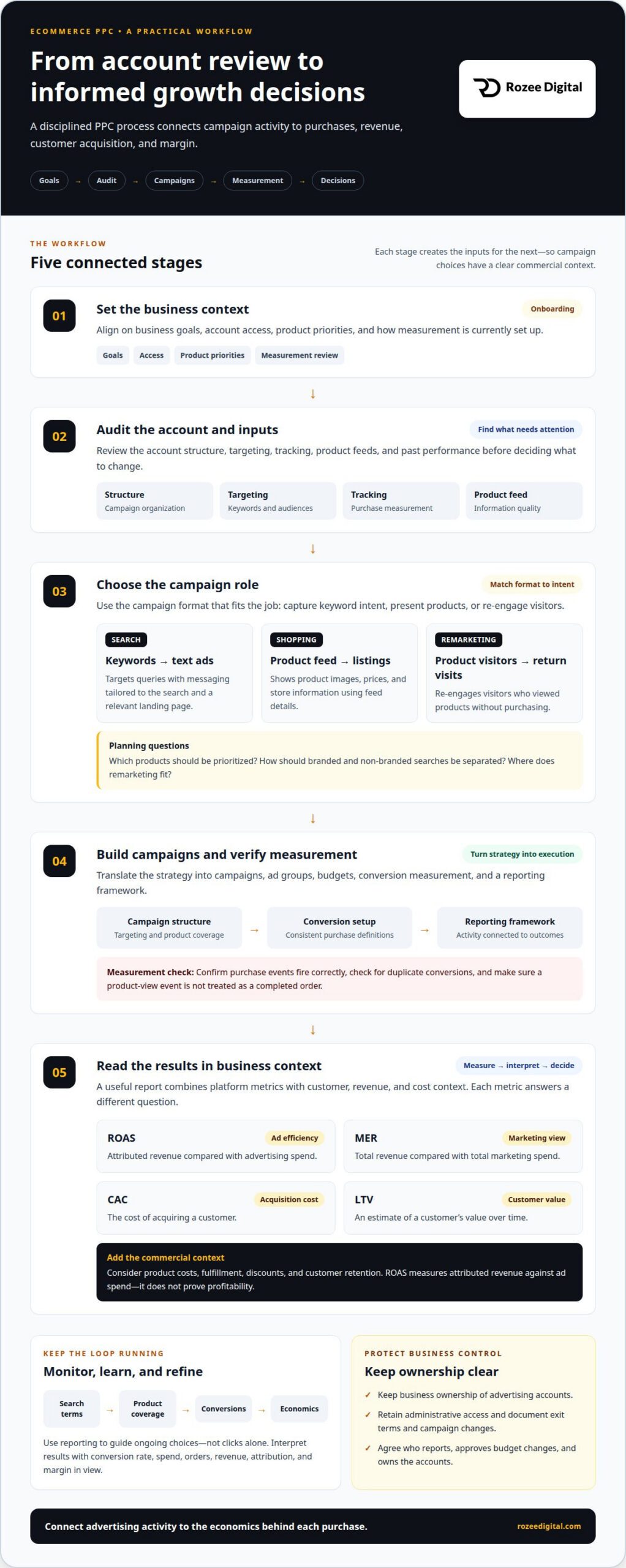
Google Search campaigns target queries through keywords; Shopping ads present products using a feed. Remarketing campaigns re-engage visitors who viewed products without purchasing. Together, these campaigns connect product discovery with return visits. Platform management may also include Amazon or Meta, depending on the agency’s scope. Confirm which channels, campaign types, and reporting responsibilities the agreement covers.
That distinction matters: Google Shopping depends on accurate product information, while Search relies on relevant keyword targeting and messaging. A sound plan explains how each channel supports commercial goals instead of treating every placement as interchangeable.
Ongoing Monitoring and Optimization
Effective paid search involves more than launching ads. Decisions should account for search terms, product coverage, conversion measurement, and the economics behind each purchase. Reporting is most useful when it connects advertising activity to revenue, customer acquisition, and contribution margin, rather than clicks alone.
A business may handle advertising in-house if it has the skills and capacity to make informed decisions consistently. External growth support can be useful when the team needs senior expertise across acquisition, creative, conversion, retention, and business economics, with agencies such as Digitalix providing targeted search marketing and optimization expertise. Keep account access and decision-making clear: agree on reporting, who approves budget changes, and who owns the underlying advertising accounts.
Audits and Strategy Development
A campaign audit examines account structure, targeting, tracking, product feeds, and past performance. Its findings inform a strategy: which products to prioritize, how to separate branded and non-branded searches, and where remarketing fits. Setup then turns that strategy into campaigns, ad groups, budgets, conversion measurement, and a reporting framework.
Onboarding typically starts with business goals, account access, product priorities, and measurement review, followed by an audit, strategy, and campaign build. Hiring risks include unclear reporting, weak access controls, and dependence on agency-held accounts. Keep business ownership of advertising accounts, retain administrative access, and document exit terms and campaign changes. This reduces operational lock-in without limiting an agency’s ability to manage daily execution.
Agency experience, budgets, and reported results
Experience matters when it connects acquisition decisions to conversion, revenue, and margin. Budget planning should reflect the business’s economics, not an unsupported promise of returns. Assess the proposed investment in light of the products, channels, and commercial constraints the work needs to address.
Performance Tracking and Analytics
Tracking should connect paid search clicks with purchases and revenue, using consistent conversion definitions across reporting systems. An experienced partner checks whether purchase events fire correctly, whether duplicate conversions appear, and whether attribution reflects the sales cycle. For example, a product-view event cannot stand in for a completed order. Reliable inputs make subsequent decisions more useful.
Reporting and PPC KPIs
A useful report connects platform measures to business outcomes. ROAS compares attributed revenue with advertising spend. MER compares total revenue with total marketing spend. CAC measures the cost of acquiring a customer; LTV estimates that customer’s value over time. Conversion rate, spend, orders, and revenue provide further context. Each metric answers a different question, so no single KPI should determine the decision.
Reported Results and ROI
Marginal ROAS and ecommerce ad spend optimization offer a more useful basis for budget decisions than reported average returns alone. ROAS measures attributed revenue against ad spend; it does not prove profitability. Product costs, fulfillment, discounts, and customer retention all affect the commercial result. A realistic target depends on those economics, conversion rate, attribution choices, and how efficiently the account can grow. Treat reported outcomes as evidence from a particular context, not a universal benchmark.
Case results need operating context: the period measured, spend, campaign scope, and whether the outcome represents revenue or profit. Compare like with like, then use margin and customer data to set a decision threshold. For a more structured view of PPC campaign management, connect reporting to the commercial outcomes your team prioritizes.
Search ads versus Shopping ads
Google Search and Shopping ads reach shoppers through different formats. Search campaigns use keywords to match queries with text ads, while Shopping ads display product listings using information from a product feed. Each format can play a distinct role in retail advertising.
Search Ad Campaigns
Google Search ads are text-based and triggered by keywords. They can capture demand for a product category, brand, or specific item. For example, a retailer can target a search for a product type with an ad leading to its relevant category page. Keyword selection and landing-page relevance shape the traffic these campaigns attract. Google Ads Help guidance on Search campaigns explains the campaign format.
Search ads let retailers tailor messaging to a query. Ad copy can highlight product benefits or direct shoppers to a relevant offer. Query and conversion data can help teams refine their approach. Search can complement Shopping, but the formats differ: Search pairs a query with written messaging, while Shopping presents a product listing.
Shopping Ad Campaigns
Google Shopping ads display product images, prices, and store information. Product feeds provide the details used to match items with relevant searches. A shopper comparing products can see listing information before clicking, so feed accuracy affects how clearly the offer appears. Google Merchant Center guidance on Shopping ads describes the format.
Feed optimization can include improving product titles and attributes, checking GTINs and categories, removing disapproved items, and syncing inventory. Google Merchant Center’s product data specification details feed attributes. Regular updates keep advertising aligned with current product information.
Choose an approach based on intent and economics, not format alone. Search supports keyword-led messaging; Shopping supports product discovery and comparison. Reporting should distinguish traffic, conversions, and revenue by activity. Assess outcomes against product margin instead of assuming either format will outperform in every account.
Ecommerce PPC agency experience and credentials
Ecommerce growth involves more than launching ads. Decisions need to account for product data, margins, inventory changes, and the path from click to purchase. When evaluating Rozee Digital, ask how its team considers paid media, creative, conversion, retention, and profitability.
Assess expertise through the process and evidence presented. Explore how a growth partner distinguishes branded and non-branded demand, addresses product-feed issues, and evaluates performance. A platform credential can indicate technical knowledge, but it does not by itself explain how decisions account for a retailer’s product mix and economics. Look for relevant examples and clear reasoning behind reported outcomes.
A useful review of agency experience should cover:
- Account approach: How the team structures campaigns around categories, margins, and business priorities.
- Measurement: How it checks purchase tracking and distinguishes attributed revenue from profit.
- Decision-making: How it responds when ad spend rises, conversion rates shift, or products become unavailable.
Reported results need operating context. Revenue growth alone does not reveal whether higher spend, improved conversion, or a change in average order value drove the outcome. Consider the measurement period, work involved, and stated result. Then assess whether the same conditions apply to your catalog, prices, and customer journey. Past results describe a particular situation, not a forecast for every ecommerce business.
Use the evaluation to understand how a potential growth partner thinks. Discuss a real decision, such as prioritizing a bestseller or a higher-margin category. Ask the team to explain the trade-offs, the data it would review, and how it would assess each purchase’s contribution. That conversation can reveal more than a credential alone.
Discuss your ecommerce PPC requirements with a team that can connect campaign management to commercial priorities.
Rozee Digital: Ecommerce ads agency
Rozee Digital supports ecommerce and DTC brands through its ecommerce advertising services, including Google Ads and Facebook Ads. Its Growth Accountability™ model focuses on ownership of growth, not day-to-day campaign management.
This approach is suited to established brands seeking growth support tied to commercial priorities, rather than a provider focused only on executing campaign tasks.
Contact Rozee Digital to discuss your ecommerce growth priorities.
Set the Next Growth Decision
Make the next step a decision about business priorities, not simply a search for more traffic. Identify the products and customer segments that matter most, the margin constraints growth efforts must respect, and the outcome your team needs to improve. That gives a PPC agency for ecommerce a clear basis for assessing channel priorities and shaping a plan around commercial goals.
Bring the discussion back to accountability. Define success, the measurements that will inform decisions, how reporting supports those decisions, and who retains account access. Clear expectations help marketing and finance assess progress against the same business objectives.
Rozee Digital works with ecommerce brands through ecommerce advertising, Google Ads, and Facebook Ads. If you’re ready to discuss how paid media could support your growth priorities, start a conversation with Rozee Digital. A focused plan is a practical place to begin.
Frequently Asked Questions
So Which PPC Agency Should You Pick?
Choose a PPC agency for ecommerce brands that connects acquisition to contribution margin and retention, not just platform activity. Ask how Rozee Digital approaches commercial growth and day-to-day campaign management. This approach suits brands seeking coordinated commercial growth, not campaign execution alone.
What is ROAS and what’s a good target?
ROAS is attributed revenue from advertising divided by ad spend; a suitable target depends on the margin left after product costs, fulfillment, and discounts. Set thresholds using contribution economics, then account for repeat purchases and customer lifetime value. A lower first-order return may support acquisition when retention economics justify it, while a higher figure can still mask weak profit.
What is the best campaign structure for ecommerce?
Organize advertising around distinct commercial priorities, separating products when margins, stock reliability, or purchase cycles call for different decisions. For example, keep seasonal inventory from obscuring evergreen product performance, and distinguish branded demand from category discovery in reporting. Give each group a relevant landing destination and clear conversion measurement. The structure should make it easier to assess product-level performance and decide where investment belongs.
How much does an ecommerce PPC agency cost in the US?
There is no single US fee for every ecommerce account. Scope, channel coverage, catalog complexity, reporting needs, and strategic involvement affect the work. Separate agency fees from media spend when assessing total investment. Compare the responsibilities included, not just the quoted amount, so the commitment matches the support required.
How do ecommerce PPC agencies charge: flat fee, percentage of ad spend, or performance-based?
A flat fee sets a defined service charge; a percentage-of-spend model changes with media investment; performance-based fees tie some compensation to an agreed outcome. Each structure creates different incentives. Define what counts as ad spend, which outcomes qualify, how attribution is handled, and whether strategy or creative work is included. A written scope makes the effective cost easier to compare than a pricing label alone.
How should I compare ecommerce PPC agencies and evaluate their results?
Compare results using the same evaluation window, spend definition, and attribution approach. Distinguish new-customer purchases from repeat orders, and account for promotions, stockouts, or major landing-page changes that may have affected performance. Review who owns account access, how decisions are documented, and whether outcomes reflect revenue, contribution margin, or profit. A sound comparison considers both the evidence and the growth approach behind it.