In ecommerce, PDP stands for product detail page: the page dedicated to one specific product, where a shopper decides whether to add it to the cart. A “PDP product” is not a special product type. It simply means the single item a given product detail page presents. (Outside ecommerce, the same letters can mean a Medicare prescription drug plan or a professional development plan. This guide covers the store meaning.)
For a brand spending real money on paid media, the PDP matters more than its plain name suggests. It is often where an ad click either turns into revenue or turns into wasted spend.
TL;DR
- A PDP (product detail page) is the page for one product, with its title, images, price, description, reviews and a clear way to buy.
- A product listing page (PLP) helps shoppers browse and compare. The PDP helps them decide.
- Weak PDPs raise your effective customer acquisition cost (CAC), because every ad click that fails to convert costs the same as one that does.
- Strong PDP content supports conversion, fewer mistaken purchases and repeat buying, which feeds lifetime value (LTV).
- Treat the PDP as a system: traffic source, page content, and post-purchase experience all affect profit.
Table of Contents
- What a PDP is, in plain terms
- What belongs on a product detail page
- PDP vs. PLP: product detail page vs. category page
- Why the PDP drives profit, not just conversion rate
- A hypothetical example: where the money leaks
- How to audit your own product detail pages
- PDPs and search visibility
- Our perspective: treat the PDP as part of one growth system
- Where Rozee Digital can help
- FAQ
- Sources
What a PDP is, in plain terms
A product detail page is a dedicated page that presents comprehensive information about a single product to encourage a purchase. It sits at the bottom of a store’s architecture: homepage, then category pages, then the PDP. It is the destination page for an item a buyer can add to a cart.
The shorthand “PDP product” causes some confusion. It refers to the individual product shown on a product detail page, and that product can be a physical good or an item or service sold or promoted online. If someone on your team says “the PDP product,” they mean the SKU or product that page is selling.
Nielsen Norman Group, a respected UX research firm, puts the page’s role simply: product pages are where users decide whether and what to buy. Baymard Institute’s research takes a similar view, noting that nearly all users visit a product page before purchasing, which is why its template and features can create major usability problems at scale.
What belongs on a product detail page
There is no single required layout, but the same components show up on pages that work. A typical PDP includes a descriptive title, high-quality images from multiple angles, pricing, stock availability, detailed descriptions and specifications, customer reviews, and clear calls to action. Many also add shipping and return information, product video, and variant selectors for size or color.
Here is how to think about each element in terms of what it does for the shopper:
| PDP element | Question it answers | Why it matters commercially |
|---|---|---|
| Title and key benefits | “Is this what I clicked for?” | Confirms ad-to-page match, protects click value |
| Images and video | “What does it look like and how does it work?” | Replaces the physical handling a store visit would offer |
| Price, variants, stock | “Can I get it in my size, and what does it cost?” | Removes friction at the decision point |
| Description and specs | “Will it do what I need?” | Prevents mistaken purchases and returns |
| Reviews | “Did it work for people like me?” | Builds trust that copy alone cannot |
| Shipping and returns | “What happens if I am wrong?” | Lowers perceived risk |
| Add-to-cart button | “How do I buy?” | Makes the next step obvious |
Images and video
Online shoppers cannot pick a product up, so the page has to do that job. NN/g’s guidelines list zoom or pan on product images and product videos among the features shoppers generally appreciate. Show scale, texture, the product in use and the back or underside where relevant.
Descriptions that answer real questions
Good copy is specific. Effective PDPs help make up for the lack of physical interaction in ecommerce, so list materials, dimensions, ingredients where applicable, compatibility and care. A 2022 academic study found that product descriptions positively and significantly affect perceived value, which is associated with customer satisfaction and repurchase intention.
Reviews
Reviews tell shoppers things your description cannot. NN/g notes that reviews can provide insight into product use that descriptions may not convey, and that shoppers found mixed reviews helpful, with some actively looking for negative ones to see the worst case. So do not scrub every three-star review. A mix reads as credible. Trustpilot found that 89% of global consumers read online reviews and 49% consider them a top influence on whether they buy.
Shipping, returns and trust signals
A shopper who cannot find your return policy assumes the worst. Put delivery windows, costs and returns near the buy button, not three clicks away.
PDP vs. PLP: product detail page vs. category page
A product listing page (PLP) displays a collection of products, such as a category or search results, to help shoppers browse and filter. The PDP goes deep on one SKU to support the final purchase decision. In short, the PLP is about discovery and comparison, and the PDP is about persuasion and conversion.
NN/g describes category and listing pages as midlevel pages that introduce product groupings and items, helping shoppers find products suited to their needs.
The two are linked. Category-page facets are derived from the information declared on PDPs. If your PDP data is thin or inconsistent (missing sizes, vague colors), filtering on your category pages suffers too.
| PLP (listing/category page) | PDP (product detail page) | |
|---|---|---|
| Products shown | Many | One |
| Shopper goal | Browse, filter, compare | Decide and buy |
| Main job | Discovery | Persuasion and conversion |
| Typical ad destination | Broad prospecting, collections | Specific product ads, retargeting |
Why the PDP drives profit, not just conversion rate
Most founders first meet the PDP through a conversion rate number. But the page affects four metrics that decide whether growth is profitable. Here they are, defined:
- CAC (customer acquisition cost): total sales and marketing spend divided by the number of new customers it won.
- ROAS (return on ad spend): revenue attributed to ads divided by the ad spend. A ROAS of 4 means $4 of attributed revenue per $1 of spend.
- MER (marketing efficiency ratio): total revenue divided by total marketing spend across all channels. It avoids the attribution arguments that make platform ROAS hard to trust.
- LTV (lifetime value): the revenue, or better, the gross profit, a customer generates over their relationship with you.
Conversion and CAC
If you pay the same for a click regardless of the page it lands on, the PDP sets how many of those clicks become customers. A store converting at 2% needs 50 visits per order. At 3% it needs about 33. Same traffic cost, a third fewer visits per sale, and a lower CAC.
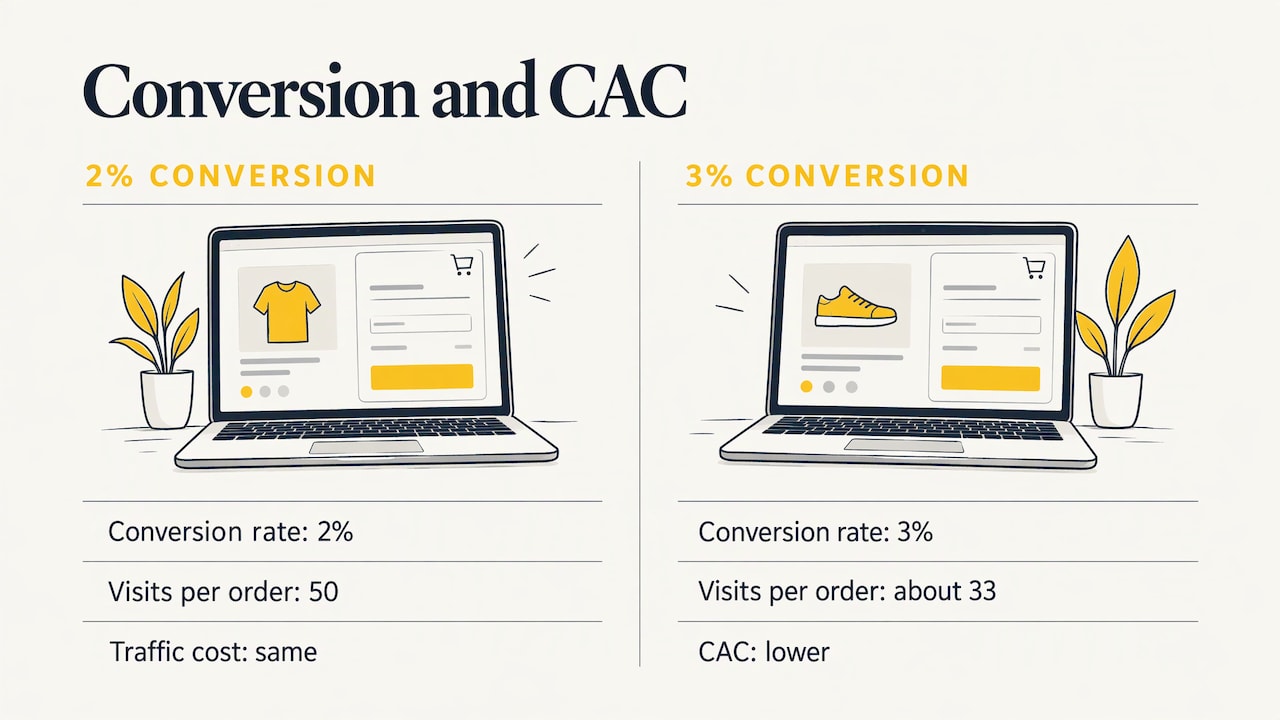
To calibrate, one widely cited benchmark puts the average ecommerce conversion rate between 2.5% and 3%. Your own number varies by category, price point and traffic mix, so benchmark against your own history first. Shopify’s guide also lists conversion rate, bounce rate, page load time and average order value as the core KPIs to watch on PDPs.
Returns and margin
Accurate, complete information builds confidence, supports comparison and prevents mistaken purchases and returns. Every avoided return protects margin, which matters because ROAS ignores what happens after checkout.
Retention and LTV
The PDP does not stop mattering after the sale. Research on a Czech e-shop published in the Journal of Marketing Analytics found that landing directly on a product detail page can predict lower customer lifetime value than landing on the home page. That does not mean you should stop sending ads to PDPs. It is a prompt to ask which customers a given entry page attracts and what you do after their first order. A buyer who arrives for one product and never sees the rest of the brand needs a deliberate follow-up through email, SMS and recommendations.
There is also evidence that returns interact with value in complicated ways. A 2025 study of a US subscription retailer found that returns had a non-monotonic relationship with CLV, and tenure moderated it. In plain terms, returns are not simply good or bad for lifetime value, so measure them by cohort rather than assuming.
Average order value
PDPs are also where you raise order size. Related products create opportunities to upsell, and personalized recommendations can increase the likelihood of buying. Bundles and cross-sells are common PDP strategies, as Taggstar’s overview of PDP elements notes.
A hypothetical example: where the money leaks
This is an illustrative scenario with invented numbers, not a client result.
Imagine a DTC skincare brand spending $50,000 a month on paid social and search. Its ads send 40,000 visits to PDPs, converting at 2%, so 800 orders. Cost per order is $62.50 before any repeat purchases.
Now suppose the team fixes the page: adds video, rewrites the description around the questions in customer support tickets, moves returns information beside the buy button, and adds an in-page bundle. If conversion rose from 2% to 2.5% on the same traffic, that would be 1,000 orders and a cost per order of $50. The ad account did not change. The page did.
The reverse also happens. A brand cuts ad spend because platform ROAS looks weak, when the real constraint is a PDP that loses people at the shipping information. Diagnose the page before you blame the channel.
How to audit your own product detail pages
Start with your highest-traffic, highest-spend PDPs, since a 10% improvement there is worth more than a 50% improvement on a page nobody visits.
- Match the ad to the page. The promise in the creative (offer, product, angle) should be visible without scrolling. If the ad shows a bundle and the page shows a single item, expect drop-off.
- Check mobile first. Most ad traffic from social platforms arrives on phones. Load the page on a mid-range device on cellular data and see what appears in the first screen.
- Read your reviews and support tickets. The questions shoppers ask repeatedly are the content gaps on your page.
- Test the information hierarchy. Title, price, variants, buy button and shipping should be findable in seconds.
- Look at the numbers by source. Segment PDP conversion rate, bounce rate and revenue per session by traffic source and device, not just the sitewide average.
- Check page speed. Slow pages punish paid traffic hardest, because you paid for each click that bounced.
- Plan the next step. Add to cart is not the end. Make sure post-purchase email and SMS flows reflect what was bought.
Enhanced content is worth testing too. Salsify’s internal data found that brands with enhanced content, such as galleries or feature tours, had 15% higher conversion on average. That is one vendor’s data, so treat it as a hypothesis to test on your own store, not a promise.
For a deeper look at testing methods, see our guides on Shopify conversion strategies and conversion rate optimization strategies. If your ad traffic lands on weak pages, how ad conversions work in ecommerce explains where the leaks usually start.
PDPs and search visibility
Product pages are also what search engines index for product queries. Clear titles, unique descriptions and structured product data help both shoppers and crawlers understand the page. If you want a practical walkthrough, this guide on how to optimize product pages for search and sales covers on-page tactics, and our own overview of SEO for ecommerce stores explains how store structure supports organic traffic. No on-page change guarantees a ranking, so measure results over time rather than expecting an overnight jump.
Structure matters beyond single pages. How your catalog, collections and templates fit together shapes both usability and scale, which we cover in ecommerce website design for scale and ROI.
Our perspective: treat the PDP as part of one growth system
Most agencies manage campaigns and stop at the click. We think that is where profit gets lost. A product detail page sits between what you pay for (traffic) and what you keep (margin and repeat customers), so it cannot be someone else’s problem.
At Rozee Digital we work through the Ecommerce Acceleration System™, which looks at acquisition, conversion and retention together. For a PDP, that means asking three questions in order. Does the ad promise match the page? Does the page give a qualified shopper what they need to buy with confidence? And once they buy, does your email and SMS program bring them back for a profitable second order?
We also believe in judging results by profit, not by one platform’s dashboard. ROAS is useful inside a channel, but MER and contribution margin tell you whether the business is actually healthier. A PDP change that lifts conversion while lifting returns is not progress, and you only see that when you look across the full journey.
Our work is led by senior strategists, and we keep our client roster deliberately small. That lets us spend time on the unglamorous details, such as which PDPs get the budget, what the page should say, and how the first order connects to the fifth.
Tom
Where Rozee Digital can help
If your paid media is working but profit per order is not improving, the gap is often between the click and the checkout, or between the first order and the second. Rozee Digital helps established Shopify, WooCommerce and Magento brands connect those stages, from paid search and paid social to conversion-focused landing pages and Klaviyo setup and optimization.
If you want a second opinion on how your ad traffic, product pages and retention flows fit together, talk to our team at Rozee Digital about where your next dollar of growth should go. For a related read first, see our piece on boosting ecommerce conversion rates while saving on CAC.
FAQ
What does PDP stand for in ecommerce?
PDP stands for product detail page. It is the page dedicated to a single product, showing its images, price, description, reviews and a way to add it to the cart. Ecommerce teams and marketplaces use the abbreviation constantly.
What is a PDP product?
A PDP product is not a separate category of goods. It is the individual product presented on a product detail page, whether that is a physical item or a service sold online. If a colleague refers to “the PDP product,” they mean the specific item that page sells.
How is a PDP different from a landing page?
A PDP is a type of landing page when ad traffic arrives on it, but it is tied to one catalog item and lives permanently in your store. A dedicated landing page is usually built for a specific campaign, offer or audience and may feature several products. Many brands test both for the same ad. Our guide to improving landing page conversion rate shows how to compare them.
What should I measure to know if a PDP is working?
Track conversion rate, bounce rate, page load time and average order value by traffic source and device. Then look past the page to returns, repeat purchase rate and LTV for customers who entered through that product. A PDP that converts well but drives returns may be costing you margin.
Does PDP mean something else outside ecommerce?
Yes. In health insurance it commonly means a Medicare prescription drug plan, and in HR it often means a professional development plan. In aviation it can refer to a planned descent point. On a store site, it always means product detail page.
Sources
- What Is PDP in Ecommerce? Product Detail Page Guide
- PDP and PLP: what they are in e-commerce
- UX Guidelines for Ecommerce Product Pages, Nielsen Norman Group
- UX Guidelines for Ecommerce Homepages, Category Pages, and Product Listing Pages, Nielsen Norman Group
- Product Details Page UX Research Studies, Baymard Institute
- What Is a PDP (Product Detail Page)? Anglera glossary
- Product Pages: A Digital Shelf Guide, Salsify
- The impact of online purchase behaviour on customer lifetime value, Journal of Marketing Analytics
- Product descriptions and perceived value study, 2022
- Product Returns and Lifetime Value in Subscription Retailing, EMAC 2025
- Product Details Page (PDP) examples and best practice, Taggstar
- Optimize product pages for higher sales and SEO