Start with a test budget, not a scale budget. New fashion brands can begin with $20–$50 per day for Meta ads, then adjust as purchase data shows what the economics support. A disciplined Facebook ads strategy for fashion brands treats that opening spend as a learning investment, not a guarantee of sales.
Budget is only one decision in a Facebook ads strategy for fashion brands. You also need to optimize for purchases, give Meta room to learn, and choose mobile-friendly formats that make each product compelling.
This guide covers four practical decisions: how to set and manage spend, how to target, which formats suit different fashion products, and how to test creative, offers, and landing pages. The aim is to prioritize purchase quality and profitable growth, not activity that merely spends.
Key Takeaways
- Set a controlled starting budget and optimize toward purchases, then use performance data to guide spend decisions.
- Build audience tests around customer fit and buying signals rather than relying on broad targeting alone.
- Test creative hooks, offers, and landing pages systematically so you can identify what helps turn interest into orders.
- Match the ad format to the shopping task, from showcasing a collection to reconnecting with product viewers.
1. Sales campaign objectives and purchase optimization
Build campaigns around completed purchases, not activity that only signals interest. Before launch, confirm that the store records orders consistently and that product, order value, and purchase events appear in Meta Ads Manager. This gives the team a basis for evaluating sales instead of treating clicks as a proxy for commercial performance.
Separate prospecting from retargeting by audience and purpose. Prospecting introduces products to potential customers who have not purchased; retargeting speaks to people who viewed products or began checkout. Keep the messages distinct: a new visitor may need a clear product introduction, while a returning shopper may need a direct path back to the item.
Set a budget the business can sustain through a meaningful testing period. Allocate spend according to each campaign’s role and the purchase data its audience can generate. If several ad sets share a goal, a campaign-level budget can shift spend between them. For more controlled comparisons, set budgets at the ad-set level and monitor delivery closely.
Assess cost per purchase, conversion rate, and return on ad spend (ROAS), which compares advertising-attributed revenue with ad spend. Compare these metrics with product margin and the customer acquisition cost the business can support. If clicks rise but orders do not, review tracking, product availability, offer clarity, and checkout before increasing spend.
Keep the campaign structure simple enough for each audience to receive useful investment and produce interpretable results. Avoid splitting limited purchase activity across too many ad sets. Test creative by changing one element, such as the opening image or product benefit, while keeping other variables steady. Review purchase outcomes before shifting budget. This ties campaign decisions to sales and provides a clearer basis for future investment.
2. What Audience Targeting Should I Use?
For US campaigns, start with the customers the brand can serve and the products it needs to sell. Use location, age, and gender only when they reflect actual buying patterns. On Facebook and Instagram, compare broad delivery with interest-based targeting, then judge both by purchase quality, not audience size alone.
Treat interest targeting as a testable hypothesis. A clothing label focused on outdoor apparel might compare relevant interests with a broader audience using the same product and offer. Keep the creative consistent so any difference is more likely to reflect the audience, not the image or message.
Use customer evidence to refine the hypothesis. Review order history, product preferences, and feedback to identify patterns worth testing. If formalwear and casual clothing attract different buyers, give each product line a distinct creative story. Don’t assume customers share the same age, style, or motivation simply because they bought from the same brand.
Base retargeting on what visitors actually did. Someone who viewed a product and left may need more information about fit, fabric, or styling. A previous customer may respond to a relevant new arrival. Keep these groups distinct from acquisition audiences when the goal is to reach new buyers, and exclude audiences that would make the comparison less meaningful.
Lookalike audiences can extend customer-based learning by finding people similar to a selected buyer group. Choose the source list carefully: prioritize customers whose purchase behavior fits the brand’s margin and retention goals, rather than using every contact indiscriminately. Assess whether new prospects become valuable customers, not just inexpensive clicks.
Keep a clear record of each audience test, its creative, and its intended customer. This makes the next decision more reliable: retain audiences that bring commercially relevant orders, revise tests that attract mismatched shoppers, and avoid shifting spend based on a short-lived signal. Targeting should sharpen customer understanding, not replace it.
3. Creative, hook, offer, and landing-page testing
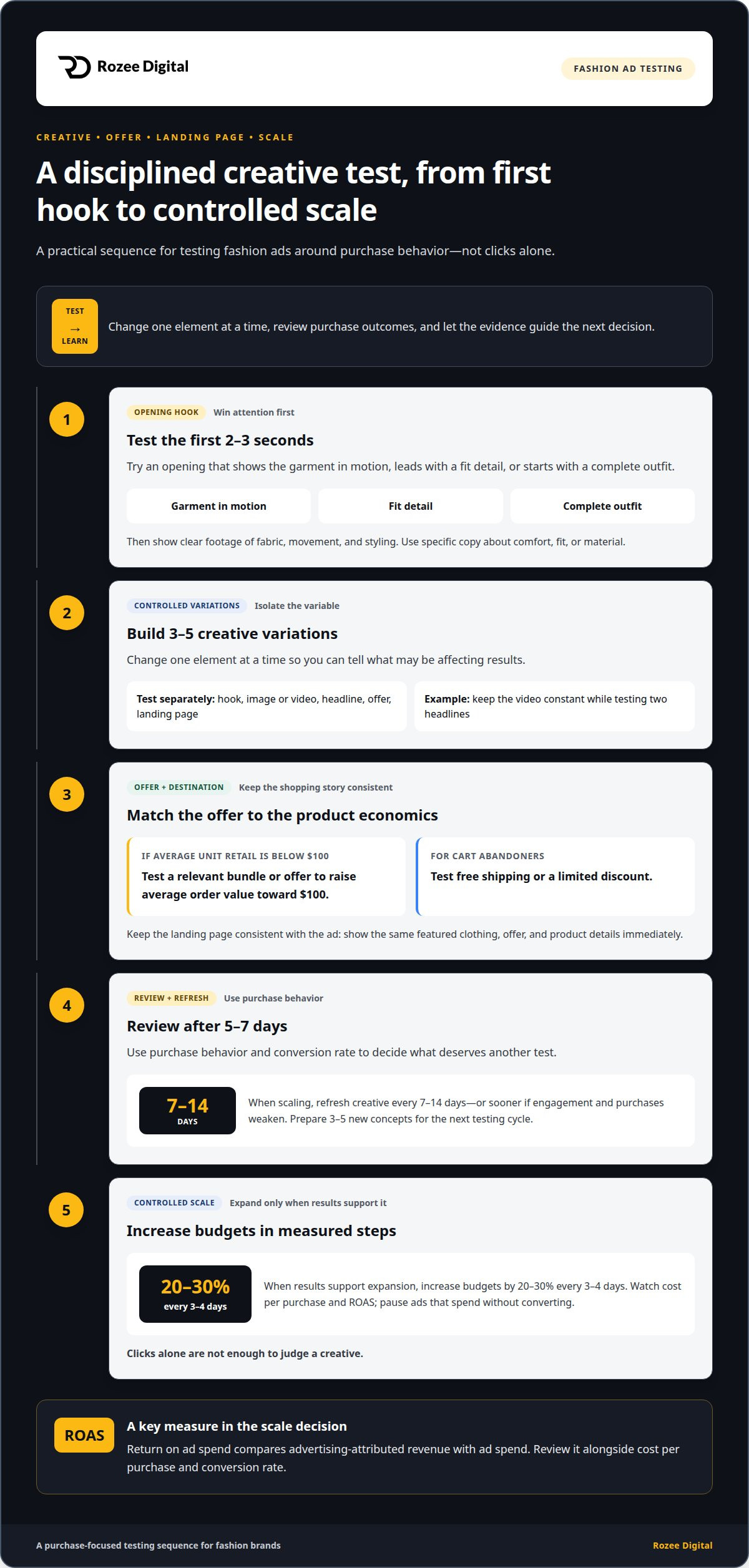
Fashion creative must earn attention before it explains the product. For video ads, test different openings in the first 2–3 seconds: show the garment in motion, lead with a fit detail, or open on a complete outfit. Then hold the audience with clear footage of fabric, movement, and styling. Use specific copy about comfort, fit, or material instead of generic claims.
Build each concept with 3–5 creative variations, changing one element at a time. Compare the hook, image or video, headline, offer, and landing page as separate variables. For example, keep the video constant while testing two headlines. Review results after 5–7 days, then use purchase behavior and conversion rate to decide what deserves another test.
Match the offer to the product economics. If average unit retail is below $100, test a relevant bundle or offer to raise average order value toward $100. For shoppers who added products to their carts but didn’t check out, test free shipping or a limited discount. Keep the landing page consistent with the ad: the same featured clothing, offer, and product details should appear immediately.
Scale with control. Increase budgets by 20–30% every 3–4 days when results support expansion, then watch cost per purchase and return on ad spend. Pause ads that spend without converting, but don’t judge a creative by clicks alone. A disciplined testing sequence helps a clothing brand optimize for purchases, preserve repeatable learnings, and build growth on evidence rather than instinct.
4. Facebook ad formats for fashion brands
Meta, TikTok, and Google can play different roles in a fashion media mix. Facebook and Instagram placements can showcase apparel and reconnect with interested shoppers. TikTok supports video-led discovery, while Google can capture shoppers actively searching for products. Compare channels by audience intent, creative fit, and purchase quality, not traffic volume alone.
Meta’s advertising policies apply to fashion campaigns, and ads must meet the platform’s current requirements. Keep product images, claims, offer details, and landing pages consistent. Review the applicable rules in Meta Ads Manager before launch.
Choose a format to suit the shopping task. Use a carousel to present a collection, multiple products, or color options in one ad. A catalog ad can display products based on website behavior, helping shoppers revisit items they viewed. Use short video when fit, fabric, or movement needs demonstration. Make the product and next action clear in every format.
For a new collection, use carousel cards to highlight distinct looks and link each card to its matching product or collection page. For a single hero item, use a strong visual and focused landing page rather than dividing attention across unrelated products. On Instagram, mobile-first framing and readable product details help the creative communicate without lengthy copy.
Match creative to intent. A prospecting video can show an outfit in motion, while a catalog ad can bring previously viewed clothing back into consideration. Compare formats using the same offer and audience, then assess purchases and cost per purchase. Favor the format that supports profitable orders, not simply the one that earns the most clicks.
Build a practical format plan by giving each campaign a clear role: discovery, collection browsing, or product follow-up. Align the landing page with the ad, then use results to decide which visual approach merits further investment. This makes format selection a commercial decision rather than an aesthetic preference.
Rozee Digital: Ecommerce ads agency
Rozee Digital takes ownership of growth for ecommerce and D2C brands through paid media strategy. Turn to the agency when your fashion advertising needs senior-level direction across audience, creative, and commercial priorities.
Its growth-accountability model connects advertising decisions to wider business performance. Rozee Digital offers ecommerce advertising, Google Ads, Facebook Ads, and PPC services for brands seeking coordinated support across these channels.
If you’re ready to discuss your advertising priorities, contact Rozee Digital.
Turn campaign learning into a growth system
Make paid social part of broader commercial planning. Connect advertising decisions to product priorities, stock availability, contribution margin, and the customer experience after purchase. That keeps marketing accountable to the business rather than isolated from it.
A durable Facebook ads strategy for fashion brands should evolve with customer behavior and product priorities. Treat each campaign cycle as an operating decision: identify what the business needs to learn, decide how results will guide the next move, and align execution across marketing and ecommerce teams. This gives leaders a clearer basis for allocating attention and investment.
When your team needs dedicated support managing fashion advertising, Rozee Digital can help bring paid media execution into focus. Contact Rozee Digital to discuss your ads and the priorities shaping your next stage of growth. Build deliberately, learn from the market, and keep moving forward.
Frequently Asked Questions
5.1 How Much Should New Fashion Brands Spend?
Set a daily budget the business can sustain while gathering enough purchase data to make decisions. First calculate the acquisition cost your margins can support, then compare that limit with actual purchases. For example, a label with thin margins should prioritize efficient order economics over faster audience testing. Increase investment only when results and stock position support it.
How Many Campaigns & What Type?
Start with one prospecting campaign, then add separate retargeting when site activity can support it. Avoid creating a campaign for every product or audience: excessive fragmentation makes results harder to interpret. For a seasonal launch, keep the main acquisition campaign focused on the collection, then use retargeting to reconnect with interested shoppers and relevant products.
What Audience Targeting Should I Use?
Use customer and product evidence to shape audience tests. If a label sells distinct lines, such as formalwear and everyday clothing, assess whether they attract different buyer behavior before separating campaigns. Surveys, purchase patterns, and product-page engagement can guide creative and audience choices. Set the US location to match where the brand can fulfill orders.
What KPIs Should I Use?
Track customer acquisition cost (CAC), the cost of acquiring a customer, alongside lifetime value (LTV), the revenue a customer generates over their relationship with the brand. Marketing efficiency ratio (MER) compares total revenue with total marketing spend. Read these alongside contribution margin and return rates: strong attributed sales can still mask weak economics if fulfillment or returns erode profit.
What Kind Of Ads Should I Run?
Choose ads that address shoppers’ decision-making needs. A static image can keep a hero product in focus; a styling video can show how an item works in an outfit. For example, show one garment styled for work and weekends, then direct viewers to its product page. Keep claims factual and the offer consistent.
What Landing Pages Work Best?
Send each ad to the page that fulfills its promise. A single-product ad should lead to that product; an ad featuring a range can direct shoppers to the relevant category. Make the advertised item easy to find, keep product details and offer terms consistent, and let shoppers move from consideration to checkout without searching the site.