A platform switch is not complete when contacts arrive. It is complete when subscriber records retain their email and SMS permission status, critical customer data stays intact, and key journeys work in Klaviyo. Omnisend to Klaviyo migration agency services should treat consent mapping as a control point, not a file-transfer detail.
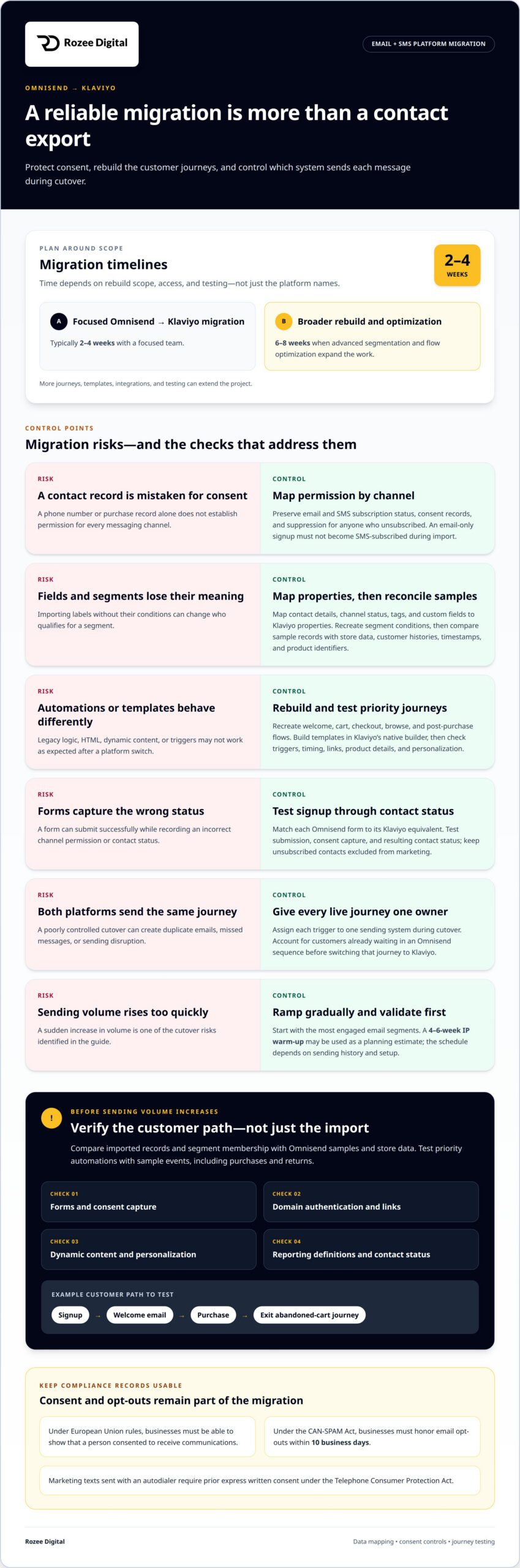
That distinction matters: a phone number or purchase record alone doesn’t establish permission for every messaging channel. A basic Omnisend-to-Klaviyo migration typically takes 2-4 weeks with a focused team; broader rebuilds take longer as segmentation, automations, and testing expand.
This guide explains what transfers and what needs rebuilding, which platform and store access is required, and how scope affects the timeline. It covers how to stage sending, preserve unsubscribed contacts as excluded from marketing, and test forms, templates, and customer journeys before increasing volume. The goal is a smooth transition, with clear ownership of each live journey and consent records that remain usable afterward.
Key Takeaways
- Plan the migration around data mapping and journey rebuilds, not a simple contact export.
- Align platform, store, and integration access early so implementation can move without avoidable delays.
- Judge performance against a pre-migration baseline; a new platform alone doesn’t prove revenue or deliverability gains.
- Use a staged cutover and clear ownership for each live journey to reduce sending conflicts and customer disruption.
Migrating contacts, workflows, segments, forms, and templates
A migration starts by mapping Omnisend fields to Klaviyo properties before importing contacts and consent records. Preserve email and SMS subscription status, including suppression for anyone who previously unsubscribed.
Contact and Segment Imports
Map contact details, channel status, tags, and custom fields to the corresponding Klaviyo properties. Recreate segments using their defining conditions, such as repeat purchasers or customers who viewed a product but haven’t bought it. This preserves the logic behind targeting instead of relying on labels alone.
Reconcile sample records against the ecommerce store, including customer histories, timestamps, product identifiers, and required custom fields. A phone number or purchase history does not establish permission for every channel. Under European Union rules, businesses must be able to show that a person consented to receive communications.
Workflow and Template Rebuilding
Recreate automation logic in Klaviyo rather than assuming it transfers intact. Prioritize welcome, cart, checkout, browse, and post-purchase journeys, then test triggers and message timing. Acceptance checks should cover purchases, returns, status changes, and missing data that could delay a flow.
Rebuild email templates in Klaviyo’s native builder instead of pasting in legacy HTML. Recreate dynamic content and check that product details, links, and personalization render correctly. This gives each template a structure designed for Klaviyo, rather than relying on code that may behave differently.
Rebuild forms with a clear purpose. Map each Omnisend signup form to its Klaviyo equivalent, then test submission, consent capture, and the resulting contact status. For example, an email-only signup must not become SMS-subscribed during import. Preserve suppression rules so unsubscribed contacts remain excluded from marketing.
Before launch, compare imported records and segment membership with Omnisend samples and source-store data. Then test each priority automation with sample events, including a purchase and a return. These checks can reveal mismatched properties, broken personalization, or a trigger that fires for the wrong customer before live messages go out.
Migration timelines and access requirements
Compare Omnisend and Klaviyo against your integration, support, add-on, and campaign requirements. Migration time depends on the rebuild scope, access, and testing, not just the platform names.
Migration Timeline Planning
A focused Omnisend-to-Klaviyo migration typically takes 2-4 weeks. A broader program with advanced segmentation and flow optimization can take 6-8 weeks. Scope expands when teams rebuild more journeys, templates, and integrations. For context, a full rebuild from scratch for Klaviyo-to-Omnisend migration can take up to 2 weeks. Direction matters: these timelines describe different projects.
Account Access Requirements
Arrange authorized access to Omnisend, Klaviyo, and the ecommerce store before work begins. For a Shopify store, integration access supports event and product data mapping. The migration also requires access to connected apps, forms, templates, and domain settings. DNS access may be needed for domain authentication. Set account permissions and name an internal approver so implementation decisions don’t stall.
Feature fit and total cost depend on your operating requirements. Compare integrations, support, add-ons, ongoing production time, temporary platform overlap, and the rebuild work each option requires. Model typical sending months and seasonal peaks, including profile growth and how sending limits work. This gives you a more useful comparison than subscription price alone.
US compliance steps include keeping opt-outs effective and consent records usable. Under the CAN-SPAM Act, businesses must honor email opt-outs within 10 business days. Marketing texts sent with an autodialer require prior express written consent under the Telephone Consumer Protection Act.
Before choosing migration support, assess the project scope, data mapping, access controls, and testing plan. Make sure the plan assigns each live trigger to one sending system during cutover. It should also account for customers already waiting in an old sequence. Clear ownership, staged milestones, and defined acceptance checks reduce operational ambiguity.
Will my deliverability drop when I switch email marketing platforms?
A poorly controlled cutover can lead to data loss, sending disruption, or duplicate emails. Common risks include unmapped contact fields, a sudden increase in sending volume, and the same journey running in both systems.
Protect deliverability by ramping up gradually, starting with your most engaged email segments. A 4-6-week IP warm-up may be used as a planning estimate, but the appropriate schedule depends on your sending history and setup. Contact count alone, including whether a brand has fewer than 100K contacts, does not determine which platform is the better choice for deliverability.
During cutover, assign each live journey to one sending system. Account for customers already waiting in an Omnisend sequence before switching that journey to Klaviyo. This reduces the risk of duplicate cart reminders or customers missing the next message.
Assess the switch against a pre-migration baseline rather than assuming Klaviyo will improve results. Compare campaign delivery, clicks, conversions, unsubscribes, and revenue using consistent reporting definitions. Review email and SMS separately because channel consent, audience segments, and customer response differ.
Before increasing sending volume, verify forms, domain authentication, dynamic content, links, and reporting definitions. Test a real customer path, such as a signup followed by a welcome email, then a purchase that should exit an abandoned-cart journey. Confirm contact status and suppression behavior for unsubscribed customers.
Keep the review window and campaign mix consistent when comparing performance. A seasonal promotion sent to highly engaged customers isn’t a clean comparison with a routine campaign sent to broader segments. Record deliverability and revenue trends through the 4-6-week warm-up, then use those observations to guide the next sending increase.
Omnisend-to-Klaviyo migration services
A sound scope for Omnisend to Klaviyo migration agency services defines decision rights, business dependencies, and post-launch ownership. Start with a stakeholder map that identifies who owns retention, ecommerce operations, customer support, and brand approvals. This matters when a change affects customer messaging, order handling, or internal reporting. One accountable decision-maker can resolve competing requirements before they delay delivery.
Document the operating rules that should carry forward, not just the software setup. For example, record how the team handles promotional exclusions, VIP treatment, and exceptions for customer service. These decisions help new and existing team members apply the same standards after transition. A concise decision log also gives leadership a record of why key choices were made, which is useful when processes change later.
Set change governance before implementation begins. Define how proposed scope changes are reviewed, who approves customer-facing copy, and where unresolved issues are tracked. A shared issue log can capture the impact, owner, and next decision for each open item. This keeps founders and marketing leaders informed without relying on informal updates across separate teams.
Close the engagement with an operational handoff. Useful deliverables include a current-state process record, ownership assignments, and a list of unresolved improvements for the internal team to prioritize. That distinction matters: migration completion marks a transfer of operating responsibility, not the end of retention strategy. Brands reviewing wider ecommerce growth priorities can connect retention planning with their commercial direction.
A cutover checklist should verify each journey’s status and identify who is responsible for pausing or activating it. If Klaviyo flows remain active when Omnisend flows go live, customers could receive duplicate cart reminders. Check flow status before customer messaging resumes as part of launch readiness.
Migration checks must preserve suppression rules. Previously unsubscribed customers should remain excluded from marketing after the move. Document this in the handoff so the internal team can maintain the exclusion after launch.
Rozee Digital
Rozee Digital helps ecommerce brands align paid acquisition with retention priorities during a platform transition. Its ecommerce advertising, Google Ads, PPC, and paid social capabilities can support a growth plan that connects campaign investment with customer value, rather than treating acquisition and email marketing as separate systems.
If your migration is prompting a wider review of acquisition strategy and measurement, contact Rozee Digital to discuss your growth priorities.
Make the Migration Part of Your Growth Plan
Choosing Omnisend to Klaviyo migration agency services is one operational decision. The wider opportunity is to connect retention with acquisition, so customer messaging and paid media support the same commercial priorities. Set clear goals for customer value and sustainable growth, rather than judging the platform change in isolation.
Rozee Digital supports ecommerce brands through its ecommerce ads agency, Google Ads Agency, and Facebook Ads Agency offerings. These capabilities can help align paid acquisition with the customer relationships your retention strategy is designed to build. The right next step is a focused conversation about your migration context and wider growth priorities.
Contact Rozee Digital about your migration to discuss how your next stage of growth can take shape. A clear plan puts your team in a stronger position to move forward with purpose.
Frequently Asked Questions
How do you move SMS subscribers and their consent?
Transfer each phone number with its SMS subscription status and associated consent record, keeping email permission separate. Preserve suppression for anyone who opted out; don’t treat a past purchase or a phone number as proof of SMS permission. For example, an email-only subscriber should remain excluded from marketing texts after import. Mapping permissions channel by channel helps prevent consent from being broadened during the move.
What does a migration cost?
Migration cost depends on the work required, not just the number of contacts. Scope can vary based on integrations, support requirements, add-ons, ongoing production time, temporary platform overlap, and flow or template rebuilds. For a useful budget comparison, separate one-time transition work from recurring platform and operating costs. Model expected sending needs for typical trading periods and seasonal peaks.
Will switching improve revenue or deliverability?
A platform switch alone does not establish that revenue or deliverability will improve. Results depend on factors such as audience quality, message relevance, customer demand, and execution after launch. Compare similar customer groups and campaign types, accounting for changes in promotions, seasonality, and sending volume. Evaluate migration as an operational change, not as proof that marketing performance has increased.
How much does an Omnisend to Klaviyo migration agency charge?
Agency pricing depends on project scope and is provided after a quote request. An estimate may account for data mapping, integrations, automation and template rebuilds, testing requirements, and coordination during platform overlap. A limited transfer requires different work from a program that restructures segmentation and customer journeys. Define the deliverables so you can assess the proposal against your migration needs.
How long does an Omnisend to Klaviyo migration take?
The timeline depends on how much needs rebuilding and how quickly access, decisions, and testing can be coordinated. A focused transfer differs from a broader program involving advanced segmentation, customized journeys, and extensive validation. Seasonal campaign schedules can also affect the cutover window. Set milestones for data mapping, implementation, testing, and launch, then align them with the team responsible for approving changes.
Which agencies offer Omnisend to Klaviyo migration services?
Rozee Digital.