Set a monthly TikTok budget by deciding how much you can allocate per active day, then compare spend with that plan. Effective tiktok ads budget monitoring and pacing strategies help separate normal delivery fluctuations from patterns that need attention.
Spend can fluctuate during a campaign, so a live dashboard figure alone may not show whether pacing is off track. Compare completed-day results with planned spend and conversion performance before adjusting budgets.
This guide covers how to plan TikTok ad spend, identify pacing issues, review full-day results, and refresh creative with a clear purpose. The goal is to make disciplined decisions based on commercial performance, rather than reacting to temporary fluctuations.
Key Takeaways
- Build the monthly plan from your intended daily spend and active campaign days, then choose daily or lifetime budgets based on how closely you need to control delivery.
- Separate genuine overspending from learning-phase fluctuations, overnight delivery, and planned promotions before changing a campaign budget.
- Judge pacing against completed-day spend and the cumulative plan, not a live intraday snapshot that can distort performance.
- Prepare distinct creative variations before launch and use performance signals to decide when a refresh can improve budget efficiency.
1. How Much Should You Budget for TikTok Ads Per Month?
Start with planned daily spend multiplied by active days. A daily target of $50 across 30 active days produces an illustrative monthly budget of $1,500. According to TikTok’s 2026 budget guidance, web conversion campaigns in North America have a minimum of $50 per day at campaign level and $20 per day per ad group.
Daily budgets set an average daily allocation, but delivery can run ahead within the day. For example, a $200 daily budget may spend $120 by noon, using 60% before the day ends. That leaves 40% of the daily allocation, but the midday figure alone does not establish overspending. Lifetime budgets set a total for a defined period and may not distribute spend evenly across days.
Keep budget levels aligned: TikTok advises setting the campaign budget no lower than the ad group budget. Once a campaign or ad group is live, TikTok Ads Manager lets you update its daily or lifetime amount, but not switch between budget types. An account-level spending cap is separate from campaign allocations, so factor in both when setting the monthly target.
Campaign budget optimization (CBO) distributes campaign spend across ad groups instead of assigning each group a fixed share. Delivery may shift toward groups with stronger opportunities, so track campaign totals and each group’s results against its target. CBO changes allocation, not the overall budget ceiling.
Use a daily review to compare impressions, reach, clicks, and click-through rate (CTR) with spend. Set an alert when planned daily spend deviates by more than 20%, and check campaign spend at least twice daily during the first week. An automated alert flags variance; it should prompt diagnosis, not an automatic budget cut.
Compare delivery over completed periods, and adjust budgets only when a trend persists. TikTok refreshes daily budgets at midnight in the account’s timezone, while lifetime budgets keep a total limit for the full period. This distinction matters when planning across platforms: a daily cap resets, but a lifetime allocation does not.
2. Still Losing Ad Budget Because Pacing Is Broken?
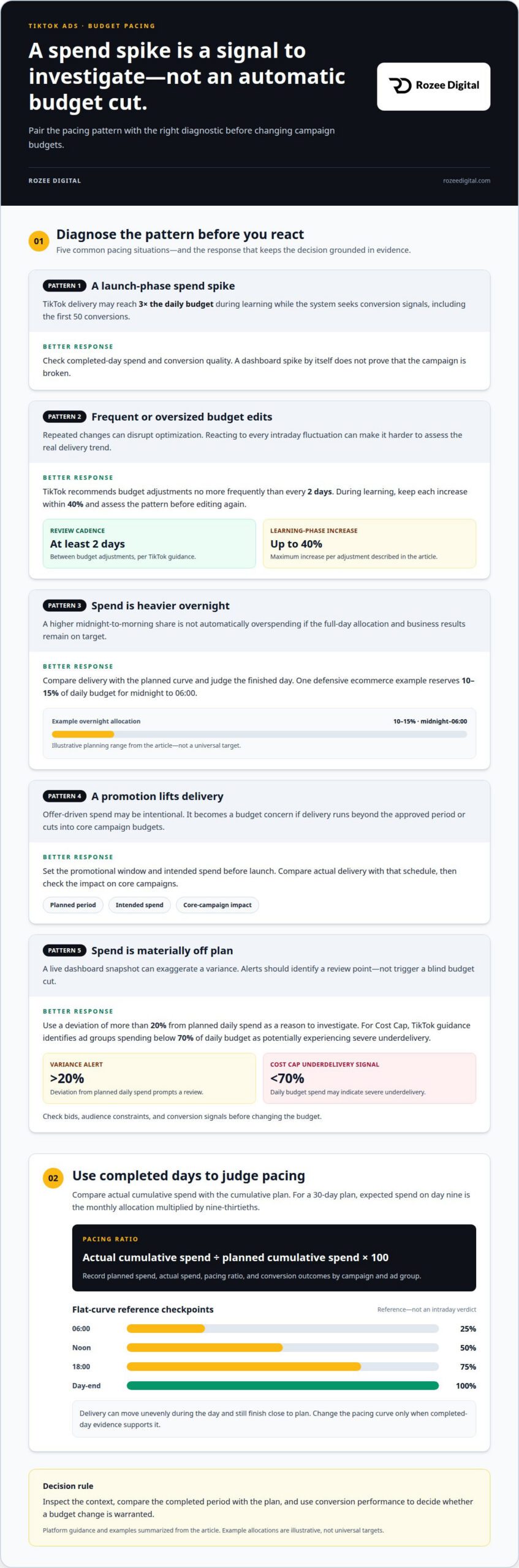
A dashboard can show a sharp spend spike during TikTok’s learning phase without proving the campaign is broken. TikTok’s platform guidance says delivery may reach three times the daily budget during this phase as its system seeks conversion signals, including the first 50 conversions. Judge the figure alongside completed-day results and conversion quality, not spend alone.
At launch, avoid reacting to every fluctuation. TikTok recommends making budget adjustments no more frequently than every two days, with increases during learning kept within 40% per adjustment. Large, rapid changes can disrupt optimization. If delivery is clearly misallocated, correct it deliberately; otherwise, preserve a stable daily budget long enough to assess the pattern.
Night hours need their own pacing context. A defensive ecommerce example allocates 10-15% of daily budget from midnight to 06:00, then weighs later delivery against the planned curve. A campaign spending more overnight is not automatically overspending if the full-day allocation and business results remain on target.
Promotions need a planned exception, too. Set the promotional period and intended spend before launch, then compare actual delivery with the schedule. Don’t mistake an intentional offer-driven increase for a pacing problem. Investigate if it pushes spend beyond the approved period or cuts into the budget for core campaigns.
Meta’s learning-phase guidance says ad sets generally need close to 50 optimization events in a rolling seven-day window to exit learning. Meta also advises keeping a single budget change under roughly 20% to reduce the risk of resetting that phase. Don’t transfer this threshold directly to TikTok; assess each platform’s delivery separately.
Use alerts to surface material variance, not to make blind cuts. A 20% deviation from planned daily spend can trigger a review, while TikTok guidance identifies ad groups spending below 70% of daily budget under Cost Cap as potentially experiencing severe underdelivery. Check bids, audience constraints, and conversion signals before changing the budget. A structured TikTok pacing review can help teams diagnose persistent delivery gaps.
3. Monitoring completed-day spend instead of intraday pacing
Use completed-day data to assess TikTok delivery. Compare actual cumulative spend with planned cumulative spend: divide actual spend by planned spend, then multiply by 100. For a 30-day plan, day-nine expected spend equals the monthly allocation multiplied by nine-thirtieths. This ratio shows whether campaigns are genuinely ahead or behind plan.
A flat curve spreads delivery across the day. It allocates about 25% by 06:00, 50% by noon, and 75% by 18:00, reaching 100% by day-end. Treat those checkpoints as a reference curve, not an intraday verdict. An ad group may move unevenly and still finish close to its daily plan.
Ecommerce demand can justify a different planned curve. A defensive example allocates 30-40% from 06:00 to 12:00, then 60-70% from 12:00 to 18:00. Use that structure when later shopping activity matters more, and compare the finished day with actual sales patterns. Change the curve only when completed-day evidence supports it.
TikTok campaigns can spend 60% of their weekly budget in their first two days. Auction conditions, audience availability, schedules, and optimization signals can accelerate or slow delivery against a set budget. Early velocity is a warning to inspect, not proof of waste; compare spend with the campaign’s full-period plan and conversion results. Effective TikTok ads budget monitoring and pacing strategies separate a temporary spike from a persistent trend.
At each review, record planned spend, actual spend, the pacing ratio, and conversion outcomes by campaign and ad group. An agency can use the same view across TikTok and Google while keeping platform-level results distinct. Escalate when projections show the budget running out more than three days before month-end. These TikTok ads budget monitoring and pacing strategies give the team time to adjust allocation before the rest of the period is affected.
4. Creative refresh and budget efficiency
Refresh creative to address a diagnosed performance issue, not simply because a calendar date has arrived. Before launch, prepare at least five distinct TikTok creative variations. Give each a clear hypothesis, such as a different opening hook, product demonstration, or offer framing. Then compare results against the same conversion target.
Review performance by creative and audience, not just by campaign totals. Track spend alongside impressions, clicks, and conversions to see whether an ad attracts attention but fails to prompt action. If a variation spends without meaningful conversion signals, investigate its message and audience fit before shifting budget. Weak results may reflect the creative, targeting, or delivery conditions.
Use a consistent format to test a specific idea. TikTok’s creative guidance includes a 9:16 vertical aspect ratio and 9-15-second in-feed ads. A practical structure places the hook in the first 0-3 seconds, then presents the value proposition from 3-10 seconds. Keep the product and offer clear enough to judge which element moves the audience toward conversion.
Manual changes should follow evidence, not every short-term swing. During the learning phase, avoid disrupting delivery with repeated edits; after an ad group exits learning, limit budget increases to no more than 30% per adjustment. Refreshing creative and changing budgets at the same time makes it harder to identify what caused a performance shift. Isolate changes where possible, then monitor the next completed-day results.
Build a refresh decision around the actual objective: maintain profitable conversions, not simply new versions. Compare each creative’s conversion efficiency with the business’s allowable acquisition cost and broader return targets. If performance weakens, test a new angle while preserving the stronger version long enough for a fair comparison. Review your TikTok creative and budget plan when testing and spend decisions need tighter coordination.
Rozee Digital: Ecommerce ads agency
Rozee Digital helps ecommerce and DTC brands manage paid media, including TikTok advertising. Turn to its support when campaign budgets, creative testing, and performance reviews need to work as one operating system, not separate tasks.
Budget decisions should look beyond platform spend. Compare TikTok conversions and return on ad spend (ROAS) with customer acquisition cost (CAC), lifetime value (LTV), and marketing efficiency ratio (MER), which compares total revenue with total marketing spend. These measures help connect campaign pacing to wider business performance.
Rozee Digital’s ecommerce advertising work can help bring that analysis into paid media management. Contact Rozee Digital to discuss how its approach could fit your growth priorities.
Make Your Next Budget Decision More Deliberate
Make pacing an operating discipline, not a recurring fire drill. Use each review to decide what merits more investment, what needs a creative test, and what should stay unchanged. The strongest TikTok ads budget monitoring and pacing strategies connect campaign-level decisions to commercial priorities, so platform activity supports the broader growth plan.
When you need support coordinating these decisions, Rozee Digital brings together ecommerce advertising across Google, Meta, Pinterest, and TikTok, alongside creative, landing pages, and retention. This broader growth approach helps teams assess how channel choices fit together without treating each platform as an isolated budget.
Bring your current objectives, campaign structure, and performance questions into the next conversation. Contact Rozee Digital about TikTok ads to discuss your account and priorities. Build the next decision on clear commercial intent, then move forward with greater control.
Frequently Asked Questions
Still Losing Ad Budget Because Pacing Is Broken?
Not necessarily. A pacing issue is more likely when completed-day spend repeatedly misses the plan or delivery fails to produce useful conversion signals. If an ad group is more than 40% under target by the end of day two, investigate audience overlap, creative fatigue, and bid caps before changing its budget. That diagnosis helps separate a delivery constraint from ordinary variation.
Cost Cap vs Maximum Delivery: Which TikTok Bidding Strategy Should You Use?
Use Maximum Delivery when you need an initial conversion baseline; consider Cost Cap when you have observed CPA data and want to guide acquisition costs. A practical test is to gather the first 50 conversions with Maximum Delivery, then set Cost Cap initially 10-20% above observed CPA. If Cost Cap delivery stays weak, review the target against actual results before treating budget as the cause.
How Much Should You Budget for TikTok Ads Per Month?
Build a monthly test budget from the conversion volume you want and the CPA assumption you can support. For example, 50 desired results at an assumed $30 CPA imply an illustrative $1,500 test spend. Treat that as a planning scenario, not a performance forecast. Check that the total fits your active campaign period and business economics before launch.
What are TikTok Ads Manager minimum daily and lifetime budgets in the United States?
For 2026 web conversion campaigns in North America, TikTok’s minimum is $50 per day at campaign level and $20 per day per ad group. A campaign lifetime budget must exceed $50.
How do you calculate a daily pacing target for a TikTok ads campaign?
Divide the budget assigned to the campaign period by its planned active days to set an average daily target. For a mid-period check, calculate planned-to-date spend using elapsed active days, then compare actual spend with that amount. Use completed days for the comparison, and account for scheduled pauses so inactive days don’t distort the target.
What TikTok ad delivery metrics indicate underdelivery or overspending?
Compare spend with impressions, reach, clicks, click-through rate, and conversions. Low spend alongside weak impressions can point to limited delivery; healthy clicks with few conversions may signal a post-click or offer issue. If an ad group is more than 40% under target by the end of day two, inspect its audience, creative, and bid settings before adjusting its allocation.