Online store growth comes from three levers pulled in the right order: acquiring customers at a cost you can afford, converting more of the traffic you already pay for, and getting buyers to purchase again. Brands that chase only the first lever see revenue climb while margin shrinks. This guide shows how the three fit together, which metrics tell you whether growth is profitable, and where to start if you want to increase online store sales without burning cash.
It is written for founders and marketing leaders at established ecommerce and DTC brands that already spend on paid media.
TL;DR
- Sustainable growth is profitable revenue growth. Shopify’s growth guide ties it to conversion, repeat purchase rate, average order value and operational efficiency.
- Rising acquisition costs are the main squeeze. Shopify reports that customer acquisition costs grew 40% from 2023 to 2025, so paid media alone is a weaker growth engine than it was.
- Fix conversion before you scale spend, then build retention so later orders carry little extra acquisition cost.
- Track MER, CAC, LTV and contribution margin together, not ROAS alone.
- Prioritize with an audit: find the biggest funnel leak, test against it, and repeat.
Table of Contents
- What online store growth actually means
- The metrics, defined
- Why acquisition alone stops working
- Step 1: Audit the funnel before you add budget
- Step 2: Acquire customers with a profit ceiling
- Step 3: Make retention the profit engine
- Step 4: Raise order value
- How to prioritize what to do first
- Our perspective
- Work with a team that covers the whole funnel
- FAQ
- Sources
What online store growth actually means
Revenue growth and profitable growth are different things. A store can double sales and lose money on every new customer. Shopify’s Ecommerce Growth Guide defines sustainable growth as profitable revenue growth that combines conversion, repeat purchase rate, average order value, market expansion and operational efficiency.
That definition points to four ways to grow, which Hostinger’s sales guide also lists:
- Get more customers.
- Increase order value.
- Encourage repeat purchases.
- Improve conversion rate.
Most brands over-invest in the first and under-invest in the other three. The first is the most expensive and the least controllable, because ad auctions are shared with every competitor. The other three work on customers and traffic you already have.
The metrics, defined
You cannot manage what you measure inconsistently. These are the numbers we put on one page before touching a campaign.
| Metric | What it means | Simple formula |
|---|---|---|
| ROAS (return on ad spend) | Revenue the platform attributes to an ad channel per dollar spent on it | Attributed revenue ÷ ad spend |
| MER (marketing efficiency ratio) | Total revenue per dollar of total marketing spend, across all channels | Total revenue ÷ total marketing spend |
| CAC (customer acquisition cost) | What it costs to win one new customer | Marketing spend ÷ new customers |
| AOV (average order value) | Average revenue per order | Revenue ÷ orders |
| Conversion rate | Share of visitors who buy | Orders ÷ visitors × 100 |
| Repeat purchase rate | Share of customers who order more than once | Customers with more than one order ÷ total customers × 100 |
| LTV (lifetime value) | What a customer is worth over the relationship | Average purchase value × purchase frequency × customer lifespan |
Two cautions make these numbers useful rather than decorative.
First, ROAS is a platform-level view. It says nothing about margin, and platforms often claim credit for the same sale. MER looks at the whole business and is harder to game. Shopify’s PPC guide maps awareness campaigns to reach and MER, acquisition to CAC, conversion rate and ROAS, and loyalty to LTV:CAC, repeat purchase rate, AOV and referrals. Each stage gets its own yardstick.
Second, use profit-based LTV. Twilio’s guide gives a profit version that multiplies lifetime value by profit margin. A customer worth $300 in revenue at a thin margin may be worth far less than the number suggests. Revenue LTV flatters your acquisition spend.
For deeper definitions, see our guides to the customer acquisition cost formula and CAC metrics for ecommerce.
Why acquisition alone stops working
The core problem is payback. Shopify’s growth guide illustrates it: with a $50 CAC, a $25 AOV and a 50% gross margin, a customer becomes profitable only after the fourth purchase. If most customers buy once, that business loses money on every acquisition.
Here is a hypothetical example, with made-up numbers for illustration only:
- AOV: $60
- Cost of goods sold: $24
- CAC: $45
- Profit on the first order: $60 − $24 − $45 = −$9
The store loses $9 on the first order. If the customer buys a second time, with no new acquisition cost, that order contributes $36. One repeat purchase takes the customer from −$9 to +$27. Klaviyo’s guide makes the same point: its one-order profit formula is AOV minus COGS minus CAC, and it warns that repeat buying must be counted, because later purchases often carry little additional acquisition cost.
This is why a brand with strong retention can bid more aggressively than a competitor with the same product. It earns more per customer, so it can afford a higher CAC and win more auctions.
If you want to see where your own numbers sit, our posts on average customer acquisition cost and CAC benchmarks are good starting points. Benchmarks are context, not targets: your margin structure decides what a good CAC is for you.
Step 1: Audit the funnel before you add budget
The cheapest growth is the traffic you already paid for. Shopify recommends that conversion optimization starts with a CRO audit followed by tests aimed at identified funnel friction. That order matters. Testing random button colors is not an audit.
A practical audit covers:
- Where visitors drop off. Split the funnel into sessions, product views, add-to-cart, checkout started and purchase. The biggest percentage drop is your first test target.
- Device differences. If mobile converts far below desktop, the problem is usually page speed, layout or checkout forms.
- Traffic source quality. A channel with cheap clicks and weak conversion may cost more per order than a pricier one.
- Product page clarity. Can a first-time visitor see what it is, who it is for, what it costs to ship and how returns work, without scrolling hunting?
Reduce checkout friction
Shopify’s sales-strategy guide reports a global ecommerce conversion rate of 2.72%, citing Mastercard research, and says seven in ten online carts are abandoned before purchase. Your own rate will differ by category and price point, so treat that figure as context.
Stripe’s conversion optimization guide recommends these checkout fixes:
- Offer guest checkout.
- Cut form fields.
- Use one-page or one-click checkout.
- Set a free-shipping threshold.
- Send abandoned cart emails and SMS, which Stripe says can recover 5–15% of abandoned carts.
Keep pages fast
Speed is a conversion issue. The same Stripe guide points to Google’s web.dev thresholds: largest contentful paint under 2.5 seconds, cumulative layout shift under 0.1 and interaction to next paint under 200 milliseconds. Heavy apps, uncompressed images and third-party scripts are the usual culprits on Shopify, WooCommerce and Magento stores alike.
Build landing pages for the ad, not the homepage
Paid traffic converts best when the page continues the promise the ad made. Sending cold social traffic to a generic collection page wastes the click. A landing page built around one offer, one audience and one next step usually beats a homepage for paid campaigns, and it gives you a clean place to run tests.
Step 2: Acquire customers with a profit ceiling
Once the funnel is not leaking, paid media can scale. The discipline is to set the economics first. Shopify’s PPC guide says campaign objectives should determine product selection, acceptable margin thresholds and evaluation metrics, rather than the other way around.
Set a CAC ceiling from your margin
Work backward from contribution margin. If a first order barely breaks even, you need the repeat rate to carry profit, and you should say so in the plan. Decide in advance:
- The maximum CAC you can pay on a first order.
- The payback window you can fund from cash flow.
- The blended MER below which you pull back spend.
Our profit-first guide to ecommerce customer acquisition walks through this thinking in more detail.
Match channel to job
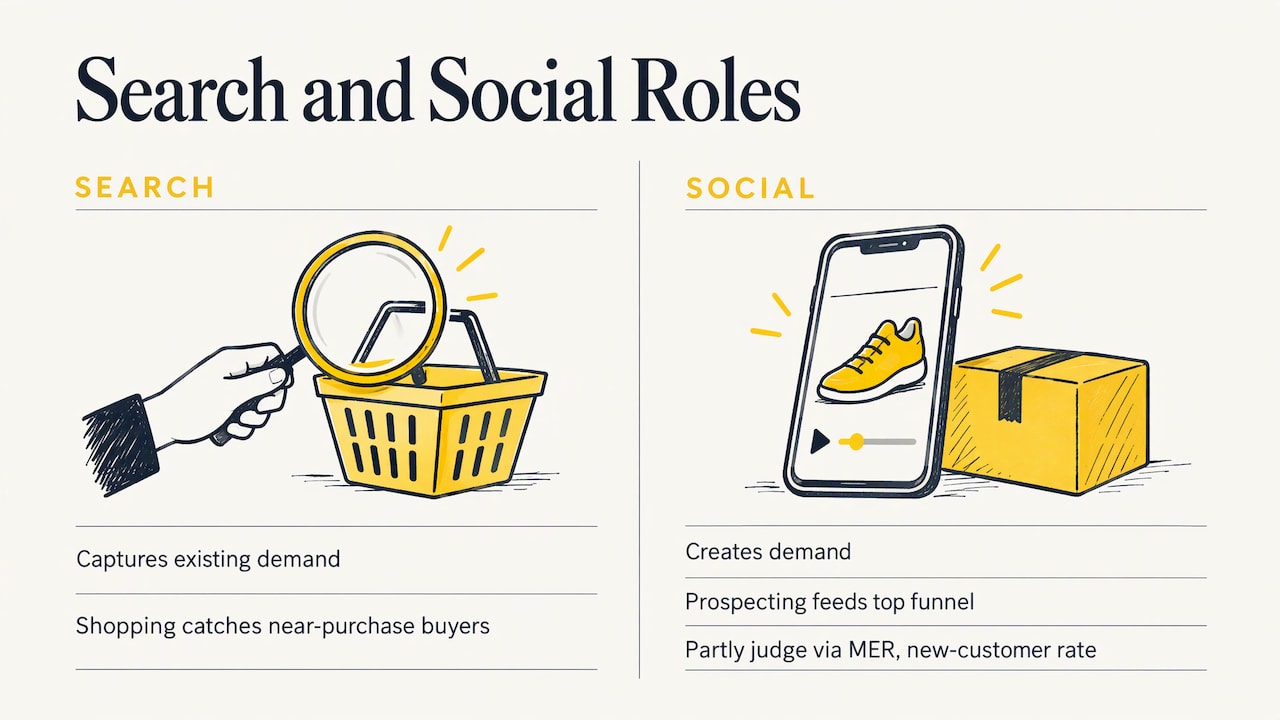
Search captures existing demand: people typing what they want. Social creates demand and reaches people who did not know they needed the product. They need different creative, different metrics and different patience. If you run both, judge social partly through MER and new-customer rate, not only last-click ROAS.
Creative is the biggest lever you control inside the ad platforms. A steady supply of new static and video concepts, tested against clear hypotheses, keeps CAC from drifting upward as audiences tire.
On the search side, Google Shopping and brand-protection campaigns tend to catch buyers close to purchase, while prospecting on social feeds the top of the funnel. Our pages on paid search services and paid social campaign management explain how we approach each.
Do not scale on a single number
A ROAS that looks strong in one platform can sit beside a MER that is flat. Before raising budgets, check that total revenue and new-customer counts rose, not just attributed revenue. Raise spend in steps, and watch CAC and MER for a full purchase cycle before the next step.
Step 3: Make retention the profit engine
Retention is where margin is made. Shopify’s strategy guide cites Gorgias data showing repeat customers generated 44% of revenue and 46% of orders while representing 21% of the customer base. The same sales-strategy guide reports that Gorgias data associates a 20% increase in repeat-customer rate with 6% additional revenue, and that Attentive’s 2026 loyalty study found shoppers subscribed to email, SMS and push were twice as likely to buy again.
Email and SMS
Owned channels cost far less per message than paid ads. Search Engine Land’s ecommerce guide cites a Digital Commerce 360 study in which 61% of retailers say email is their most profitable marketing channel. The core flows are welcome, browse and cart abandonment, post-purchase, replenishment and win-back. Segmenting by spend and timing reorders to the product’s natural use cycle matter more than blasting a bigger list.
The post-purchase experience
Retention does not start with a discount email. It starts with delivery. Klaviyo’s post-purchase guide recommends early and frequent order updates, self-service tracking and returns, and predictive reorder timing. It treats delivery communication and support as revenue levers, because trust and low friction influence repeat buying.
Loyalty that customers want
Australia Post’s loyalty guide reports that in loyalty programs, 70% of shoppers want free shipping, 58% want discounts or cashback and 56% want free gifts or samples. The survey is Australian, so test the offer with your own audience, but it suggests rewards that feel tangible beat abstract points.
To see how our Klaviyo work is organized, read about Klaviyo setup and optimization.
Step 4: Raise order value
AOV is the quickest way to improve payback, because it spreads CAC over more gross profit. Common levers:
- Bundles that make sense together, priced so the bundle margin is still healthy.
- Free-shipping thresholds set slightly above your current AOV.
- Post-purchase and in-cart offers for complementary products.
- Volume or subscription options for consumables.
Change one lever at a time and measure contribution margin, not just AOV. A discount that lifts AOV 10% but cuts margin 15% is a net loss.
How to prioritize what to do first
The research on growth tactics is broad. Adobe’s guide, for instance, lists audience research, personalization, email, content, mobile optimization, social commerce, retention, international selling and CRO, among others. Nobody can do it all at once. Shopify’s sales-strategy guide names goal-setting, audience research, multichannel management, CRO, retention and measurement as the core components. A simple order of operations:
- Measure. Build one dashboard with MER, CAC, conversion rate, AOV, repeat rate and contribution margin.
- Find the biggest leak. Use the funnel audit to rank problems by revenue impact.
- Fix and test. Run focused tests on the top leak. Document each result, win or lose.
- Scale acquisition. Raise spend only where new-customer CAC sits under your ceiling.
- Lock in retention. Build the flows and post-purchase experience that make later orders cheap.
- Repeat quarterly. The bottleneck moves as you improve.
A store with weak conversion should not buy more traffic. A store with strong conversion and a high CAC probably needs better creative and tighter targeting. A store with healthy CAC and low repeat rate needs retention work. The audit tells you which one you are.
Our perspective
Most growth conversations start with ad spend. We think that is the wrong starting point for an established brand.
At Rozee Digital we work through what we call the Ecommerce Acceleration System™, which treats acquisition, conversion and retention as one profit-focused system rather than three separate campaigns. A paid media team that never looks at the landing page, or an email team that never sees ad data, leaves money between the gaps.
We also keep our client roster deliberately small and put senior strategists on the work, because the decisions that move profit, such as where to cap CAC or which funnel leak to fix first, are judgment calls that benefit from experience. Our aim is for growth to come without sacrificing margin.
If your CAC is climbing and your retention numbers are an afterthought, start there. That is usually where the next dollar of profit is hiding.
Tom
Work with a team that covers the whole funnel
If you are an established Shopify, WooCommerce or Magento brand and want senior support across paid media, conversion and retention, Rozee Digital can help. Our services include Google Ads, Meta Ads, Pinterest Ads, TikTok Ads, static and video ad creative, conversion-focused landing pages, and email and SMS aimed at lifetime value and profit.
If the starting point is your acquisition engine, look at our customer generation services, or see the full list of services on the Rozee Digital homepage and tell us where your numbers are today.
FAQ
What is the fastest way to increase online store sales?
For most stores it is improving conversion on the traffic you already have: simplify checkout, speed up pages and recover abandoned carts. Stripe’s guide says abandoned cart email and SMS can recover 5–15% of abandoned carts. Gains here carry no extra ad cost, so they improve profit as well as revenue.
Should I scale ad spend or fix conversion first?
Fix conversion first when you see a clear leak, because every dollar of traffic you buy inherits that leak. Once the funnel performs, scale in steps and watch MER and new-customer CAC, not only platform ROAS.
What is a good CAC for an ecommerce brand?
It depends on your margin and repeat rate. A useful ceiling is the amount you can pay and still reach payback within a window your cash flow supports. Use contribution margin and LTV:CAC as your guides, and treat published averages as context only.
How do I calculate customer lifetime value?
The basic formula multiplies average purchase value by purchase frequency by customer lifespan. Twilio’s guide adds a profit version that multiplies that result by profit margin. Use the profit version when deciding how much to spend on acquisition, and keep time periods consistent across every input.
When does it make sense to hire an ecommerce growth agency?
It makes sense when you already spend meaningfully on paid media and your CAC is rising or retention is stalling. At that point the work spans ads, creative, landing pages and lifecycle messaging, and one team that sees all of it can make better trade-offs than several siloed ones.
Sources
- Shopify: Ecommerce Growth Guide
- Shopify: How To Build an Ecommerce Strategy
- Shopify: Ecommerce PPC strategies
- Shopify: Ecommerce Sales Strategy
- Klaviyo: Customer Acquisition Formulas and Strategies
- Klaviyo: Omnichannel post-purchase experiences
- Stripe: Ecommerce conversion rate optimization
- Twilio: Customer lifetime value
- Australia Post: Customer loyalty plan
- Search Engine Land: Ecommerce marketing strategies
- Hostinger: How to increase sales online