Strong advertising doesn’t start with an image or headline. Advertising creative brings together visuals, video, copy, animation, or interactive elements to promote a product or service. Its purpose is to make the message relevant and give the audience a clear reason to act.
More assets don’t automatically make advertising stronger. Each creative should reflect a business objective, customer insight, and the platform where people will see it. This article explains how research informs messaging, how strategy connects ads to commercial goals, and how to choose formats for different placements. You’ll learn to assess whether creative does more than attract attention: whether it gives the right audience a compelling reason to act.
Key Takeaways
- Use customer insights and business objectives to shape messages that fit the audience, rather than relying on assumptions about what will catch attention.
- Treat AI-generated variations as options to assess against a clear strategy, not as a substitute for audience understanding or creative judgment.
- Adapt each asset’s format, message, and visual presentation to the platform and placement where people will see it.
- Connect creative decisions to the campaign’s commercial purpose so every asset has a clear role beyond attracting attention.
Aligning messages with audience research
Audience research connects customer needs with a campaign’s business objective. Effective advertising creative gives a defined audience a relevant reason to act.
A buyer persona is a working profile built from customer insights, not assumptions. Use purchase patterns, feedback, product questions, and support conversations to identify what buyers value. For example, skincare customers who ask about ingredients may need clear product information before a discount message. That insight gives advertising creative a specific job: address the concern that could delay a purchase. Partners who understand customer relationships can help distinguish recurring evidence from isolated comments.
Capturing Audience Attention
Capturing attention means presenting a relevant idea the intended audience can recognize quickly. A distinctive product detail, concise benefit, or familiar customer problem can help an ad stand out in a busy feed. Attention matters because a message cannot influence consideration if people pass it by. For example, a running shoe ad can lead with a feature runners value, then connect it to a reason to shop.
Creative for Diverse Audiences
Creative for diverse audiences adapts its presentation to differences in preferences and context. Younger audiences may respond better to playful, humorous creative, while older audiences may prefer straightforward, informative creative. Treat these patterns as starting points, not rules for individuals. Test different tones against customer response, and avoid stereotypes. A brand can preserve one core promise while varying examples, imagery, and language for distinct audience segments.
Effective Advertising Creative
Effective advertising creative connects audience relevance, a clear message, and the campaign’s objective. It explains why the offer matters and gives the target audience a coherent next step. For example, a prospecting ad can introduce a product benefit, while a retargeting ad addresses a purchase concern. If engagement weakens, compare responses across messages before changing targeting. This helps identify whether the issue is execution, audience fit, or messaging.
AI-generated ads and creative variations
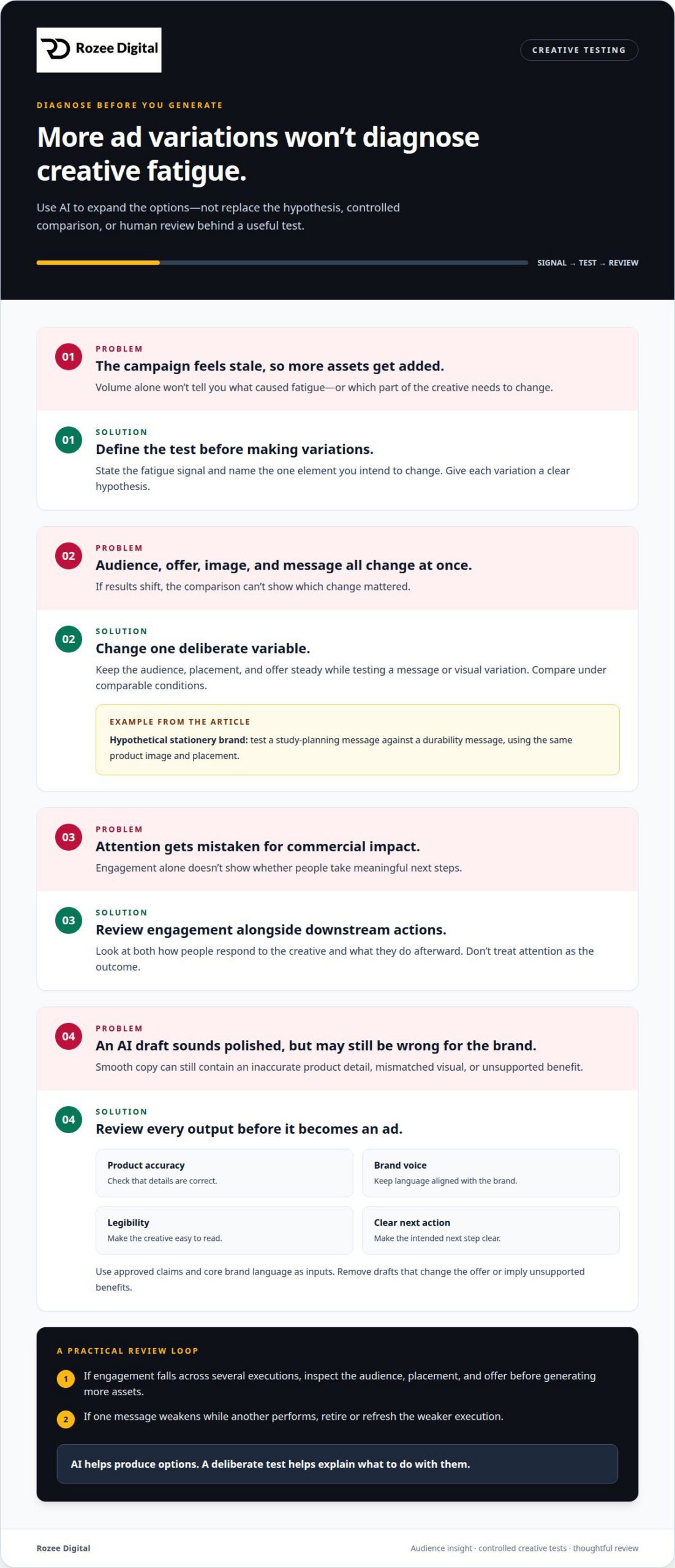
AI can accelerate creative production by drafting copy, adapting headlines, and generating visual concepts. It expands the options available to test, but volume alone won’t diagnose fatigue. A brand still needs a clear hypothesis for each variation. For example, a retailer might test a benefit-led headline against a product-feature headline while keeping the image and audience consistent.
That separation matters. If a campaign changes its audience, offer, image, and message together, performance shifts won’t reveal which change mattered. Build variations around one deliberate difference, then compare engagement and conversion behavior under comparable conditions. A hypothetical stationery brand targeting college students could test a study-planning message against a durability message, using the same product image and placement.
Use AI as a production assistant, not the decision-maker. Review each output for product accuracy, brand voice, legibility, and a clear next action. An inaccurate product detail or mismatched visual can undermine trust, even if the copy reads smoothly. Keep approved claims and core brand language available as inputs, and remove drafts that change the offer or imply unsupported benefits.
- Define the test: State the fatigue signal and the element the campaign will change.
- Control the comparison: Hold the audience, placement, and offer steady while testing a message or visual variation.
- Assess outcomes: Review engagement alongside downstream actions, so attention isn’t mistaken for commercial impact.
AI-generated variations can help teams iterate faster, but they don’t make every version useful. If engagement falls across several executions, inspect the audience, placement, and offer before generating more assets. If one message weakens while another performs, retire or refresh the weaker execution. This disciplined review makes creative production a way to investigate fatigue, not simply add more assets to the queue.
Ad formats and platform-specific sizes
The main formats include static images, video, animation, text ads, and interactive ads. Select a format based on the placement, message, and action the campaign needs to promote.
Each format offers a different way to present a product. A still image can foreground a product detail; video can show how an item moves or works. On social media, keep the visual and offer easy to identify within the placement. For example, a clothing brand could use a still to show fabric texture and a short video to demonstrate how a garment fits in motion.
Composition must also suit the placement. Square, vertical, and horizontal layouts provide different amounts of space, so a design can lose context when cropped. Keep essential product details and text in the visible area. For a vertical mobile ad, use a clear focal point and legible copy rather than compressing a wide design into a narrow frame.
Text ads follow a different logic. Google Ads Help explains that responsive search ads use multiple headlines and descriptions to assemble ad combinations, so each line should make sense alongside the other supplied text. Write distinct, accurate components that match search intent and communicate a relevant benefit. Keep mobile copy concise and readable, without assuming one fixed layout works across placements.
- Static image: Focus the frame on one product detail or benefit.
- Video: Show product use, movement, or a feature in context.
- Animation: Use motion to direct attention to a specific element.
- Text ad: Write clear components that can work in different combinations.
- Interactive ad: Make the intended action clear within the experience.
To diagnose fatigue, assess results by format and placement before replacing every asset. If one placement weakens while another remains effective, review the composition and message fit for that context. Keep the campaign objective consistent, then evaluate whether each format still communicates the offer clearly to its target audience.
Definition and purpose of advertising creative strategy
An advertising creative strategy sets the audience, objective, central message, and role of each channel. It gives advertising assets a shared direction and a clear business purpose.
Build the strategy around a commercial goal and a specific customer need. Define the offer, supporting evidence, tone, and intended action, then decide how each platform contributes. For example, a product launch could introduce a distinct benefit in one placement and address buyer concerns in another.
In the United States, the Federal Trade Commission says advertising claims should be truthful and supported, and necessary disclosures should be clear and conspicuous. The U.S. Copyright Office explains that copyright owners generally control how their protected work is used. These principles make claim review and permission for third-party assets important parts of production.
Production cost varies with the project’s scope, formats, asset volume, original production needs, and revisions. A text-based ad requires different work from a product shoot or a coordinated set of video and image assets. Define the deliverables and production requirements to understand what drives the estimate.
Develop a strategy by setting the objective, identifying the audience, defining the offer and message, choosing channels, and specifying the action each asset should support. Campaigns then move through production, launch, and evaluation. Each execution should have a defined role, rather than exist simply to increase asset volume.
Measure performance against the campaign objective. Click-through rate tracks the share of impressions that generate clicks; conversion rate tracks the share of visits that complete the chosen action. Compare results by audience, channel, and execution. Falling clicks suggest a different issue from steady clicks paired with fewer purchases.
Common risks include unsupported claims, unclear disclosures, unlicensed material, inconsistent messaging, and changing several test variables at once. If an ad’s offer and visual change together, the result won’t isolate which change affected response. A clear strategy makes the work easier to evaluate and refine.
Rozee Digital
Rozee Digital helps established ecommerce and DTC brands connect paid media decisions with profitable growth. Its approach takes ownership of growth rather than simply managing campaign activity. This can be relevant when creative fatigue raises questions about how advertising decisions fit broader business priorities.
Through its ecommerce advertising support, Rozee Digital helps brands evaluate paid media across channels including Google Ads and Facebook. The focus is on aligning advertising with business goals, customer acquisition, and sustainable growth.
If your team is reassessing creative performance and its role in growth, contact Rozee Digital to discuss your priorities.
Make the Next Creative Decision Count
Creative fatigue is a signal to investigate, not a reason to replace every asset. Treat the next change as a focused decision: identify what has weakened, choose the variable to address, and evaluate whether the new execution supports the campaign’s commercial objective.
That discipline keeps advertising creative accountable for more than attention. It connects the message and format to what the business needs from paid media, while giving each new test a clear purpose.
Rozee Digital supports ecommerce brands through its ecommerce ads agency, Google Ads Agency, and Facebook Ads Agency offerings. If your team needs a sharper approach to diagnosing fatigue and aligning creative with campaign performance, contact Rozee Digital to discuss your priorities. A clear diagnosis is a practical starting point for stronger decisions and more focused growth.
Frequently Asked Questions
What is a creative in advertising?
A creative is an individual ad execution, such as a product image paired with a headline and call to action. It’s the specific version an audience sees, rather than the broader campaign plan. For example, a retailer could have several creatives promoting the same product, each emphasizing a different use case. Comparing those executions helps teams identify which presentation connects with customers.
Why is creative strategy important?
Creative strategy gives advertising decisions a consistent commercial rationale. Without it, a campaign can accumulate disconnected assets that compete for attention without reinforcing the same value proposition. For example, a brand introducing a premium product should align its offer, imagery, and language with that positioning. A clear strategic direction helps teams assess whether each asset supports the intended customer perception and business objective.
What tasks does it involve?
Creative work involves interpreting the brief, identifying the central proposition, developing concepts, writing copy, shaping visual direction, and reviewing finished assets. Teams also coordinate feedback and adapt approved ideas to campaign needs. For example, a product launch may require a headline focused on the key benefit and supporting language that clarifies the offer. Each task should preserve accuracy and brand consistency.
What kinds of projects do creatives work on?
Advertising creatives support projects such as product launches, seasonal promotions, brand-awareness campaigns, and customer-retention messages. The deliverable might be a paid social ad, a search headline, a promotional email, or a set of product-focused video concepts. For example, a seasonal campaign could need distinct assets for gift buyers and existing customers while maintaining one recognizable brand identity.
What is advertising creative?
Advertising creative is the finished expression of an ad idea: its words, design, imagery, and selected format. The phrase can refer to one asset or a coordinated set of versions. For example, a campaign may use a product demonstration as its core concept, expressed through a video, a still image, and concise copy. The concept remains connected, while each execution serves its placement.
How do advertising creative requirements differ across platforms?
Platforms differ in placement, available space, user context, and supported ad formats. A search placement relies on concise text related to the query, while a social feed can use a visual or video to introduce the offer. A mobile layout also needs readable text and clear product presentation. Adapt the asset to its placement instead of shrinking one design for every channel.