Ecommerce demand generation is the work of building awareness and buying interest among shoppers who don’t yet know your brand or aren’t ready to buy, so that paid search, email and retargeting have more people to convert later. It is a full-funnel discipline, and it only pays off when you measure it against contribution margin and customer payback, not platform ROAS alone. This guide shows how to define it, split your budget, build the strategy and judge whether it is working.
TL;DR
- Demand generation creates future buyers. Demand capture (branded search, shopping, retargeting) harvests people who already want to buy. Healthy brands fund both.
- Give every campaign one job: cold prospecting, retargeting, or retention. Judge each by its own metric, not one blended number.
- Set your maximum CAC from contribution margin and customer LTV before you scale spend.
- Retention is part of demand generation: repeat buyers lower your blended acquisition cost and fund more prospecting.
- Treat platform attribution as directional and use holdouts or geo tests to check incrementality.
Table of Contents
- What demand generation means for an ecommerce brand
- Demand generation vs. lead generation vs. demand capture
- Why profit-first brands should care
- How to build an ecommerce demand generation strategy
- A hypothetical worked example
- Metrics: how to tell whether it is working
- Channels that create demand for ecommerce brands
- Retention is part of demand generation
- Perspective
- Common mistakes to avoid
- Where Rozee Digital fits
- FAQ
- Sources
What demand generation means for an ecommerce brand
Shopify describes demand generation as a strategy that builds awareness and reputation and touches every stage of the funnel, getting would-be customers interested in what you sell. Search Engine Journal frames it as a full-funnel approach that builds awareness, interest and desire before the buyer knows they need a solution, putting visibility, trust and education ahead of form-fills.
Most demand generation content online is written for B2B software, where the goal is a sales-qualified lead. Ecommerce is different. There is no sales rep and no pipeline stage. The “lead” is a first order, and the funnel is often a few sessions long. So in practice, ecommerce demand generation means:
- Reaching new audiences with content, video, creators and paid social before they search for a product like yours.
- Giving those audiences a reason to remember the brand: a clear product story, proof, and an offer worth returning to.
- Making sure that when they do search, shop or click a retargeting ad, your store converts them at a profitable cost.
The reason this matters commercially is simple. Search campaigns can only capture the demand that already exists. If your brand is not in the consideration set before the search happens, you are bidding against competitors for a shrinking pool of people who already have a favorite.
Demand generation vs. lead generation vs. demand capture
Three terms get mixed up, and the confusion leads to bad budget decisions.
HubSpot’s comparison puts it neatly: demand generation creates attention, lead generation turns attention into action. Shopify’s guide to the two adds that demand gen reaches a larger audience, including people who aren’t looking to buy, while lead gen works on people who have already shown interest.
For an ecommerce brand, the practical split looks like this:
| Job | What it does | Typical ecommerce tactics | Main metrics |
|---|---|---|---|
| Demand generation | Creates interest among people who don’t know you or aren’t ready | Paid social prospecting, video, creators, content, connected TV | Reach, frequency, video engagement, new-visitor growth, branded-search lift |
| Lead capture | Turns interest into a trackable contact | Email and SMS sign-up, quizzes, waitlists, first-order offers | Opt-in rate, cost per subscriber, subscriber quality |
| Demand capture | Harvests existing intent | Branded and non-branded search, shopping ads, retargeting | Conversions, CPA, ROAS, impression share |
| Retention | Brings buyers back | Post-purchase email and SMS, replenishment, win-back | Repeat purchase rate, LTV, revenue per recipient |
Search Engine Land makes the same distinction for performance marketers: connected TV can reach people before they are actively searching, while search campaigns capture existing demand. Neither replaces the other.
Why profit-first brands should care
If your cost to acquire a customer keeps rising, the cause is often a narrow funnel: too much budget on the bottom (retargeting, branded search, discount-led offers) that looks efficient in-platform, and too little feeding the top. Bottom-funnel campaigns take credit for sales that brand awareness and past customers would have produced anyway. Once you push them harder, returns fall.
Demand generation widens the top of the funnel, but it also adds spend that is harder to attribute. That is why the profit discipline matters more, not less. Without it, “brand building” becomes an excuse for unaccountable spend. With it, you can fund prospecting confidently because you know what each new customer is worth.
Our own guide on customer acquisition cost in ecommerce goes deeper on how acquisition cost behaves as you scale.
How to build an ecommerce demand generation strategy
Here is the sequence we recommend for established brands already spending on paid media.
1. Start with unit economics, not channels
Before choosing a platform, define three numbers:
- Contribution margin: revenue minus product cost, shipping, payment fees, returns and variable fulfillment costs, expressed per order or as a percentage.
- LTV (lifetime value): the gross profit (or revenue, if you are consistent) a customer generates over a defined window, such as 12 months.
- Acceptable payback period: how long you can wait to recover acquisition cost, based on your cash position.
These set your ceiling for CAC and tell you how much demand creation you can afford.
2. Define CAC fully
CAC (customer acquisition cost) is what you spend to win one new customer. Shopify gives the formula as total sales and marketing spend divided by the number of new customers acquired, and cautions that a figure built on ad spend alone can understate the real cost once agency fees, creative production and software are included. Use the full version when you decide how much you can pay. Our customer acquisition cost formula article walks through the calculation.
3. Give every campaign one job
Mixing goals in one campaign produces numbers nobody can interpret. A clean structure has three layers:
- Prospecting (demand creation): cold audiences, broad targeting, video and creator-style creative. Judge by new-customer acquisition, cost per new customer, and lift in new visitors and branded search.
- Capture: search, shopping and retargeting. Judge by conversion rate, CPA and ROAS, but remember they are partly harvesting the demand prospecting built.
- Retention: email, SMS and post-purchase flows. Judge by repeat rate, revenue per recipient and LTV.
Keeping cold prospecting separate from retargeting is the single most useful structural change for most accounts. It stops retargeting’s high ROAS from masking weak prospecting, and it stops prospecting from looking bad because it is compared to people who were already about to buy.
4. Build creative that earns attention
Demand creation lives or dies on creative. Cold audiences do not care about your discount; they care whether the first three seconds make them stop. Plan a steady testing pipeline across several angles: problem-solution, founder or product story, social proof, demonstration and comparison. Run static and video formats side by side, and expect fatigue, so refresh before frequency climbs. Our guide to DTC ads and creative covers how we think about producing and testing ads at scale.
5. Make the landing experience match the promise
Demand you create is wasted if the page it lands on is generic. Match the landing page to the ad angle: the same claim, the same proof, the same product. Conversion-focused landing pages for each prospecting angle often lift results more than another round of audience tweaks. Our technical guide on integrating DTC ads with your ecommerce stack covers the tracking side so the data you judge is reliable.
6. Capture contacts and retain
Not every visitor buys on the first session. An email or SMS opt-in turns a fraction of them into an owned audience you can nurture without paying for each impression again. That is where lead capture fits inside ecommerce demand generation, and it connects directly to retention.
A hypothetical worked example
This example is illustrative only. It is not a client result.
Suppose a skincare brand has an average order value of $60 and a contribution margin of 40% before marketing, so $24 per order. Customers place an average of 2.5 orders in 12 months. Twelve-month contribution per customer is therefore 2.5 x $24 = $60.
- If the brand wants to recover acquisition cost within 12 months at break-even, its maximum CAC is $60.
- If it wants to keep half of that contribution as profit, its target CAC is $30.
- A first-order-only view would say the maximum is $24, which would force the brand to cut prospecting far too early.
The lesson is not the numbers but the logic: knowing repeat behavior lets a brand justify a higher CAC for cold audiences. Brands that look only at first-order ROAS often under-invest in demand creation, then wonder why growth stalls.
To make this concrete, a media buyer might then set a rule: scale a prospecting campaign when its new-customer CAC stays under the target for two consecutive weeks, and pause or rework it when it rises above the break-even ceiling.
Metrics: how to tell whether it is working
Define the terms first.
- ROAS (return on ad spend): revenue attributed to ads divided by ad spend. It is platform-reported and tells you nothing about margin.
- MER (marketing efficiency ratio): total revenue divided by total marketing spend, across all channels. It is blended, so it does not depend on any platform’s attribution.
- CAC: total acquisition spend divided by new customers.
- LTV: the value a customer generates over a set period.
- Payback period: the time it takes for a customer’s contribution margin to cover their CAC.
Search Engine Land suggests tracking reach, frequency, video engagement, brand awareness, brand lift and search lift for demand creation, and conversions, CPA, ROAS and impression share for demand capture, with new-customer acquisition and CAC showing whether campaigns find genuinely new demand.
A practical scorecard for a DTC brand:
| Layer | Leading indicators | Outcome metrics |
|---|---|---|
| Demand creation | New-visitor growth, branded-search volume, video completion, returning visitors | New-customer CAC, share of new customers |
| Demand capture | Impression share, conversion rate | CPA, ROAS, contribution margin by channel |
| Retention | Opt-in rate, flow open and click rates | Repeat purchase rate, 12-month LTV, MER |
Check incrementality
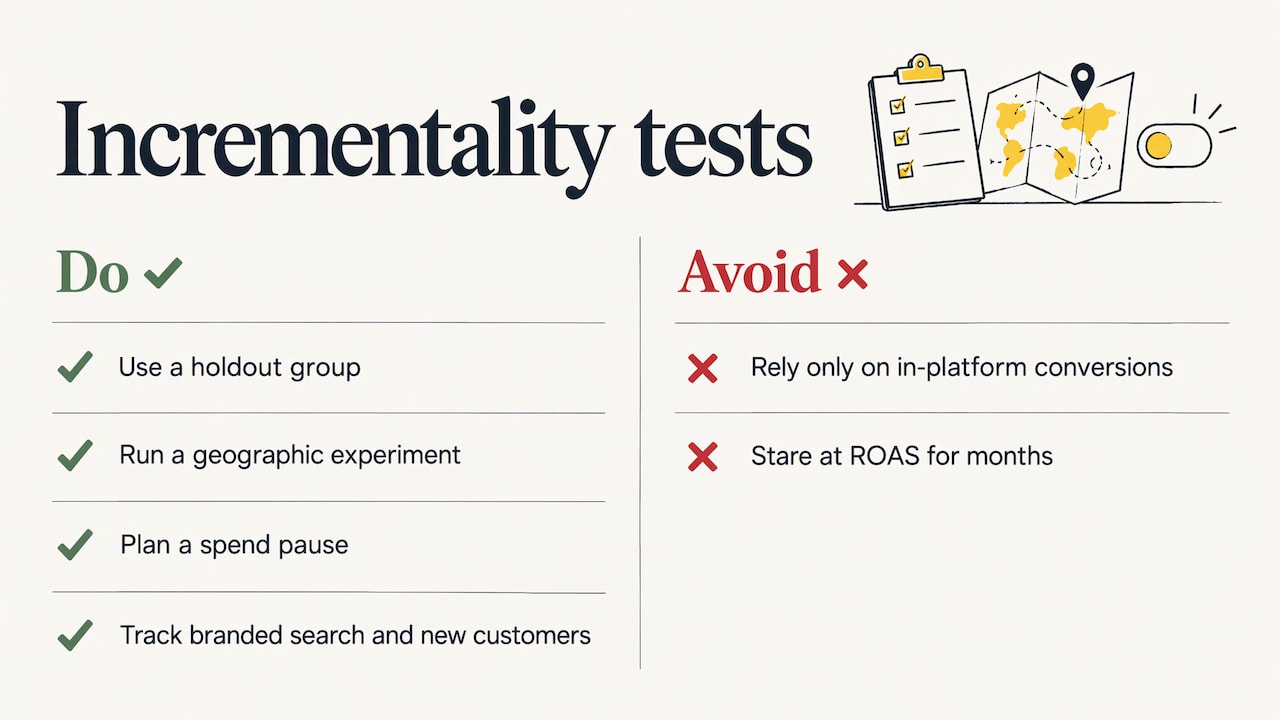
Platform attribution credits whichever ad touched the buyer last, or touched them at all. It is useful for optimizing within a platform and unreliable for deciding whether a channel created extra sales. To test it, use a holdout group, a geographic experiment, or a planned spend pause, and compare results. Watch branded search and total new customers during the test, not only in-platform conversions. Even a simple test, such as pausing prospecting in a few comparable states for a few weeks, will tell you more than months of staring at ROAS.
Channels that create demand for ecommerce brands
No single channel is “the” demand generation channel. The mix depends on your category and margins.
- Paid social (Meta, TikTok, Pinterest): the workhorse for cold reach. Video-first creative and creator-style content tend to do the job of introducing a product. Pinterest suits categories where people plan purchases, such as home, fashion and food. Our paid social campaign management service is built around this prospecting work.
- Paid search and shopping: mostly capture, but non-branded and category searches also surface shoppers earlier in their research. Our paid search services focus on capturing demand profitably, including what your prospecting efforts create.
- Video and connected TV: reach people before they are searching. Worth testing for brands with the budget and a strong creative story.
- Content and SEO: slower, but compounding. Educational content builds familiarity that later lowers paid costs.
- Creators and partnerships: social proof and reach in one, especially where trust is a barrier.
- Email and SMS: captures interest and retains customers. Treated as a channel with its own demand-building role: a good welcome flow is often the first brand experience after a click.
For examples of how brands have put these together, see our roundups of DTC marketing examples and DTC marketing campaigns.
Retention is part of demand generation
Many teams file retention under a different budget line, but it changes the economics of everything above. A customer who buys again costs you far less than a new one, so repeat purchase raises the CAC you can afford for cold audiences.
Shopify cites Klaviyo’s 2026 benchmarks showing that abandoned cart flows average $13.70 in revenue per recipient and browse abandonment $4.32, and reports that automated lifecycle messages deliver several times more revenue per send than one-off campaigns. Those are platform averages, not a forecast for your store, but they show why automated flows deserve early attention.
A sensible lifecycle skeleton:
- Welcome series for new subscribers, introducing the brand story and best sellers.
- Abandoned cart and browse flows for visitors who showed intent.
- Post-purchase sequence with usage tips and a relevant cross-sell.
- Replenishment reminders timed to when the product typically runs out.
- Win-back flow for customers who have gone quiet.
Email and SMS are the core of this, but some brands also add channels for shoppers who don’t share contact details; for instance, push notification cart recovery is one way to re-engage visitors who abandoned a cart without giving an email address. For subscription brands, our subscription email retention playbook explains how to reduce churn.
Perspective
Most of the brands that come to us are not short on ad spend. They are short on a system. The account has a strong retargeting ROAS, a prospecting campaign nobody trusts, an email program that sends campaigns but few flows, and a CAC that creeps up every quarter.
Our view at Rozee Digital is that demand generation, conversion and retention have to be planned together. That is the idea behind our Ecommerce Acceleration System™: acquisition, conversion and retention treated as one profit-focused framework, not three separate campaigns managed by three separate people.
It is also why we keep our client roster deliberately small and put senior strategists on the work. Deciding how much to spend on cold audiences, which creative angle deserves budget and when to scale takes judgment about your margins, not just platform skills.
If we had to give one piece of advice: set your allowable CAC from contribution margin and LTV first, then build the prospecting you can afford. Growth that ignores margin is just a bigger bill.
Tom
Common mistakes to avoid
- Judging prospecting by retargeting standards. Cold audiences will never show the same ROAS as people who visited yesterday. Compare like with like.
- Scaling on blended ROAS. It hides whether new customers are profitable. Use contribution margin by channel and CAC payback to decide when to push budget.
- Starving creative. Cold audiences tire of ads quickly. A weekly cadence of new concepts beats occasional big launches.
- Ignoring the post-click experience. More traffic into a weak page raises CAC.
- Skipping retention until later. Flows take weeks to build and begin paying back immediately. Build them while you scale prospecting.
- Measuring only in-platform. Pair platform data with MER, new-customer counts and periodic incrementality tests.
Where Rozee Digital fits
Rozee Digital works with established Shopify, WooCommerce and Magento brands that already invest in paid media and want to grow without giving up margin. We cover paid search, paid social on Meta, TikTok and Pinterest, static and video creative, conversion-focused landing pages and Klaviyo-based email and SMS, all within one framework.
If your acquisition costs are rising or your retention is not pulling its weight, our customer generation services are the place to start. We will look at how your demand creation, capture and retention fit together and where profit is leaking.

You can also see everything we offer, from Google Ads to lifecycle email, on the Rozee Digital homepage, or go straight to Klaviyo setup and optimization if retention is your priority. For a wider view of what is changing in the category, read our take on DTC marketing trends and our guide to a DTC marketing strategy that protects margins.
FAQ
What is ecommerce demand generation?
It is the set of marketing activities that create awareness and interest in your products among people who aren’t yet looking to buy. Typical tactics include paid social prospecting, video, creators and content. The aim is to fill the top of the funnel so that search, retargeting and email have more buyers to convert.
How is demand generation different from lead generation in ecommerce?
Demand generation builds interest in a brand across a broad audience, while lead generation captures a contact, such as an email or SMS opt-in, from someone already interested. In ecommerce the two work in sequence: demand gen brings shoppers in, lead capture keeps them, and email turns them into customers.
Which metrics should I track for demand generation?
Track leading indicators such as new-visitor growth, branded-search volume, video engagement and reach. Then check outcomes: new-customer CAC, MER, contribution margin by channel and repeat purchase rate. ROAS is useful inside a platform but should not be your only scaling signal.
How much should I spend on demand generation versus demand capture?
There is no universal split. Start from your allowable CAC, based on contribution margin and customer LTV, and fund prospecting up to that limit. Then use holdout or geographic tests to see whether extra spend creates additional customers or just relabels sales you would have made anyway.
Can a small brand do demand generation profitably?
Yes, if it keeps the scope tight: one or two prospecting channels, a steady creative pipeline, a few lifecycle email flows and clear CAC limits. Expand only when new-customer cost stays within your payback target.
Sources
- Shopify: Demand Generation: Definition, Strategies, and KPIs
- Shopify: Demand Gen vs. Lead Gen
- Shopify: Ecommerce Customer Acquisition: Channels & Formula
- Search Engine Journal: Demand Gen Vs. Lead Gen
- Search Engine Land: Beyond demand capture
- HubSpot: Demand generation vs. lead generation
- StorePush: BigCommerce abandoned cart push