The right ecommerce ads agency connects paid search and paid social to a shared commercial goal: profitable growth. Choose based on the work your brand needs, not the number of platforms on a pitch deck. A strong partner can explain how channel strategy, campaign management, and performance reporting work together.
That distinction matters. Search and social play different roles, and agencies vary in services, pricing, communication, evidence, and areas of focus. A long service list means little if the operating model does not fit your products, margins, and growth priorities.
This guide explains how to assess those differences and identify the capabilities that matter to your business. Learn what ecommerce ad agencies typically handle, how to evaluate their paid search and social strategies, what shapes pricing, and what credible evidence looks like. You’ll also see how agency specialties and onboarding affect the working relationship, helping you make a decision based on fit, accountability, and commercial priorities.
Key Takeaways
- Assess creative and conversion improvements as part of campaign performance, not as isolated tasks.
- Match agency services to your channel priorities, product range, and internal operating needs.
- Compare pricing models by the scope of work, reporting, and accountability they include.
- Use relevant proof and a clear onboarding plan to judge whether an agency can support your growth stage.
- Align paid search and paid social around shared commercial goals while giving each channel a distinct role.
Which Ecommerce Agency Is Right for You?
Choose an agency by how it connects campaign decisions to commercial outcomes. A full-funnel plan links discovery, consideration, purchase, and retention rather than treating each platform as an isolated channel. Paid search, for example, can capture existing product demand, while paid social introduces products to new audiences. Both should support the same revenue and profit priorities.
Performance creative and conversion rate optimization are part of that plan. Creative earns attention; the product page needs to turn it into a purchase. Review how an agency develops and tests hooks, product demonstrations, offers, landing pages, and calls to action. A useful test changes one variable at a time, such as comparing a benefit-led headline with a feature-led one, then applies the finding to relevant campaigns.
Full-funnel growth also requires a view of the P&L. Revenue alone can hide the impact of product costs, shipping, discounts, and returns. Connect campaign performance with contribution margin and repeat-purchase behavior. A first order with a low margin, for example, may still support a sound decision if repeat purchases improve customer economics. Set the commercial objective before allocating spend.
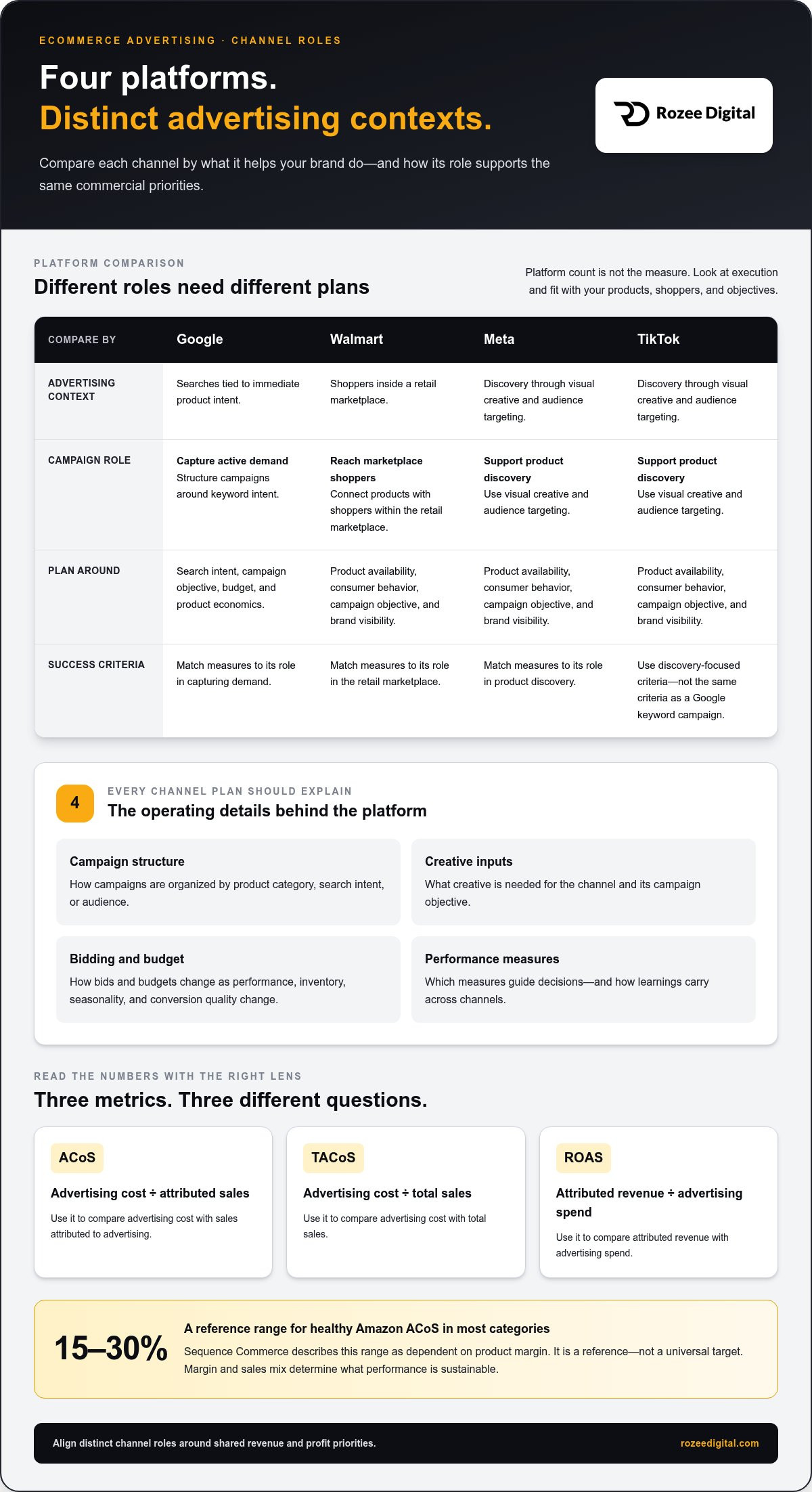
Use ACoS, TACoS, and ROAS for different decisions. ACoS compares advertising cost with attributed sales; TACoS compares advertising cost with total sales; ROAS compares attributed revenue with advertising spend. Sequence Commerce describes a healthy Amazon ACoS for most categories as 15% to 30%, depending on product margin. That range is a reference, not a universal target. Margin and sales mix determine what performance is sustainable.
Commerce brands also need to be discoverable beyond paid placements. PrimeView notes that stores may have hundreds or thousands of products, creating a wider keyword range for SEO. Organize product categories and pages around relevant search intent. Then connect paid keyword campaigns with organic content, rather than building a separate, disconnected catalog for each channel.
AI SEO and generative engine optimization focus on how products and brand information appear in AI-assisted search. Avenue Z states that 46% of buyers now begin their journey on AI search assistants. Clear product descriptions, consistent brand facts, and useful category content give search systems material to interpret. Treat this as an extension of search visibility, not a replacement for technical SEO or paid campaigns.
Performance PR can strengthen visibility by earning credible brand mentions and product coverage. Pair PR with AI search optimization by keeping product facts consistent across your site and external coverage. For example, a campaign promoting a new product line should use consistent product names, key features, and category language across landing pages and media materials. This gives search systems more consistent signals.
Assess agencies against your actual operating needs. Check whether the plan connects creative testing, conversion work, search visibility, and P&L outcomes. Ask how the agency distinguishes channel-attributed sales from overall business growth. A strong fit explains each platform’s role, identifies the metrics that guide decisions, and shows how campaign insights inform the next steps.
Advertising agency services for eCommerce brands
Advertising services can include channel strategy, campaign management, bidding, creative coordination, and performance analysis. The right scope depends on where consumers discover products and where advertising can support profitable sales.
A practical engagement starts with business priorities and maps them to specific channels. A brand seeking more product discovery, for example, may prioritize social campaigns, while one capturing active demand may focus on search. The agency should define campaign objectives, audience or keyword strategy, budget allocation, and reporting measures. This connects marketing activity to commercial priorities, not just platform activity.
PPC advertising requires active bidding and budget planning. Teams organize campaigns by product category, search intent, or audience, then adjust bids as performance changes. A Google Shopping campaign, for example, might separate high-margin products from items with tighter economics. Budget decisions should account for inventory, seasonality, conversion quality, and each product’s contribution. Set rules for shifting spend when a campaign uses budget without supporting its intended outcome.
Consider agency support when your internal team cannot maintain campaign structure, monitor multiple channels, or turn results into decisions. A brand expanding from Google into Meta and TikTok, for example, may need coordinated audience, creative, and budget workflows. Inconsistent reporting is another signal: when sales, advertising, and inventory decisions sit in separate processes, campaign changes can lag behind business needs. Define the bottleneck before assigning agency scope.
Advertising Across Ecommerce Platforms
Walmart, Meta, Google, and TikTok serve different advertising contexts. Walmart campaigns connect products with shoppers inside a retail marketplace, while Google can capture searches tied to immediate product intent. Meta and TikTok can support discovery through visual creative and audience targeting. Compare each platform’s role against product availability, consumer behavior, campaign objectives, and the visibility your brand needs.
Evaluate execution, not platform count. For each channel, identify the campaign structure, creative inputs, bidding approach, and performance measures. A TikTok discovery campaign and a Google keyword campaign should not use identical success criteria. Their roles differ, so the plan should explain how each contributes to sales and how insights carry across channels.
Comparing Ecommerce Advertising Agencies
Compare agencies using consistent criteria: channel expertise, campaign ownership, reporting clarity, and decision cadence. Look for examples that show the strategy, work performed, and business outcome, rather than isolated platform metrics. Ask how the agency handles budget shifts, creative testing, and underperforming product groups. These details show whether its process fits your commerce operation.
Compare the proposed scope with your team’s capabilities. One agency may focus on paid search; another may coordinate search and paid social. Match the engagement to the work that needs outside ownership, then define responsibilities for product data, approvals, and campaign decisions. A clear scope reduces duplicated tasks and makes performance reviews more useful.
For brands assessing coordinated channel management, paid search and paid social management can provide a relevant model for comparing service scope. Use the same criteria across platforms: campaign ownership, budget decisions, and the commercial outcomes each channel is expected to support.
Agency communication, pricing, and proof
Evaluate the working model alongside the campaign plan. Clear reporting, defined responsibilities, and evidence tied to business outcomes make digital marketing decisions easier to manage.
Set communication expectations around decisions, not activity updates. A weekly review might cover spend shifts, campaign changes, and emerging issues; a monthly review can connect those actions with revenue, margin, and inventory priorities. Name who handles approvals, data access, and implementation. This keeps your retail team and agency aligned when product availability changes.
Evidence should show the problem, the agency’s actions, and the resulting business measure. A useful case study explains which channels changed, what the team controlled, and how it assessed outcomes such as ROAS or conversion rate. Platform metrics alone do not establish commercial impact. Look for context, including the campaign objective and relevant measurement period, to make a meaningful comparison.
Pricing and Minimum Project Sizes
Pricing and minimum project sizes reflect the work required, not simply the number of platforms. Scope can depend on account complexity, campaign volume, creative coordination, reporting needs, and strategic oversight. The price depends on the case and is given after a quote request; the scope and cost factors should be clear before work begins.
Compare proposals by their deliverables. Clarify, for example, whether campaign setup, ongoing optimization, reporting, and strategic planning are included. A smaller scope may suit a focused Google Ads account, while a brand managing several channels may need broader coordination. Match the commitment to the work your team needs the agency to own.
Retainer Pricing
A retainer usually defines ongoing work across an agreed scope. Assess how it connects recurring campaign management with planning, analysis, and communication. A useful proposal states who handles each task, how priorities are set, and what reporting supports decisions. This makes the agency’s ability to manage digital activity visible beyond a monthly invoice.
Examine how scope changes are handled. A seasonal promotion, new product launch, or move into another channel can alter the workload. The agreement should explain how those requests are assessed and approved. That clarity helps brands plan resources without confusing additional work with routine campaign management.
Use a consistent process to review every proposal. Compare scope, communication, evidence, and measurement approach side by side. Then connect each agency’s commitments to internal priorities, such as protecting margin or improving retail visibility. A disciplined comparison shows whether the proposed relationship can support the decisions your team needs to make.
Agency specialties, ideal clients, and drawbacks
An agency can use the first 90 days to turn agreed scope into an operating plan. Weeks 1 and 2 establish priorities, product information, channel status, inventory processes, and existing campaign or sales data. Weeks 3 and 4 organize the catalog, review product content, and set channel priorities. Months 2 and 3 can establish regular campaign and merchandising routines.
Specialty determines fit. A fashion brand may need an ecommerce marketing partner familiar with seasonal launches, product feeds, and creative rotation. A marketplace-focused business may prioritize retail media expertise. A direct-to-consumer brand might need coordinated paid search and paid social. Match the agency’s strategy to your target customer, sales model, and internal team. Broad platform coverage has little value if the relevant channel lacks senior ownership.
Agency support is most useful when campaign execution competes with core operational work. A growing brand, for example, may struggle to coordinate product launches, inventory changes, and channel updates. An agency can organize responsibilities and build repeatable campaign routines. The tradeoff is added coordination: your team still needs to provide clear product information, timely approvals, and a decision-maker who can resolve competing priorities.
Testimonials show how clients describe communication and collaboration. Case studies should provide more: the starting challenge, strategy, campaign changes, and reported outcome. Read each result in context. A lower advertising cost ratio, for example, may matter differently for a low-margin product than for a high-margin one. Check whether a case resembles your channel mix, product category, and growth target before using it as a comparison.
Sequence Commerce reports that Joe Boxer’s year-over-year sales on Amazon.ca increased by 60%, while its Amazon.ca ACoS fell by 50%. Sequence Commerce also reports that Muscle Mac reduced ACoS on Sponsored Products by 42%. These are distinct outcomes, not a universal forecast. They show why an ecommerce agency’s proof should specify the metric, channel, and business context behind each result.
Evaluate case studies for attribution and operating detail. A result is more useful when the account describes what changed, which campaigns were involved, and how the team measured performance. Honeybee Gardens, for example, had a 200% increase in AI citations across five engines in 60 days, according to Sequence Commerce. That result concerns AI citations, not paid-media revenue; the distinction matters when selecting a partner.
Drawbacks can also stem from a mismatch in scope. A specialist may offer depth in one channel but leave you coordinating other marketing functions. A broad agency may cover multiple channels but give a complex account limited attention. Compare the proposed team, strategic responsibilities, reporting, and onboarding with the work your internal team needs to transfer or share. Choose for operational fit, not the longest service list.
The first 90 days can be used to build an operating plan, with regular campaign and merchandising routines established in months two and three. The timing and scale of performance gains can vary, since case-study results are not a universal forecast.
Paid search and paid social
Paid search and paid social address different demand needs. Google Search can capture shoppers actively looking for a product, while Meta and TikTok can introduce products through visual campaigns. Treating the channels as interchangeable obscures their roles. Give each channel a clear job, then assess its contribution to qualified traffic, customer acquisition, and revenue.
Start with the search journey. Group Google keywords by product category and intent, then match each group to relevant landing pages. A shopper searching for a specific product should reach that product, not a generic homepage. Review search terms, conversion quality, and product availability together. If clicks rise but relevant purchases do not, investigate keyword fit and landing-page alignment before increasing spend.
Paid social needs a different operating rhythm. Meta and TikTok campaigns can test product demonstrations, customer use cases, and distinct creative angles. A fashion brand, for example, can compare styling-led creative with close-up product details, then assess which attracts engaged visitors who purchase. Track audience quality alongside engagement. Views or reactions alone do not show whether a campaign is generating commercially useful demand.
Connect channels through shared customer and product insights. Search terms can reveal which benefits shoppers value, while social engagement can indicate which messages resonate. Use those signals to refine campaign language and product pages. If shoppers respond to a particular product benefit on TikTok, for instance, test that message in relevant Google ads. This creates a feedback loop without giving every platform the same job.
Use separate channel measures alongside a shared business view. For paid search, monitor search query relevance, conversion rate, and revenue contribution. For social, examine audience response, landing-page behavior, and resulting sales. Compare channel performance with product margin, stock position, and the customer acquisition goal. A campaign driving traffic to an unavailable product needs a different response from one attracting visitors who leave without buying.
Use a disciplined review sequence: confirm tracking, inspect campaign structure, assess creative or keyword quality, then decide where to shift effort. Check whether platform reporting aligns with store sales before drawing conclusions. A rise in attributed conversions may reflect measurement changes rather than incremental demand. Separate platform-reported results from broader business trends, and document the reason for each optimization decision.
Brands that need tighter coordination across Google, Meta, or TikTok can explore paid search and paid social management. The strategic objective is not simply to run more campaigns. It is to make each channel’s role explicit, connect audience insight with search intent, and direct investment toward outcomes the business can assess.
Rozee Digital: Ecommerce ads agency
Rozee Digital supports ecommerce brands with advertising management through its ecommerce ads agency, Google Ads Agency, Facebook Ads Agency, and PPC Ads Agency services. Turn to Rozee Digital when your team needs focused support managing paid search or paid social campaigns, or aligning advertising work with commercial priorities.
Start with your business objective and the channel that needs the most attention. A brand seeking stronger Google Ads management has a different priority from one developing Facebook campaigns or coordinating broader PPC activity. Clear goals help define the right scope and working priorities.
For a direct conversation about your ecommerce advertising needs, contact Rozee Digital.
Turn your growth priorities into a clear next step
Before committing to an agency relationship, define the decision you need it to improve. Identify the products and channels that matter most, the operational constraint holding back progress, and the business measures that will guide future investment. A concise brief gives your team a sharper basis for evaluating the next step.
An ecommerce ads agency should fit your priorities, not add activity without purpose. Rozee Digital offers ecommerce advertising, Google Ads Agency, and Facebook Ads Agency services. These options suit growth plans that call for focused support across paid search or paid social.
Bring your priorities into a conversation with Rozee Digital and outline where advertising needs stronger ownership. Contact Rozee Digital to discuss a practical next step. Clear priorities create a stronger foundation for growth.
Frequently Asked Questions
What does an ecommerce advertising agency do?
An ecommerce advertising agency plans and manages campaigns that bring shoppers to online products. Its work can include channel selection, audience or keyword targeting, bid management, creative testing, and performance analysis. For example, it might separate branded Google searches from generic product searches, then assess which group attracts valuable customers. The agency turns advertising activity into informed campaign decisions, while the business retains control of its products and operations.
How much do ecommerce ad agencies charge?
Fees depend on the agreed scope, account complexity, channels managed, reporting needs, and level of strategic support. Pricing structures can include a retainer, a percentage of advertising spend, or project-based work. Compare what each arrangement covers, including campaign setup, ongoing optimization, and analysis. The price depends on the case and is given after a quote request; the scope and cost factors should be clear before work begins.
What services should an ecommerce ads agency offer?
Core services should match the brand’s acquisition needs. They may include paid search, PPC management, paid social campaigns, audience and keyword planning, campaign optimization, and performance reporting. A store with strong search demand, for example, may prioritize Google Ads, while a product-led brand may need Facebook or TikTok campaigns. Ensure the proposed work addresses the business objective, and define which creative, product, and measurement responsibilities remain with your team.
How to choose the best ecommerce advertising agency in the United States?
Choose based on channel fit, relevant experience, transparent scope, and evidence tied to business outcomes. For a United States brand selling across several states, consider how campaigns account for product availability, shipping regions, and seasonal demand. Review the agency’s proposed responsibilities and reporting, then compare them with your team’s capacity. The right fit is the one whose operating model supports your target customers and commercial priorities, not simply the broadest service list.
How do ecommerce agencies compare with in-house advertising teams?
An in-house team offers direct access to product, inventory, and merchandising decisions. An agency adds dedicated campaign management and channel expertise without requiring every capability to sit internally. A retailer with an experienced marketing lead but limited Google Ads capacity, for example, could assign paid search execution externally while retaining strategy approval. Compare the models by ownership, speed of internal coordination, specialist skills, and how closely advertising decisions connect with daily operations.
Which ad platforms do ecommerce agencies manage, such as Google, Meta, TikTok, and Amazon?
Platform coverage varies by agency and engagement. Ecommerce campaign management can include Google Ads, Meta platforms such as Facebook, TikTok, Pinterest, Snapchat, or Amazon advertising. Each serves a different role: Google can capture active product searches, while social platforms can introduce products through creative and audience targeting. Amazon campaigns operate within its marketplace. Align platform selection with where customers shop, product availability, campaign objectives, and your team’s capacity to manage each channel.
What results and ROAS can ecommerce ad agencies typically deliver?
There is no single ROAS benchmark that fits every store. Results depend on product margins, average order value, repeat purchases, campaign mix, and attribution settings. A high ROAS can still mean weak profit when margins are tight; a lower first-order return may support a sound acquisition strategy when repeat purchases contribute. Set targets using contribution margin and customer economics, then assess channel results against those business measures rather than a platform metric alone.
How do ecommerce ad agencies measure performance and report results?
Agencies measure performance by combining platform data with store and business outcomes. Reporting may cover spend, clicks, conversions, revenue, ROAS, and campaign structure changes. A report can, for example, separate new-customer acquisition from returning-customer sales, then explain which campaigns influenced each result. Review how the agency defines conversions and attribution, and use consistent reporting periods. This helps distinguish platform-reported activity from broader changes in store performance.