Creative fatigue is what happens when the same people see the same ad visuals so often that they stop responding. Click-through rates slide, frequency climbs, and your cost per acquisition drifts up while the budget stays the same. The fix is rarely a new headline. It is a steady supply of genuinely different creative concepts, plus a way to tell wear-out apart from ordinary auction noise.
This guide is written for e-commerce brands already spending real money on paid social. It covers how to define the problem, which numbers confirm it, what to do in the first week, and how to build a rotation system so you stop reacting.
TL;DR
- Creative fatigue is a drop in performance caused by repeated exposure to the same creative, not just the same ad. Meta’s own analytics team frames it that way.
- Real fatigue shows up as three things moving together in the same 7-day window: rising frequency, falling CTR and climbing cost per result. One metric moving alone is usually something else.
- Meta’s “Creative fatigue” label is a lagging signal. By the time it appears, cost per result has already doubled.
- Re-cropping or swapping a headline rarely resets anything. Ship materially different concepts on a schedule.
- Repetition is not always bad. Find your own minimum effective frequency instead of copying a generic cap.
Table of Contents
- What creative fatigue actually is
- How much damage repetition does
- The three signals that confirm fatigue
- Don’t wait for the platform to tell you
- What to do in the first week
- Build a rotation system, not a panic button
- Repetition isn’t always the enemy
- Where AI creative generators fit
- Our perspective
- Getting help with creative and paid social
- A one-page fatigue checklist
- FAQ
- Sources
What creative fatigue actually is
Meta’s analytics team defines creative fatigue as the effect of users seeing the same creative repeatedly, and it stresses that the focus is on the creative (the visual elements) rather than the ad object. That distinction matters in practice. If you duplicate an ad into a new ad set with a new ID but the same image or video, the audience still sees the same creative. The platform and the shopper both treat it as a repeat.
You will see two terms used loosely. Ad fatigue usually refers to a specific ad wearing out. Creative fatigue is broader: repetitive visual elements across several ads, for example five ads that all open on the same product shot against the same white background with the same hook. A third idea, audience saturation, means you have simply reached most of the people you can afford to reach. All three look similar in a dashboard, and they call for different responses.
Why it hits harder on paid social
On feed-based placements the viewer scrolls past dozens of items a day, and the platform’s delivery system rewards ads that earn engagement. When engagement falls, the auction charges you more to win the same impression. Foundgrove puts it plainly: the people you can afford to reach have already seen your ad too many times, and it is arithmetic rather than taste.
Small audiences feel it first. A brand with a tight retargeting pool or a narrow prospecting segment can burn through a creative in days. Brands with broad audiences and heavy budgets feel it more slowly, but they feel it.
How much damage repetition does
Meta’s 2023 research reported that conversion likelihood falls by roughly 45% after four exposures to the same creative, following an approximate curve of (N+1) to the power of -0.43 per exposure. The same write-up found that in cases of high fatigue, adding fresh, diverse creative to ad sets lifted conversion rates by an average of 8%.
Two cautions when you use these numbers. First, they are averages across many advertisers, not a promise for your account. Second, they describe exposure per person, which is why a single frequency number in Ads Manager can hide a lot: some people in your audience have seen the ad once, others ten times.
Treat the figures as direction, not a forecast. They tell you the cost of waiting is real and that the first few repeats do the most damage.
The three signals that confirm fatigue
Practitioners who track this closely look for a convergence. According to Foundgrove, the pattern is rising 7-day frequency, falling CTR and climbing CPA at the same time. Common rules of thumb from the same source are 7-day frequency above 3 for prospecting and a week-over-week CTR drop of more than 15%. Those are starting points, not laws. Your own history is the benchmark that counts.
| Signal | What fatigue looks like | What else could cause it |
|---|---|---|
| Frequency (7-day) | Climbing, often past 3 on prospecting | Budget increase into a small audience |
| CTR | Falling week over week | Seasonal intent shift, a weaker offer |
| Cost per result | Rising alongside the other two | Auction competition, tracking changes |
| CPM | Often flat or rising slightly | Competitor spend, holiday auctions |
The last row is where many media buyers go wrong. CPM spikes get blamed on fatigue constantly, yet CPM is often driven by auction competitiveness and by budget and audience constraints. Foundgrove’s guidance is that if only one metric is moving, it is more likely seasonality or auction pressure than creative wear-out.
A quick worked check
Say a prospecting ad averaged a 1.4% CTR and a 2.1 frequency over its first two weeks. In week three, frequency reads 3.4, CTR is 1.1% (a drop of about 21%), and cost per purchase is up. All three signals agree, and the ad is a fatigue candidate. Now change the story: frequency is still 2.2 and CTR is steady, but CPM jumped and CPA rose. The creative is probably fine. Look at the auction, your landing page and your tracking before you commission new assets.
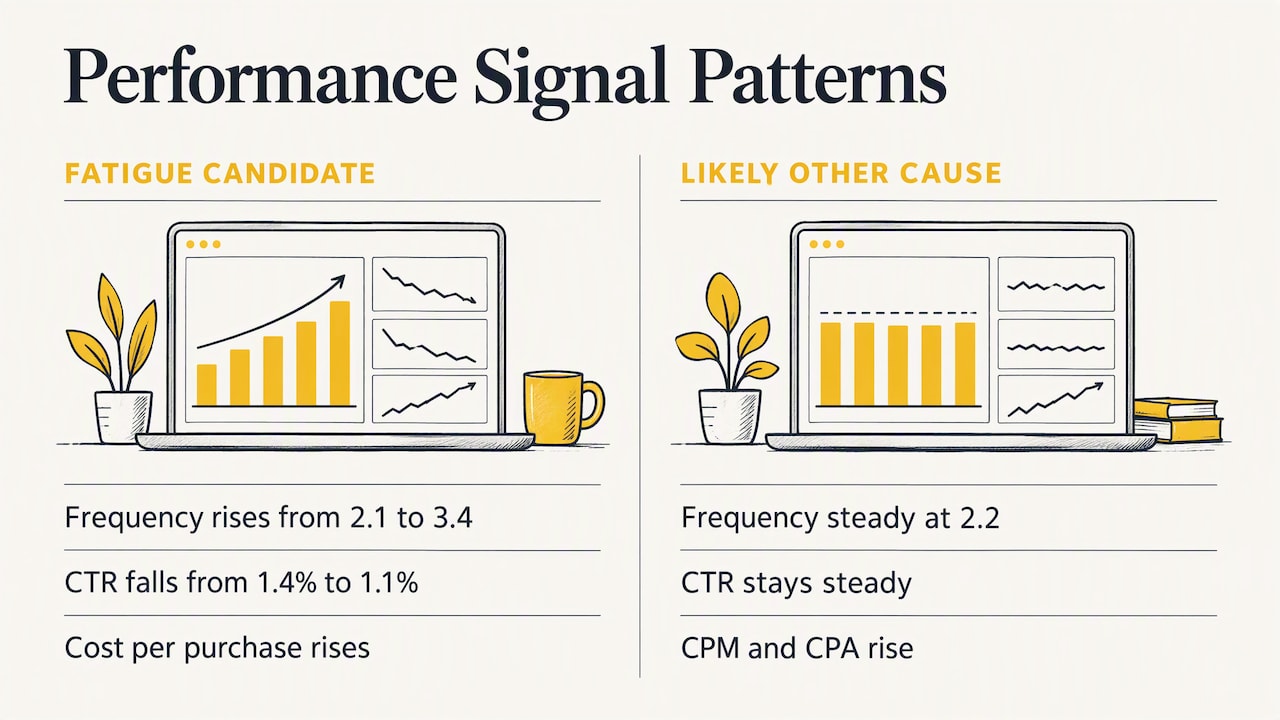
These numbers are illustrative, not client data. The method is what to take away: compare the same window, and demand agreement across metrics.
Don’t wait for the platform to tell you
Meta does surface fatigue in Ads Manager. Its delivery statuses include “Creative limited”, where cost is higher than for past ads, and “Creative fatigue”, where cost is double historical performance, as Foundgrove summarizes. The Meta Ads Manager recommendation about creative fatigue exists for the same reason.
The problem is timing. AdSights describes the official status as a lagging indicator: it fires only once cost per result has doubled against your historical account performance for that objective. Seasoned buyers treat it as confirmation that something already went wrong, not as an alarm. If your whole process is “refresh when the label appears”, you are paying double for a stretch of every creative’s life.
Set your own earlier tripwires instead: a weekly review of frequency, CTR and CPA by creative, with a flag when two of the three move the wrong way.
What to do in the first week
When the three signals line up, act in this order.
- Confirm it is the creative. Check that the pattern holds across the same 7-day window and rule out a tracking change, a stock-out, a price change or a landing page problem.
- Find what is fatigued. Break results down by creative, not just by ad set. Often one or two high-spend assets carry the decline.
- Launch materially different concepts. Meta’s guidance, as reported by Foundgrove, is to diversify formats, expand audiences and introduce materially different creative assets to the ad set.
- Let the old ad run down, don’t kill it instantly. Cut budget gradually where the ad still returns above your break-even, and pause when it does not.
- Log what you learned. Record the concept, hook, format and how many days it lasted, so the next round starts from evidence.
What counts as “materially different”
Re-cropping an image to a new ratio, changing the background colour or swapping a headline often fails to reset the fatigue state. AdSights notes that the system’s retrieval needs a materially different creative concept, and warns against shipping near-duplicates under pressure. Meta has not published a numeric threshold for how different two ads must be, so treat any specific percentage you read online with suspicion.
In practice, a different concept changes at least one of these:
- The angle: problem-led instead of benefit-led, or social proof instead of a demo.
- The format: a founder video instead of a static, a carousel instead of a single image.
- The first three seconds: a new hook with a different opening visual and spoken line.
- The person or setting: a customer in a kitchen instead of a studio product shot.
- The offer framing: bundle, guarantee or first-order incentive, where margins allow.
For more on the visual side, our guide to Facebook ad creatives walks through building assets that differ in ways shoppers notice.
Build a rotation system, not a panic button
The better answer is to stop treating fatigue as an event. AdSights recommends managing creative as a portfolio cadence: a pipeline of net-new concepts that are retired, replaced and re-tested on a schedule, rather than a scramble triggered by a status label.
A workable cadence for an established e-commerce brand looks like this:
- Weekly: review frequency, CTR and CPA by creative. Flag anything where two signals worsen.
- Every two to four weeks: launch a small batch of new concepts into testing. Cadence depends on spend and audience size, so use your own lifespan data to set it.
- Monthly: retire the bottom performers, promote winners and write down which angles are exhausted.
- Quarterly: revisit research. Read reviews, support tickets and returns reasons for fresh angles.
MesmerTools reported that media buyers it spoke with run 5 to 10 creative variants per ad set at launch and refresh winners weekly. That is one practitioner snapshot rather than a standard, and a brand with a small budget cannot copy it literally. The principle holds at any size: always have the next concepts in the queue before the current ones fade.
Our ad creative optimisation guide covers how to structure testing so each batch teaches you something.
Repetition isn’t always the enemy
It would be easy to conclude that lower frequency is always better. The research is more nuanced. Work on advertising wear-in and wear-out in the Journal of the Academy of Marketing Science examines how creativity and repetition interact, which is a reminder that quality and relevance change how fast an ad wears out. Ads that are well made and relevant to the viewer may hold up longer.
There is also evidence of a reversal effect. One study in the International Journal of Research in Marketing points to frequent repetition causing initial annoyance but increasing brand preference over the long run, once the immediate exposure period has passed. That matters if your goal includes brand building rather than only last-click purchases.
The practical takeaway is to avoid a generic frequency cap copied from a blog post. Look for your minimum effective frequency, the number of exposures your brand and concept actually need, and retire creative based on your data rather than a fixed rule. A prospecting ad for an impulse product and a retargeting ad for a considered purchase will not wear out at the same rate.
Where AI creative generators fit
People often ask whether automated ad generators solve fatigue. They help with volume: batch-producing variants for testing is cheap and quick. They do not solve the underlying issue, which is concept diversity. Twenty resizes of the same layout is still one concept.
If you try one, read the billing terms before a free trial ends. Public review pages for this category of tool show recurring complaints about automatic renewals and slow refunds, and ratings differ a lot by review site. Use generators for variations on proven concepts, and put human strategy into the new angles.
Our perspective
Most fatigue we see in e-commerce accounts is a planning problem. The ads were fine when they launched, and nobody had the next batch ready. The brand then reacts to a rising CPA by tweaking budgets and audiences, when the lever that matters is the creative pipeline.
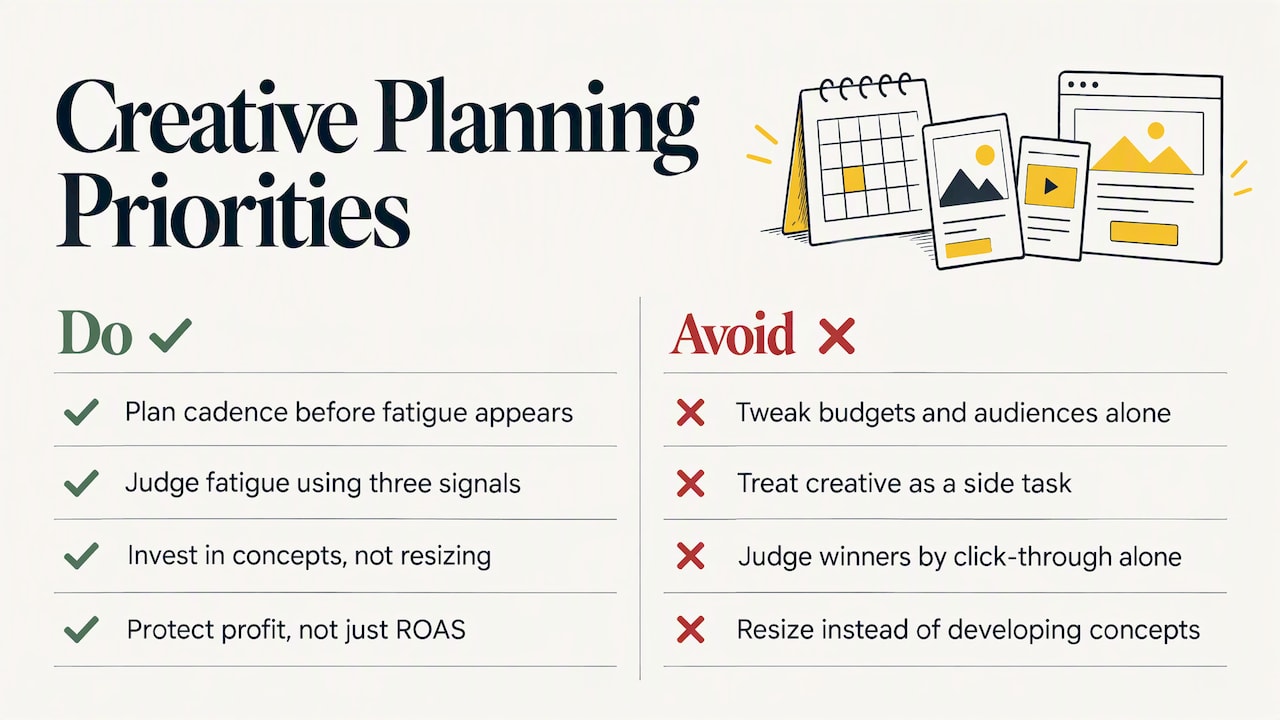
We work with established Shopify, WooCommerce and Magento brands, and we treat creative as part of a system that spans acquisition, conversion and retention, not as a side task. A fresh ad that sends traffic to a weak landing page or a thin post-purchase flow only moves the problem. That is why we look at the creative calendar, the landing page and the email and SMS flows together, with senior strategists leading the work.
Our advice is simple. Decide your cadence before you need it, judge fatigue on three signals rather than one, and spend your effort on concepts, not on resizing. Protect profit, not just ROAS: a creative that wins on click-through but attracts low-margin, one-time buyers is not a winner.
— Tom
Getting help with creative and paid social
If your CPA keeps creeping up and your team is stuck in reactive refresh mode, our paid social campaign management service covers Meta, TikTok and Pinterest buying, creative strategy and testing for established e-commerce brands. We also produce static and video ad creative, and we connect it with landing pages and email and SMS so gains carry through to profit. You can see everything we offer on our main site.
A one-page fatigue checklist
Keep this next to your weekly report.
- Is 7-day frequency rising on prospecting, and how does it compare with this creative’s first two weeks?
- Has CTR fallen week over week by a meaningful margin, such as the 15% rule of thumb?
- Is cost per result rising in the same window?
- Are at least two of those three true? If not, check auction, seasonality, tracking and landing page first.
- Do you have at least two new concepts, not resizes, ready to launch?
- Did you record the lifespan of the creative being retired?
FAQ
What does creative fatigue mean in Meta ads?
It means performance declines because the same audience keeps seeing the same creative elements. In Ads Manager you may see the status “Creative limited” or “Creative fatigue”, the latter appearing when cost per result is double your historical level. Because that label arrives late, track frequency, CTR and CPA yourself.
How do I deal with creative fatigue?
Confirm that frequency, CTR and cost per result are all moving the wrong way in the same 7-day window. Then launch materially different concepts, vary formats and widen the audience where it makes sense. Headline swaps and re-crops alone usually will not help.
How often should I refresh ad creative?
There is no universal number. Spend, audience size and product category all change the speed of wear-out. Set a weekly review and a regular batch launch, then adjust the rhythm using the lifespans you record.
Is high frequency always a problem?
No. Some research points to wear-in periods and to better long-term brand preference after heavy repetition. Judge frequency against results and your own minimum effective frequency, not a fixed cap.
Sources
- Creative Fatigue: How advertisers can improve performance by managing repeated exposures (Analytics at Meta)
- Meta Ad Fatigue and Creative Refresh (Foundgrove)
- Meta Andromeda: The Advertiser Playbook (AdSights)
- The effects of creativity on advertising wear-in and wear-out (Springer Nature)
- Advertising repetition research (ScienceDirect)
- Advertising wear-in research paper (AEA conference)
- Best Facebook Ad Creative Tools in 2026 (MesmerTools)