A low agency fee can hide an expensive mismatch. When choosing a paid media agency for DTC retail brands, compare channel expertise, growth ownership, and measurement approach, not just the fee. Total cost depends on the scope of support, channel mix, advertising budget, and reporting needs. Agency fees and media budgets are separate costs.
Cost matters because ad spend can grow while profitability remains unclear. ROAS compares attributed revenue with ad spend; MER compares total revenue with total marketing spend; CAC is the cost to acquire a customer; LTV estimates the revenue a customer generates over time. No single metric captures the full commercial picture.
This comparison explains key cost drivers, how to prioritize Meta, TikTok, Google, and YouTube, and what to consider when evaluating Google Shopping and Performance Max. It offers a practical way to assess channel fit, measurement, and scope before choosing support. The goal is not more campaign activity. It is accountable acquisition aligned with profitable growth.
Key Takeaways
- Assess Google Shopping and Performance Max management by the agency’s approach to feed quality, creative testing, and policy compliance.
- Look for an agency that coordinates paid media across ecommerce touchpoints rather than treating each channel as a separate effort.
- Choose between paid social and Google Shopping based on customer intent, product discovery needs, and the strength of your creative assets.
- Compare channel plans by how they connect Meta, TikTok, Google, and YouTube to business outcomes, not just platform-reported results.
Do you manage Google Shopping and Performance Max?
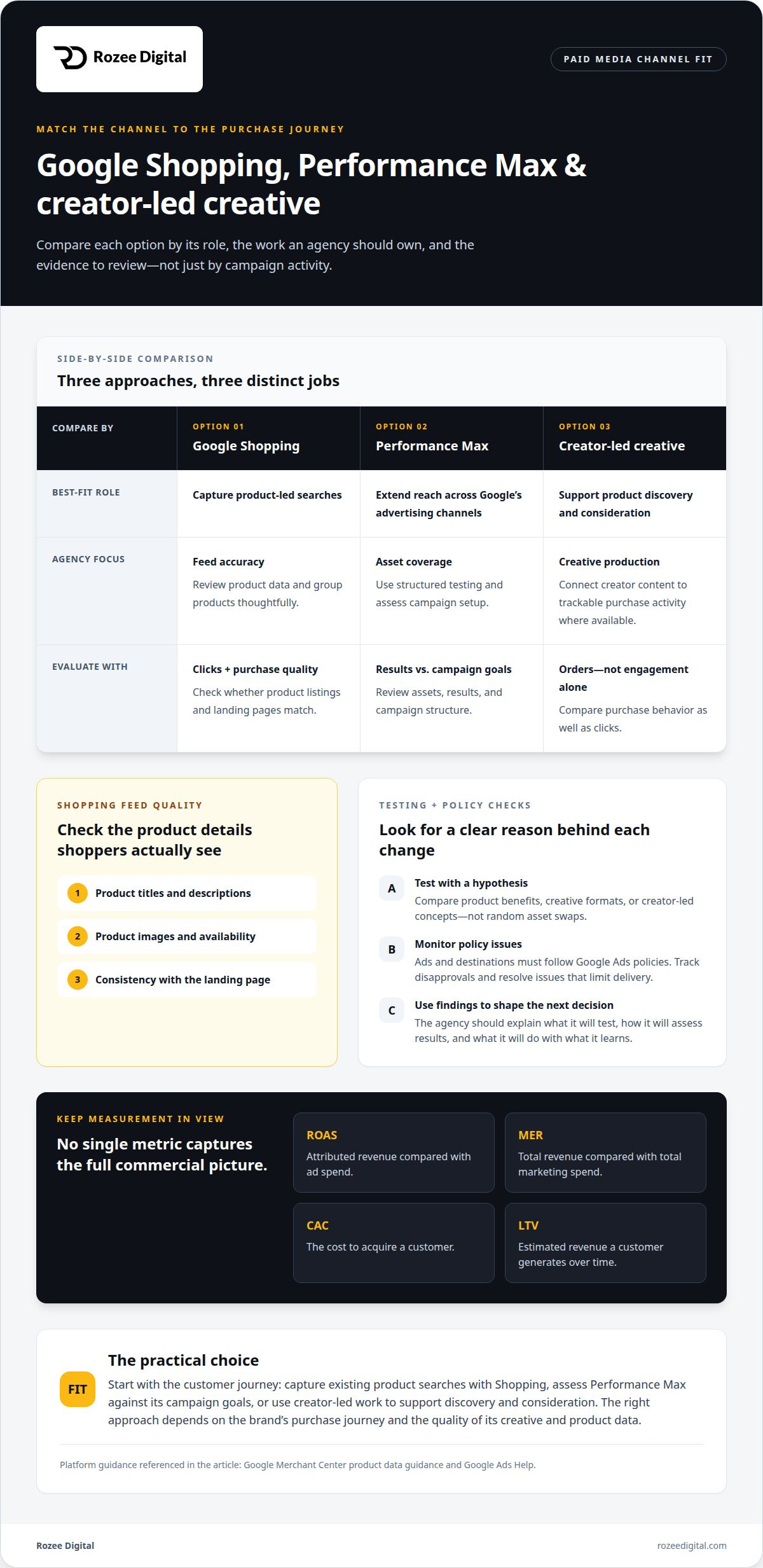
Effective Google Shopping and Performance Max programs connect product data, creative testing, and purchase quality. Google Merchant Center guidance says product data should match the items and landing pages shown to shoppers. Google Ads Help describes Performance Max as a goal-based campaign type that can serve across Google’s advertising channels. Ask how the agency evaluates assets, results, and campaign structure.
Feed management involves reviewing product titles, descriptions, images, availability, and landing-page consistency. A specific product title, for example, gives shoppers clearer context than a vague label. Google Merchant Center’s product data guidance explains the attributes retailers submit for listings. Google Ads policies also apply to ads and destinations, so teams should monitor disapprovals and resolve policy issues that limit delivery.
Creative testing needs a clear hypothesis, not random asset swaps. An agency can test product benefits, formats, or creator-led concepts, then compare purchase behavior as well as clicks. For creator marketing tied to retail purchases, connect influencer content to trackable campaign activity and completed orders where available. Shopper insights, such as common objections and product preferences, can inform the next creative iteration.
| Option | Best-fit role | Agency focus | Key evaluation |
|---|---|---|---|
| Google Shopping | Product-led searches | Feed accuracy and product grouping | Clicks and purchase quality |
| Performance Max | Google campaign reach | Asset coverage and structured testing | Results against campaign goals |
| Creator-led creative | Product discovery and consideration | Creative production and purchase tracking | Orders, not engagement alone |
Choose an approach that matches the purchase journey, then look for a clear testing framework. The agency should explain what it will test, how it will assess feed and policy issues, and how those findings will inform the next decision.
What is a DTC marketing agency?
A DTC marketing agency aligns paid media with a brand’s products, customers, and sales channels. Common measures include ROAS, attributed revenue per ad dollar; CAC, the cost to acquire a customer; and incrementality, the sales generated by advertising beyond what would otherwise have occurred.
For B2C ecommerce and retail brands, omnichannel media buying connects discovery, consideration, and purchase. Meta and TikTok can introduce products through social placements; Google can capture shoppers actively searching. Retail media and marketplace advertising reach customers near a purchase, while campaign planning should account for direct-to-consumer and retailer sales together.
Channels have different roles. Connected TV (CTV), online video, digital audio, and podcast advertising can build awareness or explain a product before shoppers search. Meta, Google, and TikTok can then support discovery or conversion. Match creative and targeting to each channel’s role rather than treating every impression as a direct sale.
Retail media adds another layer. Marketplace advertising promotes products within a retailer’s shopping environment, while a brand’s ecommerce advertising can direct traffic to its own store. A coordinated plan sets distinct objectives, connects available sales reporting, and avoids counting the same purchase as independent success on multiple platforms.
For a United States brand, the media plan should reflect where products are sold and which retail partners carry them. Map each channel to its sales destination, then align campaign objectives and reporting with that path to purchase. This keeps direct-store activity distinct from marketplace or retail media investment.
For an ecommerce advertising strategy, align channel roles, reporting, and campaign goals before launch. That gives teams a clearer basis for separating platform-attributed ROAS from the wider commercial effect of advertising.
How does an agency decide whether a DTC brand should start with paid social or Google Shopping?
In the United States, DTC ecommerce brands can choose among paid social specialists, paid search specialists, and cross-channel growth agencies. The right fit is the team whose core expertise matches the brand’s acquisition constraint, sales model, and measurement needs.
Start by assessing demand and how customers discover the product. If shoppers already search for a clearly defined product, Google Shopping can capture that intent through product listings. If the product needs demonstration or its audience discovers it through content, Meta or TikTok advertising can introduce the offer. Neither channel is automatically the right starting point.
Connect channel choice to the conversion path. Paid search captures active queries; Shopping presents products in search results; paid social can create demand and reach interested audiences again. Programmatic services can extend reach across digital placements. Reporting should distinguish each channel’s role, track conversions, and connect optimization decisions to business outcomes, not clicks alone.
Assess specialist versus broader support by matching required work to an agency’s capabilities. A specialist may suit a focused need, such as Google Shopping feed management. A broader team may fit brands coordinating paid social, search, and programmatic activity. Clarify who owns strategy, media buying, creative testing, measurement, and reporting. Unclear responsibilities can slow decisions.
Service location matters less than operating coverage. For a US brand, clarify which markets the agency can support, how communication fits working hours, and whether reporting covers the same regions as sales. Targeting and campaign structure should reflect the brand’s shipping footprint and retailer relationships, rather than assume one national setup suits every product.
Choose a model that addresses the current bottleneck. If search demand exists, prioritize Shopping and search expertise; if discovery is the constraint, prioritize paid social creative and audience testing. Choose cross-channel support when coordinated activity and unified measurement are essential.
Media buying across Meta, TikTok, Google, and YouTube
Give Meta, TikTok, Google, and YouTube distinct roles in a DTC growth plan. Set a primary objective for each channel before launch. This prevents teams from judging every placement by the same immediate conversion measure. It also clarifies which decisions sit with channel owners and which need coordination across the wider plan.
Build audience strategy around how customers encounter a product. A shopper might first see a brand on TikTok, then search for it on Google. Meta may support further consideration, while YouTube can provide a deeper product explanation. Treat this as a planning hypothesis and assess it against customer and sales data.
Use shared definitions across platforms. Align conversion events, attribution windows, campaign naming, and reporting periods before comparing results. Platform-reported performance can differ because each system uses its own attribution settings and signals. Reconcile those reports with commerce data before reallocating investment or assessing a channel’s contribution.
Use a controlled process. Record the audience, creative, offer, and objective for each test. Keep a change log to connect shifts in delivery with changes to targeting, bids, or assets. When several platforms change at once, results become harder to interpret. Coordinated testing preserves useful learning as activity evolves.
Cross-channel plans also need commercial coordination. Align promotions, product availability, and landing pages across active placements. If a product sells out or an offer changes, update relevant advertising and customer-facing content together. This reduces mismatches between advertising and the buying experience and helps teams interpret sales changes.
Choose a partner that can explain how it coordinates these decisions across channels. For teams seeking a connected ecommerce advertising strategy, align channel roles, measurement, and operating responsibilities before expanding activity.
Rozee Digital
Rozee Digital supports established ecommerce and DTC brands through Growth Accountability™, taking ownership of growth rather than managing campaigns day to day. Its services include paid media across Google and Meta, as well as creative, conversion-focused landing pages, and retention marketing.
Consider Rozee Digital when your team needs senior-level expertise to connect paid acquisition decisions with broader growth priorities. The scope should reflect your business objectives and current needs.
Contact Rozee Digital to discuss your paid media priorities.
Make the next move with a clear growth mandate
The right paid media agency for DTC retail brands should work toward a defined commercial priority, not simply cover a checklist of channels. Before expanding investment, align stakeholders on the outcomes that matter, the reporting that informs decisions, and who owns follow-through across marketing and commerce. That clarity supports better planning and accountability to the business.
Rozee Digital can support ecommerce brands with paid media management across relevant acquisition channels. The next step is a focused discussion about your growth priorities, current campaign structure, and where specialist execution could strengthen the plan. Bring the commercial objective, not a predetermined platform answer.
Discuss your paid media priorities with Rozee Digital. A clear mandate is the foundation for a more disciplined path to growth.
Frequently Asked Questions
How much does paid media cost?
Paid media cost includes the advertising budget and the agency’s fee. The fee depends on scope, channel count, creative needs, reporting, and the level of strategic ownership. Compare those elements separately so media spend isn’t confused with service costs. Ask agencies to explain how their proposed scope and campaign complexity affect the fee.
What is the best paid and performance marketing firm for direct-to-consumer brands?
The best paid media agency for DTC retail brands is one whose expertise, operating model, and measurement approach fit your commercial priorities. Rozee Digital focuses on established ecommerce and DTC brands and offers a growth ownership model. Assess whether that level of support matches your business stage and needs.
How do paid media agencies identify and address creative fatigue?
Agencies can investigate possible creative fatigue by reviewing changes in delivery, engagement, conversion rates, and acquisition costs alongside audience and campaign context. A dip in results alone does not prove creative is the cause. Compare recent assets with earlier versions, then test a new hook, format, or product benefit while keeping other variables controlled. This helps isolate what changed before replacing the wider strategy.
What services do paid media agencies offer DTC retail brands?
Services may include paid search, Shopping, paid social, measurement, creative development, and performance reporting. Some agencies also connect acquisition with retention through email marketing. Rozee Digital’s services include Google, Meta, Pinterest, and TikTok advertising, static and video ad creative, conversion-focused landing pages, and email and SMS retention. Its model is Growth Accountability™, not day-to-day campaign management.
What should DTC brands look for when comparing paid media agencies?
Compare channel expertise, measurement, reporting, and responsibility for strategy, creative, and optimization. Check that the approach reflects your sales model, margins, and customer lifecycle, not just platform-reported performance. Clarify account ownership and decision-making, including who translates results into budget changes and coordinates acquisition with retention priorities.
What do paid media agencies charge DTC brands, and what pricing models do they use?
Agencies may use a fixed retainer, a fee tied to media spend, or a scoped project fee. The right model depends on workload and responsibilities, including channel breadth, creative production, and reporting needs. Separate the agency fee from advertising spend when assessing total investment. Ask agencies to explain how scope and complexity affect their fees.