To scale ecommerce profitably, grow the amount you spend only when the contribution margin on each new order covers it, and fund that growth by raising conversion rate and customer lifetime value before you raise the ad budget. Brands that do the reverse, pushing spend into a leaky funnel, usually find that revenue climbs while profit falls. At Rozee Digital we work with established Shopify, WooCommerce and Magento brands on exactly this problem, and the approach below is the one we use to think about it.
TL;DR
- Profitable scale is a margin question first. Know your contribution margin per order and your break-even ROAS before you increase any budget.
- Track blended efficiency (MER) alongside platform ROAS, because platforms over-credit themselves and ignore returning customers.
- Raise spend in steps, and only after conversion rate and retention can absorb more traffic at the same or better cost.
- Retention (email, SMS, repeat purchase) is what lets you pay more to acquire a customer than a first order alone would justify.
- If acquisition costs are climbing, the fix is usually spread across acquisition, conversion and retention, not a single channel.
Table of Contents
- Start with the numbers that decide whether growth pays
- Know your break-even and your target before you scale
- How to scale ad spend without wrecking efficiency
- Fix conversion before you buy more traffic
- Retention is what makes higher CAC affordable
- Build the rest of the engine around profit
- A simple scaling scorecard
- Our perspective
- Where Rozee Digital fits
- FAQ
- Sources
Start with the numbers that decide whether growth pays
Most scaling problems are measurement problems. Before changing a campaign, make sure the whole team uses the same definitions. Here are the metrics that matter, in plain terms.
- Contribution margin: revenue from an order minus product cost, shipping, payment fees, returns and discounts. It is what is left to pay for marketing and overhead. It is the number that decides everything else.
- ROAS (return on ad spend): revenue attributed to ads divided by ad spend. A 3.0 ROAS means $3 of revenue for every $1 spent. It says nothing about profit on its own.
- MER (marketing efficiency ratio): total revenue divided by total marketing spend across all channels. Because it ignores attribution arguments, it is the steadier read on whether growth is healthy.
- CAC (customer acquisition cost): total sales and marketing spend divided by the number of new customers won.
- LTV (customer lifetime value): the gross profit a customer generates over their relationship with you. Use profit, not revenue, or the figure flatters you.
- Break-even ROAS: 1 divided by your contribution margin percentage. It is the ROAS at which an ad pays for itself and nothing more.
A worked example (hypothetical)
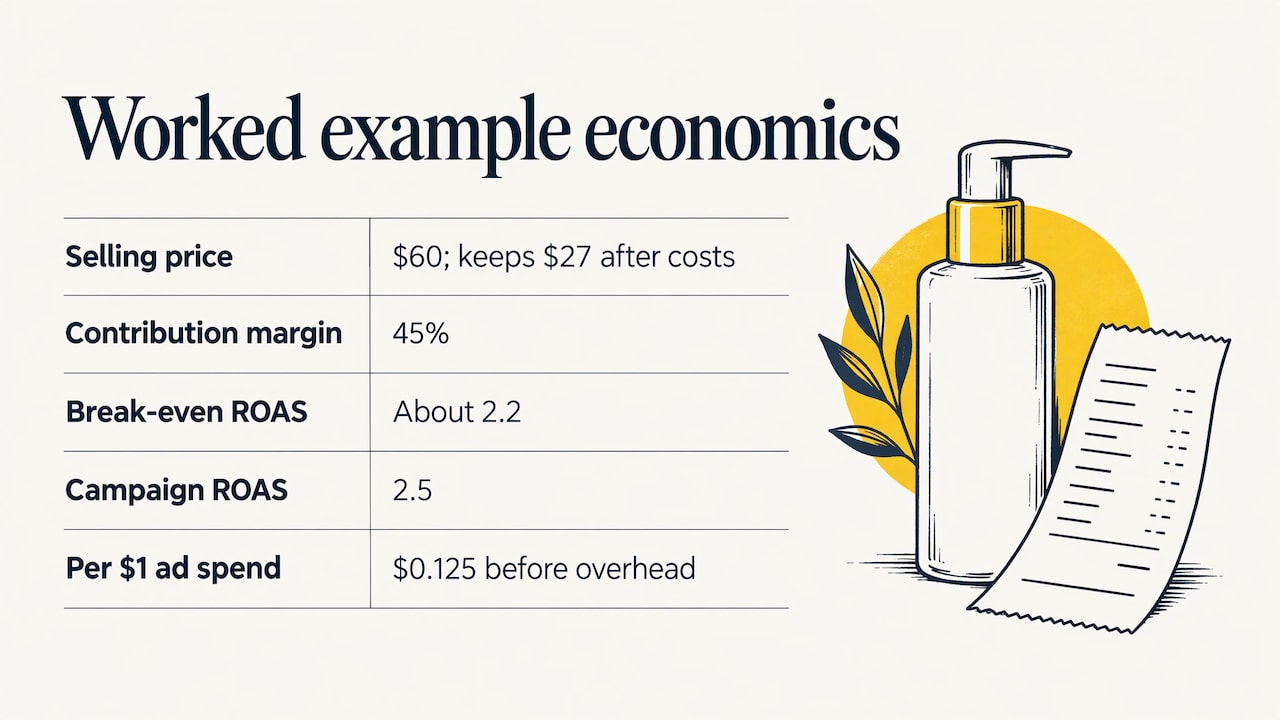
This example is illustrative and not a client result. Say a skincare brand sells a $60 product. After product cost, shipping, fees and average returns, it keeps $27, a 45% contribution margin. Break-even ROAS is 1 / 0.45, or about 2.2. A campaign reporting a 2.5 ROAS looks fine in the ad dashboard, but it leaves roughly 10 cents of contribution per dollar of ad spend (2.5 x 0.45 = 1.125, so $0.125 of margin per $1) before overhead. Once salaries, software and agency fees are counted, that campaign can easily lose money.
Now add retention. If 30% of those customers buy again at a similar margin within a year, the first-order break-even stops being the only test. You can accept a lower first-order ROAS because the second purchase repays it. That is how brands with strong retention outbid competitors for the same customer and still stay profitable.
Know your break-even and your target before you scale
Write down three ROAS figures for each major product line or campaign group:
- Break-even ROAS on a first order, from contribution margin.
- Target ROAS on a first order, set above break-even so that a first order produces a real contribution.
- Payback-adjusted ROAS, a lower floor you tolerate only when your repeat purchase data supports it.
The third figure is where most brands get greedy. Use it only with cohort data (customers grouped by the month they first bought) showing how many of them reorder and how fast. Without that, stay with the first-order target.
If you bid on Google with value-based strategies, the platform’s own documentation on target ROAS bidding explains how the setting works. Feed it a target that reflects margin, not an aspirational revenue number. A target set too high starves delivery, and one set too low buys unprofitable orders.
If your platform ROAS looks fine but the business feels tight, the cause is often hidden in the attribution. We cover how to find it in fixing low ecommerce ROAS by finding what is driving it.
How to scale ad spend without wrecking efficiency
Scaling ad spend profitably is less about the size of each increase than about what you check before and after it. A workable routine:
1. Confirm the account is ready
Before raising budget, check that tracking is accurate (purchases, values and deduplication between platforms and your store), that your best-selling products are in stock, and that margins on promoted products are known. Scaling toward low-margin items is the quickest way to grow revenue and shrink profit.
2. Raise budgets in measured steps
Increase budgets in moderate increments, then let the campaigns stabilize before the next one. Large jumps tend to push automated bidding back into a learning phase, where results are volatile. Many teams use steps of around 20% as a working habit, but treat that as a rule of thumb, not a platform requirement. What matters is that you wait long enough to read results, which for many accounts means several days at least, longer for low-volume campaigns.
3. Judge on MER and contribution, not platform ROAS alone
When you scale, platforms often claim credit for sales that would have happened anyway, including branded search and returning customers. Watch MER and new-customer revenue together. If spend rises 30% and total revenue rises 5%, the extra spend is mostly buying orders you already had.
4. Split new-customer and returning-customer performance
Blending them hides the truth. A campaign that looks efficient may be retargeting people already in your email list. Report new-customer CAC separately so you can see the real cost of growth.
5. Add channels when the current ones saturate
When a channel’s marginal return falls below your target (the next dollar returns less than the last), it is time to diversify instead of pushing harder. Search captures existing demand, while paid social creates it, so the two carry different roles. Pinterest and TikTok often reach different audiences again. Our teams run paid search and paid social campaign management as parts of one plan, not separate silos.
6. Refresh creative on a schedule
Creative fatigue is a common reason costs creep up. Plan new static and video concepts every cycle, test one variable at a time, and keep the winning angles in rotation. Strong creative lowers CAC without touching the budget at all.
Fix conversion before you buy more traffic
Every visitor you pay for passes through the same product pages, cart and checkout. If that path converts poorly, each dollar of extra spend is partly wasted. Raising conversion rate from 2% to 2.5% cuts the cost of each order by 20% with no change in ad spend, because the same traffic produces 25% more orders.
Baymard Institute’s aggregated research puts the average documented online cart abandonment rate at around 70%, per its cart abandonment statistics. That means most people who add an item never buy, which makes checkout friction one of the largest recoverable sources of profit in most stores.
Places to look first:
- Product pages: clear photography, honest sizing and shipping information, reviews near the buy button.
- Landing pages for paid traffic: match the page to the ad promise instead of sending every click to the homepage or a generic collection.
- Cart and checkout: fewer fields, visible total cost early, and the payment methods your customers actually use.
- Speed on mobile: most paid social traffic arrives on phones.
To go deeper, read our guides on raising ecommerce conversion rates to save CAC and how conversion optimization works. Product discovery matters too, since shoppers who cannot find the right item will not convert however good the ad was; see ecommerce product discovery.
Retention is what makes higher CAC affordable
Acquisition costs have risen for many brands as competition for the same audiences intensifies. You cannot control the auction, but you can control how much each acquired customer is worth. That is the lever retention pulls.
The components that usually carry the most weight:
- Welcome and post-purchase flows: automated email and SMS sequences that introduce the brand, teach product use and prompt a second order.
- Abandonment flows: cart, browse and checkout reminders that recover part of that roughly 70% who leave.
- Replenishment timing: for consumables, a message timed to when the product runs low.
- Segmentation by value: treating your best customers differently from one-time discount buyers.
- Winback: a defined path for customers who have lapsed.
The measure that ties these together is the repeat purchase rate and the margin on a second order, not open rates. Email and SMS are owned channels, so their marginal cost is low next to paid media, which is why they raise contribution without raising ad spend. Our Klaviyo setup and optimization work focuses on lifetime value and profit, not just send volume.
A brand that earns more from each customer can bid more for the next one. That is the practical meaning of sustainable ecommerce scaling: acquisition, conversion and retention improving together, so that no single channel carries the whole load.
Build the rest of the engine around profit
Paid media is only one growth source. Two others deserve a place in the plan.
Organic content compounds slowly but lowers your dependence on paid traffic over time. A plan for content marketing for ecommerce can bring in shoppers at the research stage, before they are exposed to competing ads.
Financial discipline matters just as much. Growth consumes cash: inventory is bought before it is sold, and ad spend is paid before revenue lands. Forecasting cash needs and tracking margin by product keeps a good growth month from becoming a cash crunch. These financial strategies for growing businesses cover budgeting and forecasting habits that support this.
A simple scaling scorecard
Use this table monthly. If a row is red, fix it before the next budget increase.
| Check | Question to answer | Healthy signal |
|---|---|---|
| Margin | Do we know contribution margin by product? | Ads point mostly at products above your target margin |
| Efficiency | Is MER holding as spend rises? | Total revenue grows roughly in line with spend |
| Acquisition | Is new-customer CAC stable? | CAC stays below the margin a customer returns within your payback window |
| Conversion | Is site conversion rate flat or improving? | Higher spend does not dilute conversion rate |
| Retention | Are repeat rates rising by cohort? | Newer cohorts reorder as well as older ones |
| Creative | Are new concepts in test every cycle? | A steady flow of winners replaces fatigued ads |
Our perspective
Brands rarely get stuck because they lack a channel. They get stuck because acquisition, conversion and retention are run by different people against different numbers, so each one looks fine while the business is squeezed.
That is why we built the Ecommerce Acceleration System™ around all three together, with profit as the shared target. When someone is deciding where the next dollar goes, the answer should come from margin and customer value, not from whichever dashboard looks best.
It is also why our client work is led by senior strategists and why we keep our roster small. Scaling decisions about budget, creative and lifecycle are judgment calls, and they deserve the same experienced person looking at the whole picture week after week.
Tom
Where Rozee Digital fits
If your acquisition costs are rising and you want one team accountable for acquisition, conversion and retention, Rozee Digital runs paid media, creative, landing pages and email and SMS for established Shopify, WooCommerce and Magento brands. Senior strategists lead the work, and the number of clients we take on is deliberately small.
To see how we would approach your account, start at rozeedigital.com, or look at our customer generation services if new-customer growth is the priority.
FAQ
How do I scale my ecommerce business without losing profit?
Set your break-even and target ROAS from contribution margin, raise spend in steps, and judge each step on MER and new-customer CAC rather than platform ROAS alone. Improve conversion rate and retention at the same time so each customer is worth more than the last.
What is the 80/20 rule in ecommerce?
It is the observation that a small share of products or customers often produces most of the revenue or profit. In practice, rank your products by contribution margin and your customers by lifetime value, then point most of your budget and attention at the top of both lists.
How fast can I increase ad spend?
There is no universal speed. A common habit is to raise budgets in modest steps and wait several days to read the results before the next one. If MER or new-customer CAC worsens after a step, hold or pull back before adding more.
What is a good ROAS for ecommerce?
The right ROAS is the one above your own break-even, which depends on your margin. A brand with a 45% contribution margin breaks even near 2.2, while a brand with a 25% margin needs 4.0 just to pay for the ads. Retention can justify a lower first-order target when cohort data supports it.