The lowest agency fee is not always the lowest-cost choice. Ecommerce marketing agency pricing models in 2026 typically center on a fixed retainer, a percentage of ad spend, or a hybrid that combines a base fee with performance-based compensation. The right fit depends on the work required, your media budget, and how the fee aligns with profitable growth.
Agency costs can be hard to compare when one proposal charges a fixed monthly fee and another scales with advertising spend. A percentage-based fee may rise as the budget grows, while a retainer makes the agency fee more predictable. Neither structure guarantees better performance. Scope, measurement, and alignment with business results matter just as much.
This guide explains how retainers, ad-spend fees, hybrid arrangements, and brand revenue can shape agency pricing. It also shows how to compare fee structures with acquisition and retention goals, so you can assess the full commercial commitment, not just the headline fee.
Key Takeaways
- Separate agency fees from ad spend, software, creative production, and onboarding to understand the full cost of an engagement.
- Assess a retainer against its scope and ongoing work, not just the monthly fee.
- Model how a percentage-of-ad-spend fee changes as your media budget grows, then compare it with a fixed or hybrid structure.
- Use brand revenue as context for choosing an agency scope, while keeping profitability and business needs at the center of the decision.
What are the main ecommerce agency pricing models?
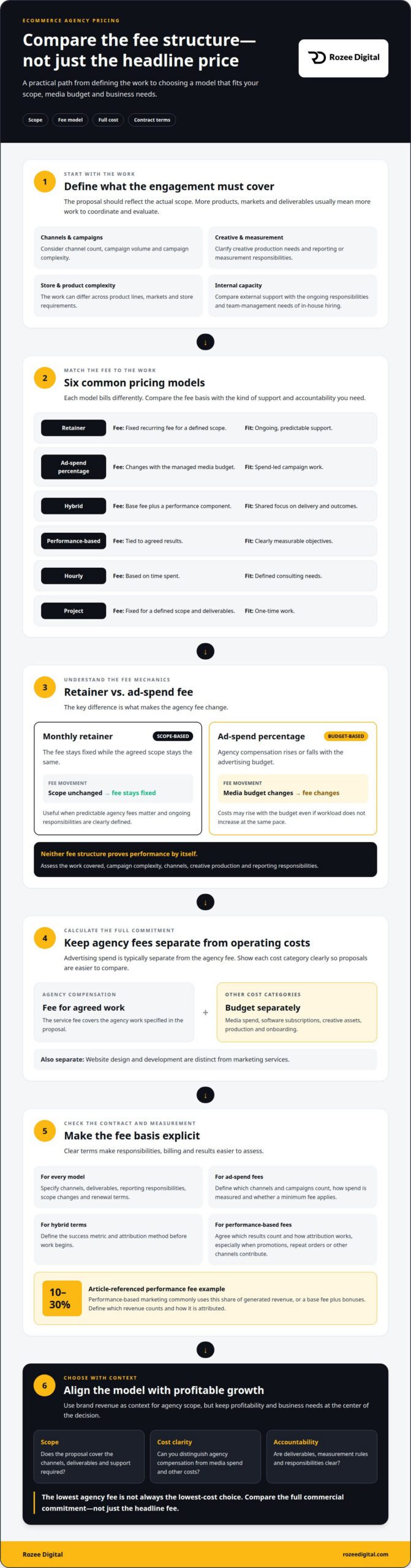
Ecommerce marketing agency pricing models 2026 generally include retainers, percentage-of-ad-spend fees, hybrid agreements, performance-based fees, hourly consulting, and fixed projects. The right structure depends on scope, channel mix, campaign complexity, creative requirements, and store size. More products, markets, and deliverables usually mean more work to coordinate and evaluate.
Ad spend is only one cost driver. Channel count, campaign volume, creative production, measurement needs, and store complexity all affect the work involved. Coordinating Google and Meta advertising across several product lines, for example, differs from focusing on one channel. The proposal should reflect the actual scope.
Budget for costs beyond the agency fee. Software subscriptions, creative assets, and production may be billed separately. Ask the proposal to identify each cost category and deliverable. This makes it easier to clarify responsibilities and compare proposals without confusing agency compensation with operating expenses.
Retail demand and advertising auctions also affect planning. Competition, customer demand, and platform pricing can change campaign costs and efficiency. Treat media budgets as adjustable inputs, then assess performance against conversion and business economics rather than assuming the same spend will produce the same outcome.
| Model | How the fee works | Best fit |
|---|---|---|
| Retainer | Fixed recurring fee for defined scope | Ongoing, predictable support |
| Ad-spend percentage | Fee changes with managed media budget | Spend-led campaign work |
| Hybrid | Base fee plus a performance component | Shared focus on delivery and outcomes |
| Performance-based | Compensation tied to agreed results | Clearly measurable objectives |
| Hourly | Pay for time spent | Defined consulting needs |
| Project | Fixed scope and deliverables | One-time work |
Compare agency support with in-house hiring: an employee brings ongoing salary and team-management responsibilities, while an agency fee covers agreed external work. Keep website design and development separate from marketing services. Choose the model that fits the deliverables, accountability, and internal capacity you need.
Monthly retainer pricing
A monthly retainer sets a recurring fee for agreed work and deliverables. Compare it with hourly, project-based, and hybrid arrangements by looking at scope, budget predictability, and how compensation changes when activity shifts.
Retainer-based service packages
A flat retainer keeps the agency fee stable as long as the agreed scope stays the same. Packages may cover specific channels or broader services, such as SEO, email marketing, or multiple areas of work. Unlike hourly billing, the fee does not fluctuate with time spent. Unlike project pricing, it supports ongoing responsibilities rather than a single deliverable.
Scope shapes the relationship. A contract should identify channels, deliverables, reporting responsibilities, and how additional work is handled. For example, if email supports customer retention alongside paid acquisition, specify the lifecycle work and reporting included. Email marketing services are one distinct scope to define. Clear terms help the business assess whether the retainer matches its operating needs.
Percentage-of-ad-spend pricing
In this model, the agency fee is calculated as a share of advertising spend. Unlike a flat monthly retainer, it changes as ad spend changes. This can tie compensation to campaign scale, but costs may also rise with the budget even if the workload does not increase at the same pace.
Set the calculation basis in the contract. Specify which channels and campaigns count, how spend is measured, and whether a minimum fee applies. Keep advertising spend separate from agency compensation so the total commitment is clear. A hybrid arrangement combines a fixed base with a performance component; define the success metric and attribution method before work begins.
Hourly pricing charges for time and can suit bounded consulting, such as reviewing a specific account question. Project pricing ties payment to a defined output, while retainers cover ongoing responsibilities. Hybrid terms pair a predictable base with an outcome-linked element. Before choosing, review each contract’s scope, billing basis, deliverables, and renewal terms.
What is the difference between a retainer and a percentage-of-ad-spend model?
A retainer sets a fixed fee for agreed work, while an ad-spend model ties the fee to media investment. Compare both against the scope, measurement rules, and how compensation changes as advertising activity scales.
Ad-spend fees versus monthly retainers
With percentage-of-ad-spend pricing, agency compensation rises or falls with the advertising budget. A monthly retainer stays fixed while its agreed scope remains unchanged, making the service fee more predictable as media spend shifts. Neither structure proves performance by itself. Assess the work covered, campaign complexity, channels, creative production, and reporting responsibilities.
Performance-based pricing uses a separate basis. It links compensation to an agreed outcome, such as attributed revenue. Performance-based marketing commonly uses 10-30% of generated revenue, or a base fee plus bonuses. The contract must define which revenue counts and how attribution works, especially when promotions, repeat orders, or other channels contribute to sales.
Advertising budgets billed separately
Advertising spend is typically separate from agency fees. The service fee covers agreed agency work; the media budget pays for placements on advertising platforms. A proposal should show these amounts separately and explain whether creative production, software, or onboarding is included or billed as additional work.
Compare proposals using a written scope that lists every cost category and deliverable. This reveals what each fee covers and clarifies the full financial commitment. A lower service fee may reflect a narrower scope, so compare responsibilities, not just headline amounts.
Scope, contract length, and performance fees
Assess each proposal’s channels, campaign responsibilities, reporting, creative production, and measurement method. Distinguish attributed revenue from incremental revenue, or sales that would not otherwise have occurred. Agree on the baseline, calculation rules, exclusions, and payment timing before the engagement begins.
Red flags include vague attribution, undefined performance triggers, or compensation based on revenue without agreed exclusions. Review renewal, notice, and exit terms alongside the scope. A contract should clarify responsibilities and evaluation criteria, so both parties can assess the relationship against commercial outcomes rather than disputed assumptions.
Choose an arrangement that makes compensation, scope, and accountability clear. Compare the full proposal with your growth priorities and the economics of the channels involved.
Agency pricing by ecommerce brand revenue
Annual revenue is a useful starting point for defining agency scope, not a fixed fee formula. Revenue bands indicate operating scale, but actual costs depend on channels, deliverables, media complexity, and the support a brand needs. A profitable engagement must fit the business’s margins and measurement requirements, not just its top-line sales.
According to Common Thread Collective’s 2026 Ecommerce Agency Benchmark, brands with $1M to $10M in revenue are classified as seven-figure brands, while those with $10M to $100M are classified as eight-figure brands. These labels help frame maturity, but two brands in the same band can have different acquisition economics, product portfolios, and internal capabilities.
For brands with less than $2M in annual revenue, single-channel management focused on one acquisition channel may fit better than a broad engagement. Concentrating scope can keep responsibilities clear while the team evaluates customer acquisition cost (CAC), conversion, and the contribution margin generated by that channel.
- Under seven figures: Prioritize a defined channel and clear reporting before expanding scope.
- $1M to $10M in revenue: Match agency responsibilities to the growth constraints and internal capacity of a seven-figure business.
- $10M to $100M in revenue: Coordinate channel performance and margin reporting across a more complex operation.
Above $3M in annual revenue, a brand may be suited to broader marketing that includes retention and SEO. At nine-figure revenue, custom engagements are typical because team structure, markets, and reporting needs vary widely. Revenue alone does not establish whether added channels will be profitable; actual results depend on unit economics, repeat purchasing, and incremental contribution.
Set the commitment around business priorities. Define ownership, reporting cadence, channel scope, and the margin measures used to assess the relationship. Compare agency responsibilities with internal capacity, then expand only when the operating model supports it. Discuss a scope that fits your brand’s growth stage.
Rozee Digital: Ecommerce ads agency
Rozee Digital supports ecommerce brands managing paid acquisition and email marketing. Turn to its services when your growth plan needs focused campaign management across advertising and retention, rather than a website build or ecommerce platform.
For brands prioritizing search, a Google Ads agency can support paid search activity. For paid social acquisition, Facebook Ads management addresses a different channel. Email marketing can complement acquisition by supporting customer retention. The right scope depends on your channel priorities, internal capacity, and the commercial outcomes your team tracks.
Bring your growth priorities and channel requirements into the conversation. Contact Rozee Digital to discuss your ecommerce marketing needs.
Set the commercial terms before scaling
Your next decision is not just choosing a fee format. First define what the engagement should achieve: more efficient acquisition, improved conversion, or better coordination between paid media and retention. Set the business outcome, then clarify responsibilities, reporting ownership, and decision rights. That makes the agreement an operating framework tied to results, not an expense detached from them.
Use ecommerce marketing agency pricing models for 2026 as a framework, not a substitute for brand-specific economics. A workable scope should reflect your margin profile, acquisition priorities, and the channels your team can support. ROAS measures revenue against ad spend; assess it alongside contribution margin to understand whether growth supports the business. Align on how results will be reviewed and what changes prompt a scope discussion.
Rozee Digital provides ecommerce advertising, including Google Ads and Facebook Ads management. To connect agency scope with your growth priorities, discuss pricing with Rozee Digital. Bring your channel priorities and commercial objectives into the conversation. Clear terms create a stronger foundation for deliberate, profitable growth.
Frequently Asked Questions
How much does an ecommerce marketing agency cost?
An agency fee depends on the scope, channels, creative requirements, and level of strategic support. Ask Rozee Digital about pricing for the engagement you are considering. Set your evaluation around the work required and the business outcomes you need, rather than relying on a general market figure that may describe a different service mix or operating model.
Are onboarding or setup fees normal when hiring an ecommerce agency?
Some agency agreements separate initial onboarding from ongoing services; others include it in the first engagement period. The distinction depends on what setup involves, such as account access, measurement planning, campaign structure, and coordination with your internal team. Ask for onboarding deliverables to be listed in the scope, so the initial work is clear and does not become an unexpected recurring charge.
Do Agency Fees Include Ad Spend?
Ad spend is usually separate from the agency fee, but the proposal should say so explicitly. For example, an agency invoice may cover strategy while platform charges remain a separate media cost. Reconcile the contract, invoices, and advertising account billing before approving budgets. This helps finance distinguish service expenses from paid placements and track total marketing investment accurately.
Does a lower hourly rate always mean a lower total cost?
No. Total cost depends on the time required, the work that time produces, and whether revisions or coordination add effort. A lower rate can cost more overall if a task takes longer or needs repeated correction. Compare the estimated effort and defined output in each proposal. For example, assess the time and deliverables for an account review, not just its hourly charge.
How Can I Get the Best Value from My Agency Partnership?
Set a shared business objective and provide timely access to the inputs needed to act on it. Product availability, promotional calendars, and pricing changes, for example, can affect advertising decisions. Agree on who approves changes and how performance is reviewed. Value comes from coordinated decisions and useful analysis, not simply from maximizing the number of tasks in an agreement.
How should you budget for eCommerce growth?
Build a forecast that separates media, agency services, creative production, technology, and retention activity. Test the planned investment against cash flow, inventory capacity, and contribution margin. A brand preparing for a seasonal peak, for example, should account for stock availability before increasing acquisition budgets. Revisit the forecast when costs, conversion performance, or repeat-purchase behavior changes.