Performance creative strategy is the discipline of treating every ad as a testable argument for a specific customer, then judging it on business outcomes such as profit and repeat purchase, not on how it looks or how many clicks it earns. In practice it is a loop: gather customer evidence, form a hypothesis, test one variable, read the result against pre-set rules, and feed what you learned into the next round. This guide shows how to run that loop at an established ecommerce brand.
TL;DR
- Creative is the biggest lever you control in paid media. Nielsen research attributes a larger share of sales contribution to creative than to targeting, reach or recency.
- A testing framework is a repeatable sequence: evidence, hypothesis, one variable, decision rules set before launch, an uninterrupted test, documented learnings.
- Judge creative on cost per purchase or purchase ROAS first, and use hook rate, CTR and conversion rate to diagnose why, not to declare winners.
- Check results against incrementality and retention, so you scale ads that bring profitable customers, not just cheap first orders.
- Write every result down where creative, paid and ecommerce teams can read it.
Table of Contents
- What performance creative strategy actually is
- Start with evidence, not ideas
- A creative testing framework in seven steps
- What to test first
- Sizing tests: conversions, time and confidence
- Metrics that decide winners
- Turn results into the next round
- Beyond acquisition: retention and lifetime value
- Our perspective
- Where Rozee Digital fits
- FAQ
- Sources
What performance creative strategy actually is
Creative strategy answers one question: what should we say, to whom, in what form? The “performance” part means the answer is treated as a hypothesis to be proven with data, not a taste call from a design review.
That matters because creative does more of the work than most media plans assume. Nielsen reported that creative quality contributed as much to in-market advertising success as all other measured factors combined, and in strong campaigns creative accounted for up to 80% of success on traditional TV and 89% on digital. A separate Nielsen and NCSolutions analysis of nearly 500 campaigns attributed 47% of sales contribution to creative, against 9% for targeting, 22% for reach, 5% for recency, 2% for context and 15% for brand. These studies are several years old and cover advertising broadly, so treat them as direction, not a promise for your account. The direction is clear, though: as platforms automate targeting and bidding, the thing you still control is what the ad says and shows.
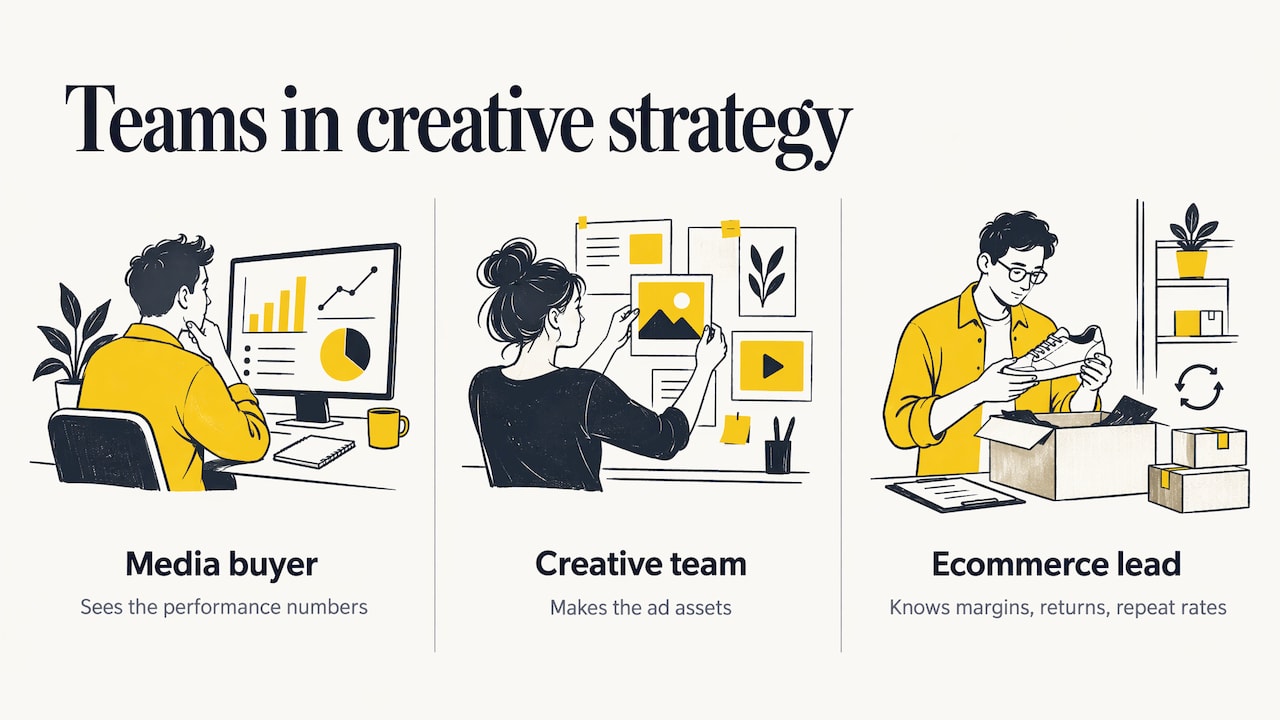
A performance creative strategist sits between three groups: the media buyer who sees the numbers, the designers and editors who make the assets, and the ecommerce lead who knows margins, returns and repeat rates. The job is to turn customer insight and performance data into a clear, testable brief.
Terms used in this guide
- CAC (customer acquisition cost): total acquisition spend divided by new customers won.
- ROAS (return on ad spend): revenue attributed to ads divided by ad spend. A 3.0 ROAS means $3 of tracked revenue per $1 spent. It ignores margin, returns and what happens after the first order.
- MER (marketing efficiency ratio): total revenue divided by total marketing spend across all channels. It is blunt but hard to game, because no platform attribution model is involved.
- LTV (lifetime value): the gross profit, or revenue if you state it that way, a customer generates over a defined period. Use the same definition every time you compare.
Start with evidence, not ideas
Most weak tests fail before launch, because the brief began with “let’s try a video.” A stronger starting point is customer evidence: reviews, support tickets, post-purchase survey answers, search terms, returns reasons and the language your best repeat customers use.
From that pile, pull three things:
- Motivations: why people buy (the problem, the identity, the occasion).
- Objections: what stops them (price, sizing, trust, shipping time).
- Proof: what convinces them (reviews, demonstrations, comparisons, guarantees you actually offer).
Each becomes a candidate angle. A brand selling skincare might find that reviews keep mentioning “finally stopped breaking out,” which suggests an angle about a specific result, not the generic “clean ingredients.” That is a hypothetical example, but it shows the shape: the angle comes from customer words, not from the studio.
If you want a deeper look at turning raw ideas into briefs, our guide to ecommerce ad creative development walks through the process, and these ad creative tips cover the visual basics.
A creative testing framework in seven steps
One published ecommerce framework describes seven repeatable stages: a falsifiable hypothesis, one isolated variable, a testing method, a budget and duration, decision rules set before launch, an uninterrupted test, and documented results. Here is how we would apply those stages in a working ecommerce account.
1. Write a falsifiable hypothesis
A good hypothesis names the insight, the single variable, the audience and the success metric. Example (hypothetical): “Because reviews mention fit anxiety, leading with a ‘true to size’ demonstration will lower cost per purchase among prospecting audiences compared with our current lifestyle opener.” If no result could prove that sentence wrong, it is not a hypothesis.
2. Isolate one variable
Changing one thing at a time keeps results attributable. If version B has a new hook, a new offer and a new format, a win teaches you nothing you can reuse. That does not mean you can only test tiny tweaks. A new concept (a different angle) counts as one variable if everything else is held constant.
3. Choose the testing method
There are three practical options:
- Platform split test: the platform divides the audience evenly and reports a comparison. Cleanest read, slower and costlier.
- Dynamic or multi-variant ad set: the algorithm shifts spend toward early favorites. Faster, but it can starve ads that need more time.
- Separate test campaign: new concepts run apart from your scaling campaigns, and winners graduate into them.
Pick one and keep it consistent between rounds so results stay comparable.
4. Set budget and duration
See the sizing section below. The principle is to fund each version enough to reach a decision, and to decide the budget before you see any data.
5. Pre-commit decision rules
Write down, before launch, what counts as a win, a loss and an inconclusive result. For example: “Version B wins if cost per purchase is at least 15% lower after 50 purchases per version; otherwise we keep control.” The 15% there is a placeholder for you to set against your own margin, not a benchmark. Rules written after the fact tend to favor whichever ad you already liked.
6. Run the test without meddling
Editing budgets, swapping ads or pausing the “loser” on day three resets learning and muddies the read. The same source puts it bluntly: uploading random ads and watching CPA is gambling, not testing.
7. Document and share
Log the hypothesis, the setup, the result and the decision. Store it where creative, paid and ecommerce leads can all read it, because a winning hook can also be reused on product pages and in email subject lines. Our guide to ad creative analysis covers how to read the results.
What to test first
Not all variables are equal. The same framework suggests prioritizing in this order: concept, then hook, format, offer and copy. The logic is that the big swings come from what you say, not from button colors.
| Variable | What it is | Typical question |
|---|---|---|
| Concept | The core angle or argument | Do we lead with the result, the problem, or social proof? |
| Hook | The first 1 to 3 seconds or the headline | Which opening stops the scroll for this audience? |
| Format | Static, video, carousel, UGC style | Does the same concept work better as a demo video? |
| Offer | Bundle, discount, free shipping, guarantee | Does the offer change who buys, and at what margin? |
| Copy | Primary text, headline, call to action | Does a shorter line change conversion? |
A sensible rhythm is to run concept tests to find a few promising angles, then run iterative tests on the winners: new hooks, formats and offers around the same core idea. Keep a steady trickle of fresh concepts going, because every winning angle eventually fatigues. Our ad creative testing guide goes deeper on setup.
What about the 3-3-3 rule?
You may see “the 3-3-3 rule in marketing” mentioned. One common version is a messaging planning shortcut: three benefits, for three audience segments, across three touchpoints. It is a useful way to keep a brief from sprawling. It is not a statistical rule, and it says nothing about how much budget or time a test needs. Use it, if you like it, to structure the concepts you will test, then let the framework above decide the winners.
Sizing tests: conversions, time and confidence
Underpowered tests are the most common source of false winners. Three guardrails help.
Conversions per version. A practical target is about 50 purchase conversions per version. If your cost per purchase is $40, that is roughly $2,000 per version before you can read the result, which is why low-volume accounts should test fewer, bigger ideas.
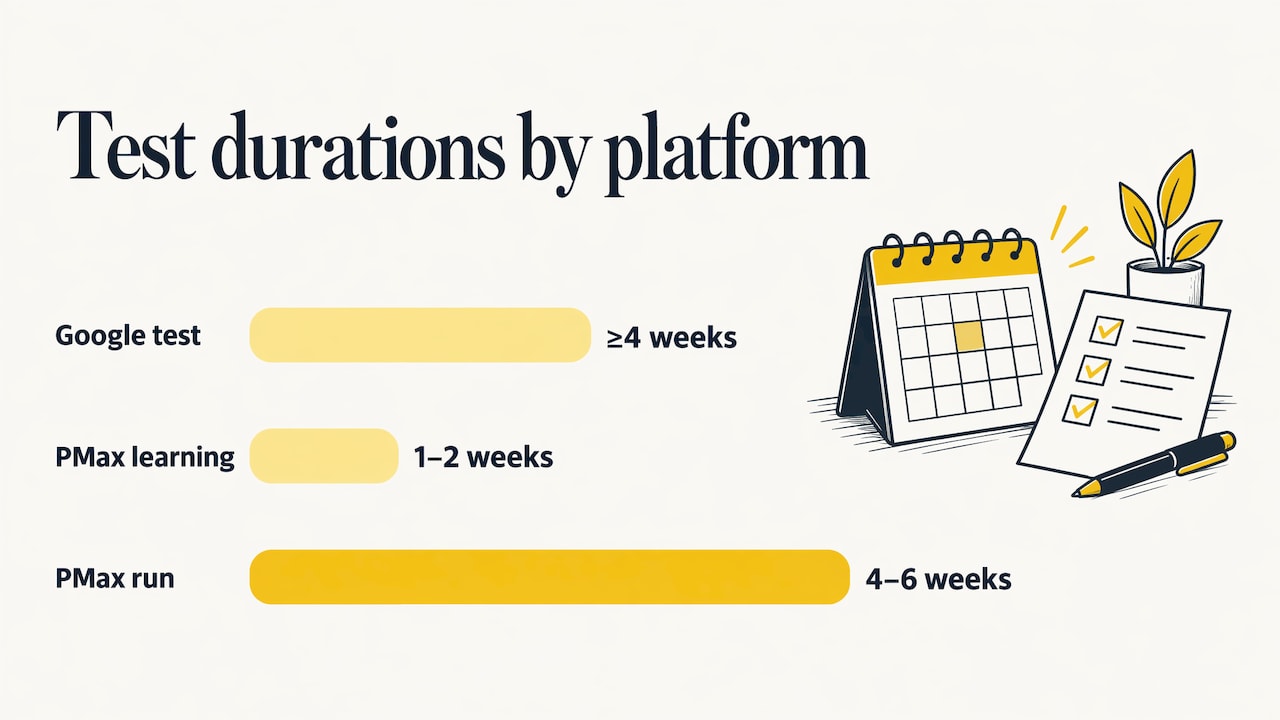
Duration. The same source notes that Meta recommends at least 7 days (up to 30) for tests, while Google recommends at least 4 weeks. For Performance Max, Google’s guidance says a sound experiment starts with a clear hypothesis and one or two business-relevant metrics, uses comparable campaign settings, allows a 1 to 2 week learning period and runs at least 4 to 6 weeks for more accurate results. Check the platform’s current documentation before you plan, since these numbers get revised.
Chance. A p-value is the probability of seeing your results if the experiment had no real effect, and a threshold of 0.05 corresponds to 95% confidence. A lift that does not clear your threshold is a hint, not a result. Treat it as a reason to retest.
The same discipline applies to search and shopping. If you are applying experimentation to Google campaigns, planning digital campaigns around organic and paid learning is one way to think about how tests feed a wider program.
One more caution on structure. In 2022, Meta advised advertisers to consolidate ads, ad sets and campaigns and try broad targeting so its delivery system could find opportunities. That guidance is a reason to keep test structures simple: fewer, cleaner ad sets, with creative doing the differentiating.
Metrics that decide winners
Clicks are cheap to win and easy to misread. A thumb-stopping ad that attracts browsers can post a great CTR and a poor return.
A workable hierarchy:
- Primary metric: cost per purchase, or purchase ROAS when order values differ between versions.
- Diagnostics: hook rate (the share of viewers who watch past the opening seconds), CTR, landing page conversion rate and AOV (average order value). They explain why a version won or lost.
- Profit check: contribution margin after product cost, shipping and returns. A winner at 3.0 ROAS on a 40% margin product may lose money once fees and returns are counted.
Our guides to ad creative metrics and ad creative ROI cover the definitions in more depth, and the piece on tracking real store profit from paid social shows how to move from platform numbers to margin.
Check incrementality, not just attribution
Platform-reported conversions include people who would have bought anyway. Meta’s measurement guidance says incrementality is best measured by experiments, including Conversion Lift studies. Google’s ASOS case study describes using brand-lift studies and geo experiments, reporting a 22% lift in site visits and sales in the United States and a 45% lift in conversions in Canada. It is one retailer’s result, and not a benchmark for yours, but the method travels: hold out a region or audience and compare.
You do not need a lift study for every test. Use creative tests to pick candidates, then use an incrementality check when you are about to scale spend on a winner or when MER and platform ROAS tell different stories.
Turn results into the next round
A test is only finished when the next brief is written. A simple routine:
- Read against the rules. Compare to the decision rules you set, using the primary metric first.
- Explain with diagnostics. If version B won, was it the hook rate, the landing page conversion, or AOV?
- Promote the winner into your scaling campaign and keep the control as a benchmark for a period.
- Seed variants. Use the winning concept as the seed for further variants (new hooks, formats, offers) while continuing to develop fresh concepts, as in combined concept and iterative testing.
- Log it. Hypothesis, setup, result, decision, next step.
Over a few quarters this log becomes your most valuable asset: a map of which arguments work for which customers.
Beyond acquisition: retention and lifetime value
The cheapest first order is not always the best customer. A discount-led angle can win on cost per purchase and then deliver customers who rarely return. If you only read the first-order number, you will keep scaling the wrong ads.
The fix is to close the loop. Tag each test winner by the angle it used, then look at how the customers acquired through it behave over 60, 90 or 180 days: repeat rate, AOV on second orders, refunds. Feed that back into the next brief, so angles that attract loyal buyers get more budget even if their first-order CPA is slightly higher. Email and SMS are the natural place to carry the same argument forward after purchase, and hooks that win in ads often make strong subject lines.
Our perspective
Most agencies manage campaigns. We think the creative testing loop only pays off when it is tied to acquisition, conversion and retention together, because an ad that wins on cost per purchase but sends traffic to a weak page, or brings customers who never reorder, has not really won.
That is the idea behind our Ecommerce Acceleration System™. We keep a deliberately small client roster and put senior strategists on the work, so the person who reads your test results is the person who designs the next test. Our bias is toward fewer, sharper tests with pre-set rules, judged on profit, not on the metric that looks best in a platform dashboard.
— Tom
Where Rozee Digital fits
If you run an established Shopify, WooCommerce or Magento brand and your CAC is climbing while creative output is ad hoc, structure usually helps more than volume. Rozee Digital runs paid social campaign management and paid search, along with static and video ad creative, landing pages, and email and SMS, so test insights move across the whole funnel.
If you would like senior eyes on your current creative testing process, talk to Rozee Digital about where the biggest gaps are.
FAQ
What is a performance creative strategist?
A performance creative strategist turns audience insight and performance data into testable creative direction. They write the briefs and hypotheses, work with media buyers and designers, and read results to decide what to make next. The role connects the numbers to the creative team.
How long should a creative test run?
It depends on the platform and your volume. Published guidance puts Meta at a minimum of 7 days and Google at 4 weeks or more, with Performance Max experiments recommended at 4 to 6 weeks after a learning period. Check each platform’s current documentation, and decide the stopping rule before launch.
How many creatives should I test at once?
Fewer than most teams think. Each version needs enough purchase conversions, around 50 as a practical target, to be read reliably. If your budget cannot fund that for every version, test two or three distinct concepts instead of a dozen variants.
Is ROAS enough to judge creative?
No. ROAS ignores margin, returns and repeat purchases, and platform attribution can overcount. Use cost per purchase or purchase ROAS as the primary test metric, then check profit, MER and, for big spend decisions, an incrementality test.
Sources
- Nielsen: Want a Successful Ad? Get Creative
- Nielsen and NCSolutions: Five Keys to Advertising Effectiveness
- Ad Creative Testing Framework for Ecommerce
- Creative Testing Playbook
- Google Ads API: Report on experiments
- Google: Key tools to run successful Performance Max campaigns
- Social Media Today: Meta ad performance insights
- Meta: Measurement 360
- Google: How ASOS used incrementality to drive growth
- Innervate: Beyond Basic Creative Testing
- Planning digital campaigns that drive organic growth