Author: Tom Rozee, Founder
Tom Rozee has been running paid media since 2016. He has helped E-commerce brands generate more than $500M in client revenue and managed over $100M in ad spend.
Introduction
Paid social can put your products in front of people before they search for them. That makes it powerful for E-commerce brands. It can also waste money fast when the offer, creative, audience, or landing page is weak.
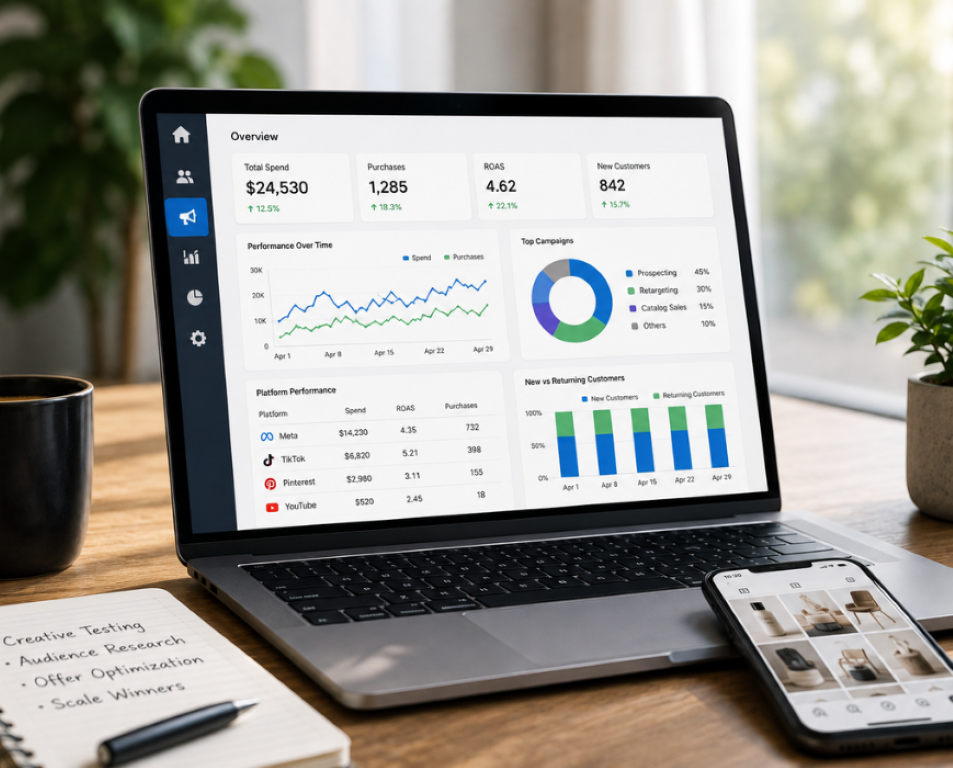
A paid social agency should do more than launch ads. It should understand why a person stops, clicks, buys, and comes back. It should connect creative testing with customer economics. It should know when to scale, when to hold spend, and when the real problem sits outside the ad account.
This guide explains how paid social works for E-commerce, which channels matter, how Meta and TikTok fit into a wider plan, and what good E-commerce social advertising looks like. You will learn how to measure paid social ROI E-commerce brands can trust, set budgets, and decide when an agency makes sense.
This guide gives checks you can use before changing campaigns or hiring outside help for a brand. The goal is clear. Know what to ask, what to measure, and what your paid social partner should own before you spend more. It also shows where paid social fits beside email, search, and direct traffic. This helps you plan better before making major changes.
What Is a Paid Social Agency?
A paid social agency plans, creates, runs, tests, and improves ads on social platforms. For E-commerce, the work should connect media buying with products, offers, creative, conversion, and retention.
Common paid social agency services include:
- Account setup and campaign planning
- Audience and market research
- Creative strategy and testing
- Meta ad management
- TikTok campaign management
- Budget and bid planning
- Product catalog setup
- Conversion tracking checks
- Landing page reviews
- Performance reporting
- New customer analysis
The job is to turn paid attention into profitable customer growth.
Rozee Digital has applied this approach to help E-commerce brands generate more than $500M in client revenue and managed over $100M in ad spend — turning paid attention into measurable, profitable growth.
Why E-commerce Needs a Different Paid Social Strategy
Social ads differ from search ads. Search often captures demand that already exists. Social can create interest before a shopper knows what to search for.
Your ad must stop the scroll. Your message must make sense fast. Your page must keep the promise.
The path is:
Attention → Interest → Product View → Purchase → Repeat Purchase
The Problem With Chasing ROAS
ROAS is useful, but it is not the full answer.
Imagine a brand sells a $120 product. One campaign reports a 4.5x ROAS. That sounds strong. But much of the revenue comes from existing customers.
Another campaign reports a 3x ROAS. Most buyers are new. They also have a strong repeat purchase rate. The second campaign may create more long-term value.
Your team should review:
- New customer CAC
- Contribution margin
- Average order value
- Customer lifetime value
- Payback period
- Repeat purchase rate
- New customer revenue share
A paid social ROI E-commerce plan should connect ad results with these numbers.
What Channels Should E-commerce Brands Use?
There is no universal channel mix. The right choice depends on the product, audience, creative style, price, purchase cycle, and data.
| Channel | Best Use | Main Role |
| Meta | Broad E-commerce demand | Prospecting and retargeting |
| Visual product discovery | Product and brand stories | |
| TikTok | Creator-led discovery | Demand creation |
| Planning and discovery | Product inspiration | |
| YouTube | Video education | Awareness and consideration |
Meta Ads for E-commerce
Meta ads can help brands reach shoppers based on interests, behaviour, signals, and platform activity. Its strength often comes from creative testing and broad reach.
A strong setup needs tests for hooks, offers, product angles, formats, and proof.
For example, a skincare brand might test:
- A problem-led hook.
- A product demonstration.
- A customer review.
- A founder story.
- A comparison with a common alternative.
The goal is to learn which message makes the right buyer care.
TikTok Ads for E-commerce
TikTok can work well when products are easy to show, explain, or demonstrate. It can also work for brands with strong creator content.
A good TikTok test might compare:
- Creator review
- Product demo
- Before-and-after story
- Founder explanation
- Customer reaction
TikTok and Meta Ads E-commerce agency
Using both channels can reduce dependence on one source of paid demand. But do not run identical creative everywhere.
Use each platform for its strengths. Then compare customer quality, not only platform ROAS.
How to Build an E-commerce Paid Social Agency UK Strategy
A strong plan starts with the business. The media account comes later.
1. Define the Business Goal
Choose the outcome first.
Do you need more new customers? More revenue? Better margin? More repeat sales? A stronger launch?
The goal affects the campaign setup and the data you should review.
2. Know the Customer
Build a simple picture of the buyer.
Ask:
- What problem are they trying to solve?
- What makes them hesitate?
- What alternatives do they consider?
- Why would they choose your product?
- What proof helps them trust you?
3. Build the Offer
A weak offer makes the media work harder.
Review price, bundles, discounts, guarantees, shipping, proof, and product benefits.
For example, a $90 product with free shipping and a useful bundle may feel easier to buy than the same product sold alone.
4. Create Multiple Angles
One product can solve different customer needs. A running shoe could be sold around comfort, speed, injury support, daily use, or trail grip.
Each angle can become a creative test.
5. Match Creative to the Buyer Stage
Cold audiences need a reason to care. Warm audiences may need proof. Returning shoppers may need a reason to buy again.
A simple structure can look like:
Cold: Problem → Product → Benefit
Warm: Proof → Objection → Offer
Hot: Product → Urgency → Purchase
This helps your message match the buyer’s state.
6. Build the Landing Page Around the Ad
Your ad creates a promise. The page must keep it. If the ad promotes a specific bundle, show that bundle first. If it makes a product claim, explain the claim on the page. A message mismatch can waste good traffic.
7. Track the Right Events
Your tracking should show the path from click to purchase.
Review:
- View content
- Add to cart
- Begin checkout
- Purchase
- New customer purchase
Bad tracking can make good campaigns look weak. It can also make weak campaigns look good.
How Does Creative Testing Work?
Creative is often one of the biggest growth drivers in paid social. But testing should have a reason.
Do not change five things at once and call it a test. Change one main idea, then learn from the result.
Test the Hook
The first seconds matter in video. The first line matters in static ads.
Examples:
- “Still replacing this every month?”
- “Three reasons your morning routine feels slow.”
- “What if your dog refused every other bed?”
The hook should attract the right person.
Test the Proof
Proof can include:
- Customer reviews
- Ratings
- Demonstrations
- Creator clips
- Product tests
- Expert comments
- Before-and-after evidence
Use proof that fits the product. Do not make claims you cannot support.
Test the Offer
Try different reasons to buy:
- Bundle
- Free shipping
- First-order offer
- Limited-time promotion
- Gift with purchase
- Subscription
Watch the margin while testing. A promotion that raises orders but hurts contribution may not be a win.
How Should Paid Social Budgets Work?
The budget should follow demand, economics, creative capacity, and inventory. Start with your target customer acquisition cost. Then check whether your margin can support it.
For example, suppose a brand has a $100 average order value. Its contribution after product and fulfilment costs is $45. A $60 acquisition cost would create a problem unless repeat purchase value changes the economics.
That simple check can stop a brand from scaling an unprofitable campaign.
Budget Allocation
Do not split spend evenly just because the account has several campaigns.
A stronger approach asks:
- Which audience has room to grow?
- Which creative is winning?
- Which product has a healthy margin?
- Which channel brings quality customers?
- Is inventory available?
- Is the offer still strong?
The budget can then move toward real opportunity.
What Does Good Paid Social Management Look Like?
It is clear decision-making.
Creative Performance
Which hooks, formats, angles, and creators attract buyers?
A winning creative should teach you something. Maybe customers care about ease of use. Maybe price matters more than expected. Maybe a product demonstration beats polished brand footage.
Audience Quality
Are new customers coming from the intended market? Are they buying at healthy costs?
Do not judge an audience only by cheap clicks. Check purchase behaviour and customer value.
Product Performance
Which products drive profit? Which ones consume without enough return?
A brand may have ten products but only three with enough margin and demand to support aggressive acquisition.
That should affect the budget.
Funnel Performance
Where do shoppers stop?
A high click-through rate with low add-to-cart activity may point to a landing page issue.
Strong carts with weak purchases may point to checkout, shipping, price, or trust.
The data should help you find the broken step.
Customer Quality
A first order can be only the start.
Track repeat purchase rate and customer value when enough data exists.
A campaign that attracts loyal customers may deserve more spend than one that creates one-time buyers.
How Do You Measure Paid Social ROI E-commerce Brands Can Trust?
Start with ad metrics:
- CPM
- CTR
- CPC
- Conversion rate
- Cost per purchase
- ROAS
Then move deeper:
- New customer CAC
- Contribution margin
- Average order value
- Customer lifetime value
- Payback period
- Repeat purchase rate
Then compare channel results with the wider business.
A campaign may show a 3x ROAS while the brand struggles to make money. Another campaign may show 2.5x ROAS and create better new customer growth.
For example, a fashion brand with strong repeat purchases may accept a higher first-order CAC. A one-time purchase brand may need tighter acquisition costs.
Paid Social Agency vs. In-House Team
Both models can work. The choice depends on your spend, team, creative needs, and growth stage.
| Factor | In-House | Agency |
| Specialist skills | Depends on team | Access to specialists |
| Hiring | Internal | Already staffed |
| Creative testing | Depends on resources | Shared experience |
| Channel knowledge | Team-dependent | Wider exposure |
| Cost | Salaries and tools | Agency fee |
| Outside view | Limited | Built into the model |
An in-house team may work well when you have enough volume to support senior talent.
An agency can make sense when you need specialist media buying, creative testing, or channel skills without hiring a full team.
What Should You Look for in a Paid Social Agency?
Choosing a partner should start with how they think.
E-commerce Experience
Ask whether the team understands products, margins, catalogues, repeat purchases, and customer acquisition.
A team that only knows platform settings may miss the business problem.
Senior Specialists
Find out who touches the account.
You should know who makes major media decisions and who owns the results.
Ask what happens after the sales call. If senior people sell the work but junior staff run it, you should know before signing.
Creative Strategy
Ask how they create and test ads. A media plan without a creative plan is incomplete.
You should hear clear answers about hooks, angles, formats, customer objections, proof, and testing speed.
Clear Reporting
Reports should explain:
- What happened
- Why it happened
- What changed
- What comes next
Reports should help you make decisions. They should not simply repeat platform numbers.
Full-Funnel Thinking
The agency should be willing to question the offer, page, checkout, and retention. Do not accept a report that blames every problem on the platform.
What Are Common Paid Social Mistakes?
1. Scaling Weak Creative
More spending does not fix a message people ignore.
If an ad fails to create interest, adding budget can simply create more expensive failure.
2. Testing Too Little
One winning ad cannot carry an account forever.
Markets change. Creative fatigue happens. Competitors copy ideas. Your team needs a steady test plan.
3. Chasing Cheap Clicks
Cheap traffic can still produce weak customers.
A low CPC means little if shoppers do not buy.
4. Ignoring Margin
Revenue without healthy contribution can create false growth.
Always connect acquisition targets with product economics.
5. Sending All Traffic to One Page
Different products and messages may need different landing experiences.
A cold shopper may need more education. A warm shopper may need proof and a clear offer.
6. Ignoring New Customers
A high share of repeat buyers can make results look stronger than new customer growth.
Track first-time buyers when possible.
7. Making Decisions From One Day
Paid social skills can move from day to day.
Review trends before making major changes. Consider promotions, creative launches, stock, holidays, and tracking changes.
How Does Paid Social Fit Into Full-Funnel Growth?
Paid social is one part of a larger system:
Offer → Creative → Paid Media → Conversion → Retention
The offer gives the customer a reason to buy.
- Creative turns that reason into a message people can understand.
- Paid media puts that message in front of relevant people.
- Conversion turns attention into orders.
- Retention turns first orders into repeat revenue.
This is why a paid social media agency E-commerce partner should look beyond campaign settings.
A strong paid social plan can send more people to a site. If the offer is weak, creativity cannot fully solve the problem. If the product page is unclear, the media cannot fix the full conversion gap.
If retention is poor, first-order acquisition may look more expensive than it needs to be. The strongest growth plans connect each part.
When Should an E-commerce Brand Hire a Paid Social Agency?
Outside help may make sense when:
- Paid spend is already meaningful.
- Growth has slowed.
- Creative testing feels too slow.
- Your team lacks channel specialists.
- You need clearer new customer data.
- Your account has become hard to manage.
- You want to scale while protecting margin.
You may need more groundwork first if you are pre-launch or still testing product-market fit.
The right time also depends on your internal team.
How Much Do Paid Social Services Cost?
There is no single fee for every brand.
Pricing can depend on:
- Monthly ad spend
- Number of platforms
- Creative support
- Account complexity
- Catalog size
- Reporting needs
- Strategy scope
Ask what the fee includes before comparing offers.
Facebook ad management services may include campaign setup, testing, budget planning, reporting, and ongoing optimisation.
Other packages may include creative production, landing page reviews, or wider growth strategy.
Compare the work and expected value, not just the monthly fee.
A low monthly fee can still become expensive if poor decisions waste media spend.
Ask how the agency measures success and who will manage your account.
Questions to Ask Before Hiring a Paid Social Agency
Ask these questions before signing:
- Who will manage my account?
- Who creates the creative strategy?
- How often do you test new ads?
- How do you measure new customer CAC?
- How do you track contribution margin?
- How do you manage Meta and TikTok?
- How do you decide when to scale?
- What does reporting include?
- What happens when performance falls?
- How do you know when the problem sits outside the ad account?
The answers should show how the team thinks.
Look for clear answers about ownership, testing, reporting, customer economics, and the full funnel.
Is a Paid Social Agency Right for Your E-commerce Brand?
A paid social agency may fit when you have proven demand, meaningful spend, a clear offer, and a goal to grow.
It may not fit yet if you are still testing product-market fit or have little paid data.
You also need enough creative capacity. Paid socialism relies on fresh ideas. If you cannot produce useful creative, media buying alone will not solve the issue.
Before hiring anyone, check your basics:
- Product-market fit
- Gross margin
- Customer acquisition target
- Conversion rate
- Tracking
- Creative supply
- Inventory
- Repeat purchase potential
If those areas are clear, you can make a better decision about outside support.
Conclusion
A paid social agency should do more than buy impressions. It should help your E-commerce brand turn attention into profitable customer growth. That means testing offers, finding strong creative angles, reaching the right buyers, and improving the path from ad to purchase.
Meta can help capture broad demand. TikTok can create product interest through creator-led content. Other channels can support discovery and planning. But no platform works alone. Your product, offer, landing page, margin, tracking, and retention all shape the final result.
The right partner should also look beyond the dashboard. It should explain what happened, why it happened, and what should change next. Rozee Digital uses this full-funnel view because paid media works best when every part of the customer generation supports the next.
Check your conversion path. Then choose a partner that can own the full picture. The best agency relationship should make your decisions clearer. It should help your team learn from each test. It should connect ad performance with real customer value. And it should tell you when more spending is not the answer.
If your brand has demand, sound economics, and enough creative fuel, paid social can become a strong part of your customer generation system.
Ready to turn paid social into profitable customer growth — not just impressions?
Get a free Profit Diagnosis™ from Rozee Digital and see exactly where your Meta, TikTok, and paid social campaigns are leaking revenue — no obligation, you keep the roadmap either way.
GET YOUR FREE PROFIT DIAGNOSIS →
Frequently Asked Questions
Q1: What does a paid social agency do for E-commerce?
A paid social agency plans, runs, tests, and manages social ad campaigns. It may also handle creative strategy, reporting, tracking, budget planning, and landing page reviews.
Q2: Is paid social good for E-commerce brands?
Yes. Paid social can work well when a brand has a clear offer, useful creative, sound economics, accurate tracking, and enough demand.
Q3: What is the difference between paid social and paid search?
Paid search often captures existing demand from people who are already searching. Paid social can create interest before a shopper searches for a product.
Q4: How do you measure paid social performance?
Track platform metrics such as CPM, CTR, CPC, conversion rate, and ROAS. Then review the new customer CAC, contribution margin, customer value, and repeat purchase rate.
Q5: How do I choose a paid social agency?
Look for E-commerce experience, senior specialists, strong creative testing, clear reporting, and full-funnel thinking. Ask how the agency measures profitable customer growth.