The halo effect in marketing is a cognitive bias: a good impression of one thing about a brand, such as a hero product, an endorser or great packaging, makes shoppers judge its other products and traits more favorably. For an ecommerce brand, that means one strong product, review or creative asset can lift conversion, repeat purchase and trust across the whole catalog. It also means a weak spot can drag the rest down. This guide explains how the effect works, what the research shows, and how to measure it without fooling yourself.
TL;DR
- The halo effect transfers a positive impression from one attribute, product or endorser to the wider brand. Its mirror image, the horn effect, transfers a negative one.
- Academic research finds the transfer is real but uneven: it varies by brand, attribute and country, and consistent halos are rarer than most marketing blogs suggest.
- Do not assume a halo caused your results. Test it with behavioral data (repeat rate, cross-category purchases, blended MER) rather than awareness surveys alone.
- Build the halo deliberately: a flagship product, strong reviews and user content, credible creators, and a consistent post-purchase experience.
- Protect it. One bad product, review pattern or stretch into a lower tier can reduce loyalty among your best customers.
Table of Contents
- What the halo effect is, in plain terms
- How the halo spreads across a brand
- Real-world examples
- Why the halo is not guaranteed
- The horn effect and how a halo gets reversed
- How to measure a halo without fooling yourself
- How to build the halo on purpose
- Perspective
- Work with a team that measures the whole funnel
- FAQ
- Sources
What the halo effect is, in plain terms
People rarely evaluate every attribute of a brand separately. They form a general impression and let it color the details. The term goes back to psychologist Edward Thorndike, and the standard definition is that positive impressions of a person, company, brand or product in one area positively influence opinions in another.
The mechanism is a mental shortcut. Scribbr describes it as a heuristic: one positive characteristic forms a broader opinion, which makes judgments faster but potentially less accurate. The Decision Lab adds that an admired trait can create a positive predisposition toward unrelated qualities, including how people judge products and brands.
For a marketer, the practical reading is this: shoppers are constantly inferring things you never told them. A site that looks premium gets assumed to ship fast. A product with 4,000 glowing reviews gets assumed to be well made, and so does everything next to it on the page.
How the halo spreads across a brand
There are four common routes. Each one maps to something you can influence.
From a hero product to the rest of the range
Shopify’s guide puts it simply: a good experience with one high-quality product leads shoppers to assume other products from the same brand are also high quality. Apple’s iPod is the textbook case, since its popularity generated enthusiasm for the company’s other products.
Academic work backs the basic pattern. A study of rave reviews found positive evaluation transferred to the parent company and other products, with a smaller effect even on related products outside the brand family. So a halo does not always stay inside the advertised item.
From reviews and customer content to the brand
Reviews are the most accessible halo source in ecommerce, because they are specific, social and sit right next to the buy button. Strong reviews on one product shape how shoppers see the brand’s service, quality and shipping. The link between online reviews and ecommerce SEO shows the same logic from the search side: reviews influence both visibility and perceived trustworthiness.
Customer photos and video work the same way. If you want a practical starting point, our guides on user-generated content tools and user-generated content statistics in ecommerce cover how to collect and use it.
From an endorser to the brand
Creators and celebrities lend credibility. Resolver’s analysis of influencers describes the influencer as a shortcut: when they use a product, it arrives with a halo of trust, and ongoing interaction can deepen that relationship and transfer positive perception to the brand. The Decision Lab notes the flip side: perceived attractiveness or credibility can make audiences less critical of what is recommended.
A 2020 study of YouTube campaigns for mobile games found that influencer marketing had large effects on revenue early on, which faded quickly. It also indirectly raised purchase intention among people who had not watched the videos. Plan creator work as a rhythm of bursts and renewals, not a one-time bet.
From design and packaging to perceived quality
Scribbr’s example is attractive packaging: it can make consumers judge unrelated product qualities more positively, while poor packaging does the reverse. In ecommerce the equivalents are your product page photography, unboxing, site speed and checkout polish. Shoppers read them as signals of how the product itself will perform.
Real-world examples
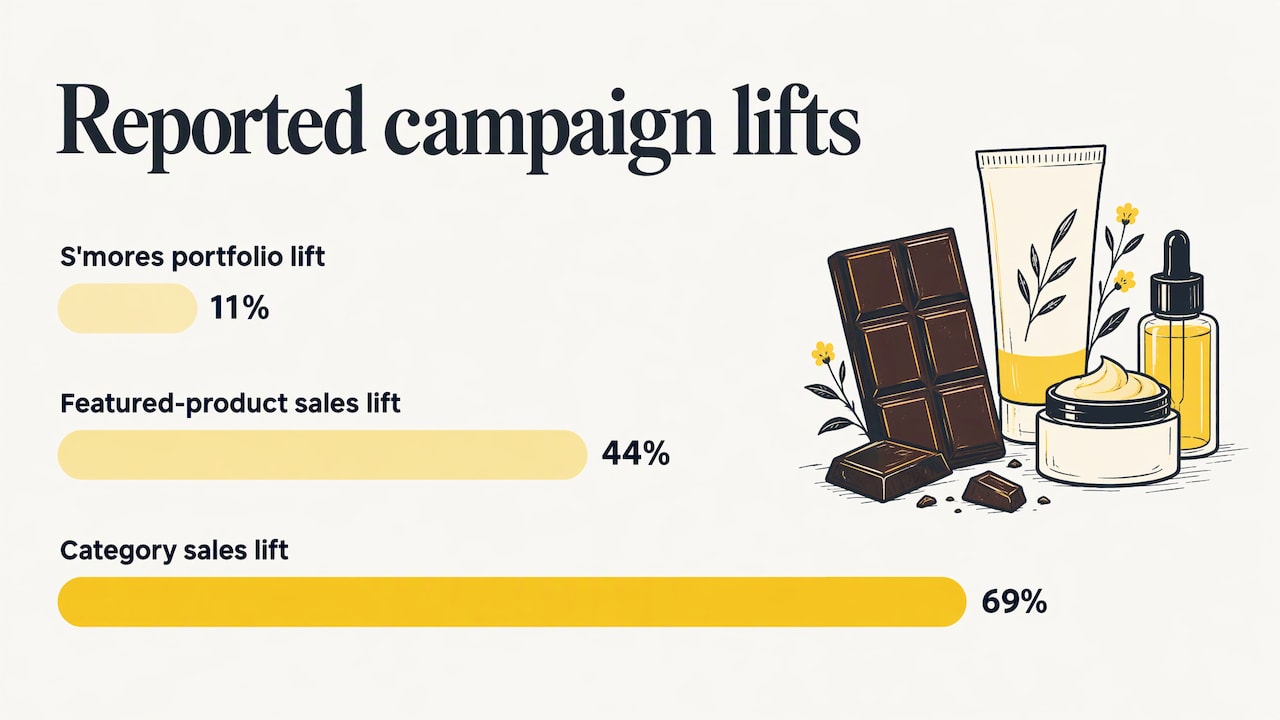
Hershey’s s’mores campaign. According to an awards case study, a campaign for the Milk Chocolate with Caramel Bar, featuring country artist Russell Dickerson and his wife Kailey, generated 170 earned media placements, more than five billion earned impressions and $14 million in sales. It also reported an 11% lift across the total s’mores portfolio. The portfolio lift is the halo: the campaign’s spillover reached products it was not about. These are the campaign’s own reported numbers, so treat them as a directional example, not a benchmark.
Rimmel and creator sampling. A Bazaarvoice case study describes a campaign that sent products to 2,000 women aged 18 to 30 in two test markets. It reports 1,200+ reviews, 15.7 million impressions across 2,400 social posts, and a sales lift of 44% for featured products and 69% for their categories against an IRI benchmark for average beauty digital campaigns. Again, a vendor-reported result, but it illustrates the pattern: the category moved more than the featured item.
Health halos. The Decision Lab notes that an organic label can create a health halo that raises perceived quality and willingness to pay. If you sell food, supplements or skincare, be careful that the claims you make are true and substantiated, because shoppers will extend the halo to things you did not say.
A hypothetical for your own brand. Imagine a DTC skincare brand whose cleanser has thousands of strong reviews. It adds a moisturizer. In this illustrative scenario, the moisturizer’s product page inherits trust from the cleanser’s reviews, so it converts better from existing customers than a standalone launch would. That is a halo you can plan around, and test, rather than hope for.
Why the halo is not guaranteed
Much marketing content treats the halo as a reliable lever. The research is more careful.
A study by Raggio, Black and Leone covered 55 brands in four product categories across nine global markets and found consistent halo effects were rare in global consumer packaged goods. A separate cross-national study using consumers in Argentina, China, Spain and the United States found halo effects were more pervasive for product quality than for corporate social responsibility associations, and that halo strength varied across brands and markets. The implication: if you sell internationally, diagnose each market separately instead of assuming one uniform halo. Brand work that fits each market, like the thinking behind avoiding generic digital experiences, helps the impression you make travel well.
Familiarity matters too. A Journal of Marketing Research study found that positive information spills over to unmentioned attributes when consumers like or are committed to a brand. Among unfamiliar brands, negative information spilled over more readily than positive. For a newer brand, that means the first impressions you control (reviews, page quality, delivery) carry extra weight, and mistakes travel faster than praise.
The horn effect and how a halo gets reversed
The horn effect is the halo’s opposite: a negative experience with one product tarnishes the wider brand. Investopedia calls the halo a double-edged sword: a very positive perception can extend to new products and boost retention and loyalty, but a single bad experience can make some consumers swear a brand off altogether.
Brand stretching is a documented risk. In an experiment on luxury brands, a step-down Armani extension hurt the core brand’s affective evaluation, explaining 38.8% of its variance. Purchase intention among existing customers fell from 4.49 to 4.18, while among noncustomers it rose from 3.35 to 4.00. The lesson for DTC brands is that a discount line or a lower-quality sub-range can win new buyers while quietly cooling your best ones.
Shopify’s guide also warns that leaning on a halo can breed complacency in product development and quality control. If shoppers assume quality, you have to keep earning it.
How to measure a halo without fooling yourself
The biggest mistake is crediting a halo for any good number that appears after a campaign. Halo is a hypothesis about causation, so test it like one.
Define the metrics first
- ROAS (return on ad spend): revenue attributed to an ad platform divided by the spend on it. It only sees what the platform can attribute, so it tends to miss halo effects entirely.
- MER (marketing efficiency ratio): total revenue divided by total marketing spend, across all channels. Because it is blended, halo benefits that show up in other channels or products land in MER.
- CAC (customer acquisition cost): marketing spend divided by the number of new customers acquired.
- LTV (lifetime value): the revenue or gross profit a customer generates over their relationship with you. Halo shows up here when satisfied customers buy more across your range.
Look for the signature
A halo usually leaves a pattern across metrics, not in one number:
| Signal | What to watch | What it suggests |
|---|---|---|
| Platform ROAS flat, MER improves | Blended efficiency rises while channel-level numbers stay the same | Spillover into direct, organic or other channels |
| Non-featured products grow | Sales of products not in the ad rise during a campaign | Product-to-product halo |
| Cross-category repeat purchase | Share of customers buying a second, different product | Halo from the hero product to the range |
| Branded search and direct traffic | Rises after creator or video bursts | Endorser or creative halo |
| Lower CAC on new launches | Launch converts better with existing customers than with cold audiences | Parent-brand trust transferring |
Use behavioral evidence
The academic guidance points the same way. A Journal of Marketing study used scanner-panel purchase data before and after real extension launches to examine trial, repeat and reciprocal effects between extensions and parent brands. That is a stronger test than a one-off survey about hypothetical products. For brand-level diagnosis, research on halo as a systematic bias in attribute ratings shows halo measurement can itself indicate brand equity.
In practice for an ecommerce brand, that means:
- Hold out a region or audience from a campaign and compare product-level sales between exposed and unexposed groups.
- Track cohorts. Compare the 90-day repeat rate and cross-category rate of customers who first bought the hero product against those who first bought something else.
- Watch MER weekly, next to platform ROAS, so you do not cut a channel that is quietly feeding the others.
- Log creative and product changes so you can tell a halo from a coincidence like a seasonal peak or a promotion.
How to build the halo on purpose
Shopify’s playbook is a good outline: build and market a flagship product, use influencer marketing, expand strategically into complementary products, and optimize the customer experience to encourage loyalty across the range. Here is how that translates to acquisition, conversion and retention.
Acquisition. Lead paid campaigns with the product that earns the strongest reaction, then let that creative introduce the brand. Strong static and video creative carries the halo into cold audiences, and online video advertising is often where a flagship product tells its story best.
Conversion. Put proof where doubt appears: review counts and photos near the add-to-cart button, creator content on landing pages, and consistent design from ad to checkout. If an ad promises a premium feel and the page feels generic, the impression breaks. A halo is only useful if every step reinforces it.
Retention. The halo pays off most after the first order. Post-purchase email and SMS flows can introduce complementary products to people who already trust you, which is the easiest place for a hero product’s halo to become second-order revenue. A brand that keeps that experience consistent also builds the loyalty described in our piece on how a D2C branding agency builds customer loyalty.

Expansion. Launch complementary products that fit what the hero product promises. Resist stretching into a tier or a quality level that contradicts the brand, as the Armani experiment warns.
Perspective
At Rozee Digital, we see the halo effect most often as a measurement problem. Brands run a strong creative angle on Meta, watch platform ROAS barely move, and then see blended MER and repeat purchases improve a few weeks later. If the only dashboard is channel-level, the halo looks like noise, and the budget gets cut at exactly the wrong moment.
That is why we work across acquisition, conversion and retention inside one framework, the Ecommerce Acceleration System™, instead of managing one channel in isolation. When the same senior strategist looks at the ad, the landing page and the email flow, it is far easier to see where a good impression is being built and where it leaks.
Our view is simple: build the halo with a product and a story people believe, check it against profit, not just attributed revenue, and defend it in every touchpoint that follows the click. You can read how we think about brand building in our guide to ecommerce marketing branding.
Tom
Work with a team that measures the whole funnel
If your paid media numbers look flat while the business grows, or the reverse, the answer is usually in how acquisition, conversion and retention are measured together. Rozee Digital works with established Shopify, WooCommerce and Magento brands, with work led by senior strategists, and covers paid search, paid social, creative, landing pages and Klaviyo and email programs under one profit-focused approach.

To see how that works in practice, start with Rozee Digital or browse our real-life ecommerce marketing case studies. If you are weighing outside help for a DTC brand, our guide to what sets winning brand marketing agencies apart lays out the criteria.
FAQ
What is the halo effect in business?
It is the tendency for a favorable impression of a company, product or person in one area to improve how people judge it in other areas. In business, that shows up as a hero product lifting the rest of the range, or an endorser lending credibility to a brand. The reverse, the horn effect, happens when one negative experience taints the whole brand.
What is the difference between the halo effect and the horn effect?
The halo effect transfers positive impressions, and the horn effect transfers negative ones. Both rely on the same shortcut, where people judge unfamiliar attributes from an overall feeling. Research suggests negative information can spill over more readily than positive among unfamiliar brands, so early customer experience deserves extra care.
How do you measure the halo effect?
Use behavioral data rather than awareness surveys alone. Compare blended MER with platform ROAS, track sales of products not featured in the ads, and run holdout tests by region or audience. Cohort analysis of repeat and cross-category purchases shows whether a hero product pulls the rest of the range along.
Does the halo effect work the same in every market?
No. Cross-national research found that halo strength varied by brand, attribute and country, and that consistent halos were rare in global packaged goods. If you sell in several countries, check each market’s results on their own instead of copying one market’s assumptions.
Can influencer marketing create a halo?
It can. A credible creator can transfer trust to a brand, and studies of YouTube campaigns suggest the revenue effect is strongest early and fades quickly. Plan creator work in recurring waves, and measure spillover on non-featured products as well as on the promoted item.
Sources
- Halo effect (Wikipedia)
- What Is the Halo Effect? (Scribbr)
- Halo effect (The Decision Lab)
- Halo Effect Marketing: Definition and Retail Examples (Shopify)
- Riding the coat-tails of a positive review (Emerald)
- The Moderating Role of Commitment on the Spillover Effect (Journal of Marketing Research)
- Global Product Quality and Corporate Social Responsibility (Journal of International Marketing)
- The Halo Effect (Investopedia)
- Hershey’s Milk Chocolate with Caramel Bar case study (The Drum)
- Case Study: Rimmel (Bazaarvoice)
- Halo Effect of Social Media Influencers (Resolver)
- How do popular online streamers influence viewers’ purchase intention (RePEc)
- Beyond Halo (University of Richmond)
- Brand equity: the halo effect measure (Emerald)
- The Impact of Brand Extension Introduction on Choice (Journal of Marketing)
- Stretching a luxury brand down (experimental study)