ROAS alone can’t show whether paid search is driving profitable ecommerce growth. A paid search agency for ecommerce connects product-level search intent with commercial outcomes, including revenue, customer acquisition cost, and wider business performance. ROAS compares ad-attributed revenue with ad spend; MER compares total revenue with total marketing spend; CAC is the cost to acquire a customer; LTV estimates the revenue a customer generates over time.
It’s reasonable to expect clear reporting and active campaign management, not just a set of ads and a monthly performance summary. The right analysis connects keyword choices, budgets, and landing pages to outcomes that matter commercially.
This article explains how ecommerce paid search is structured, evaluated, and connected to broader growth priorities. You’ll also learn what to look for in strategic support, from keyword intent and product economics to reporting that informs business decisions.
Key Takeaways
- Build campaigns around product-level search intent, with keyword research, relevant ad copy, and landing pages aligned to what shoppers want.
- Choose platforms and campaign types based on your audience and growth priorities rather than spreading budget without a clear rationale.
- Use performance signals together to understand whether paid search is contributing to profitable growth, not just generating clicks or attributed revenue.
- Evaluate agency support by its approach to ecommerce strategy, campaign management, and actionable performance reporting.
PPC campaign creation and keyword research
Effective PPC starts with commercial priorities, not a keyword dump. Map product categories to margins, inventory, and growth goals. A hypothetical apparel brand might assess outerwear separately from accessories because search intent and order economics differ. This structure helps teams evaluate demand and decide where advertising investment supports business priorities.
Keyword research connects shopper language to the right campaign. Group related terms by intent, such as “waterproof hiking jacket” and “women’s raincoat,” rather than forcing them into one ad group. Focused ecommerce ad groups can contain 10-20 related keywords, supporting copy that matches search intent. Add negative keywords when a query signals a poor fit, such as searches for repairs when the business sells new products.
- Organize by product category: Separate campaigns or ad groups for distinct categories, brands, and product lines. This makes budget decisions and demand analysis more precise.
- Target location: Align geographic settings with delivery coverage and business priorities. Compare regions using order quality and conversion performance, not clicks alone.
- Set time controls: Review when valuable conversions occur, then adjust schedules where account data supports a change. Consider time zones, customer behavior, and fulfillment capacity.
Ad copy should match both the search query and the destination page. A search for “linen duvet cover” should lead to relevant linen bedding, not a broad home page. Make the product and offer clear, and ensure the landing page answers the shopper’s specific need.
After launch, evaluate search terms, budget allocation, and the match between ads and landing pages as performance data builds. Quality Score is a diagnostic measure based on expected click-through rate, ad relevance, and landing-page experience, not a business outcome. PPC strategy should prioritize profitable orders and fit the wider marketing mix, including marketplace and social channels when they have a clear role.
What are the fundamentals of paid search for ecommerce?
Google Ads and Microsoft Advertising, which serves Bing search, reach shoppers actively looking for products. Google Shopping displays product listings in search results, while text ads can address specific queries such as “ceramic dinner plates.” Choose channels based on where customers search, the product data available, and the potential to attract commercially valuable orders.
Product advertising takes more than platform familiarity. Ecommerce expertise includes understanding catalog structure, margins, stock changes, promotions, and the path from click to checkout. For example, promotion decisions should account for both an item’s margin and inventory. A high-volume product with limited stock may call for a different investment decision than a reliably stocked bestseller.
Amazon advertising serves a different role from Google Shopping. Amazon reaches shoppers within a retail marketplace, while Google can connect product searches with a retailer’s own store. Retail media can complement search, but each channel needs a distinct objective and measurement approach. Compare order quality and business value, not just the conversions each platform attributes to itself.
- Google Ads: Match search campaigns and Shopping activity to product demand and the intended destination.
- Microsoft Advertising: Assess Bing search as a distinct channel, with separate targeting, budgets, and performance analysis.
- Amazon: Treat marketplace advertising as a route to shoppers on Amazon, distinct from traffic sent to your ecommerce site.
- Social media: Use platforms such as Facebook or TikTok to introduce products through audience and creative-led advertising. Paid social supports discovery; it does not replace search intent.
Give each advertising channel a defined role, such as reaching new audiences or supporting marketplace sales. A disciplined strategy evaluates each channel’s contribution alongside other marketing activity. Avoid duplicating efforts across Google, Bing, Amazon, and social media without a clear reason. The aim is coordinated investment, not platform coverage for its own sake.
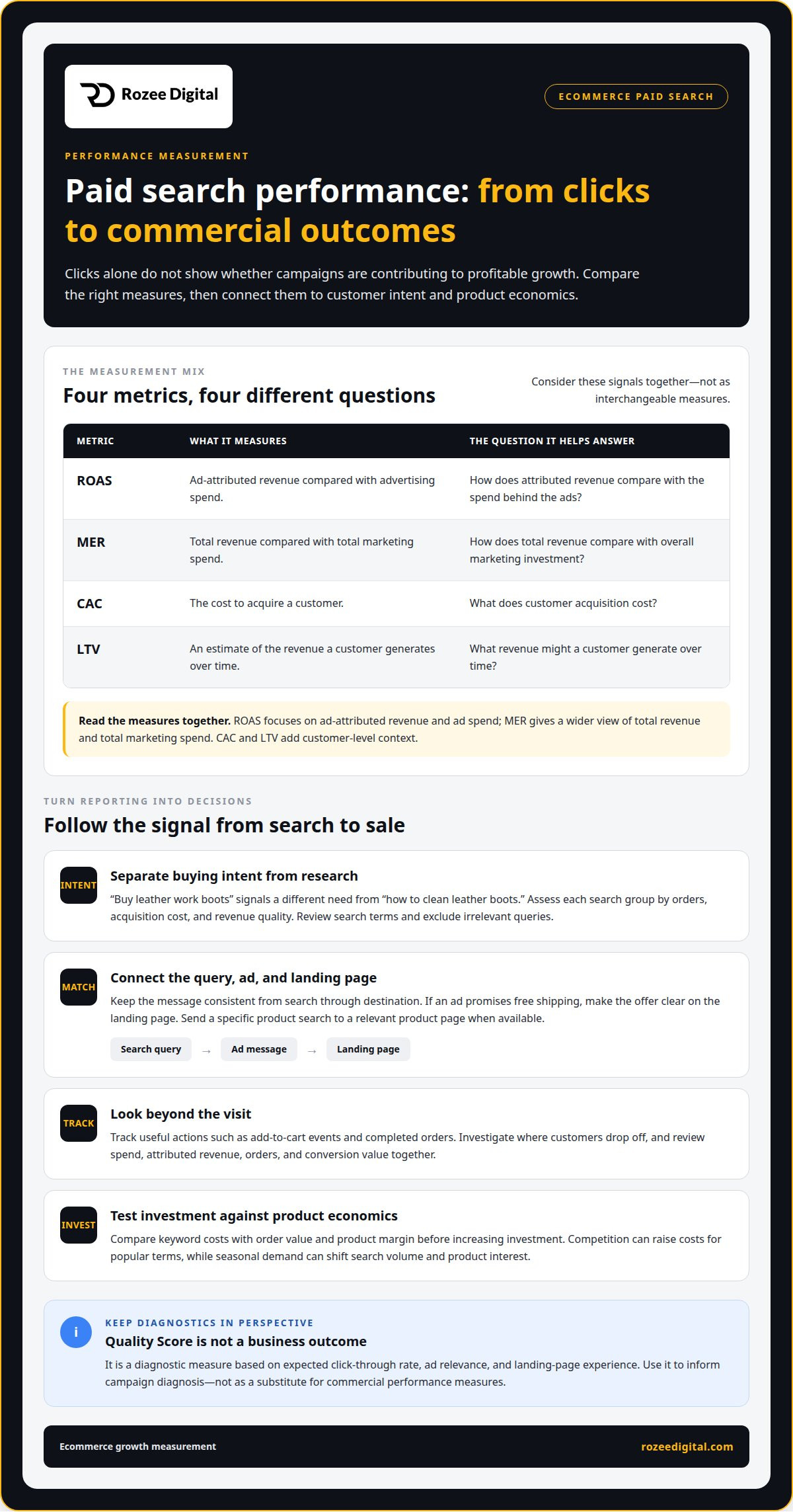
How can I measure the success of my paid search campaigns?
Measure commercial outcomes, not clicks alone. In Google Ads, review spend, attributed revenue, orders, and conversion value together. ROAS compares ad-attributed revenue with advertising spend; MER compares total revenue with total marketing spend. CAC tracks customer acquisition cost, while LTV estimates customer revenue over time. Each measure answers a different question, so consider them together.
Begin keyword analysis with intent. “Buy leather work boots” signals a different need from “how to clean leather boots.” Separate purchase-intent terms from research queries, then assess each group by orders, acquisition cost, and revenue quality. Keep ad groups focused on related searches so the message can address a specific product need. Review search terms regularly and exclude irrelevant queries.
Next, connect the query, ad, and landing page. If an ad promises free shipping, make the offer clear on the destination page. A search for a specific product should not lead to a broad category page when a relevant product page is available. Track whether visits lead to useful actions, such as add-to-cart events and completed orders, then investigate where customers drop off.
Evaluate bidding against conversion evidence and business priorities. Compare keyword costs with order value and product margin before increasing investment. Competition can raise costs for popular terms, while seasonal demand can shift search volume and product interest. For example, assess holiday performance against comparable periods while accounting for promotions, inventory, and changes in average order value.
- Monitor: Check spend, conversions, revenue, and search-term relevance in each reporting period.
- Diagnose: Identify whether weak results come from query quality, ad engagement, or landing-page conversion.
- Optimize: Adjust keywords, copy, bids, or destinations, then assess the impact on business outcomes.
Useful reporting explains each decision, its rationale, and the outcome. This record helps distinguish temporary fluctuations from persistent issues and supports informed choices about future growth priorities.
Ecommerce paid search agency recommendations
Choose strategic support based on your ecommerce model, operating capacity, and growth priorities. The right fit connects advertising decisions to commercial outcomes and gives your team a clear basis for action.
Agency, In-House, and Freelancer Comparisons
An in-house team stays close to product, inventory, and finance decisions; a freelancer can offer focused support; an agency may bring broader capabilities and established processes. Specialized firms like NSPYRE Digital Marketing Agency, for instance, can combine dedicated paid search execution with cross-channel acquisition expertise. Choosing a paid search agency for ecommerce means looking beyond platform skills. Assess who owns strategy, reporting, and coordination with your team. A seasonal launch, for example, needs input from merchandising and inventory, not an isolated focus on advertising.
Preparation Before Hiring an Agency
Before engaging support, prepare business goals, priority categories, margin context, inventory considerations, and historical account data. Clarify whether the priority is acquiring new customers, supporting a product line, or improving efficiency. A paid search agency for ecommerce can use this context to assess activity and shape recommendations around your operating priorities. Set clear account access and decision-making responsibilities from the outset.
Common risks include vague reporting, unclear account access, and recommendations based only on clicks or platform-attributed revenue. Treat guaranteed-result claims, unexplained decisions, and plans that ignore stock or product margins as warning signs. Good strategic support ties recommendations to business objectives and explains the evidence behind them.
Evaluate the working model as well as platform expertise. Establish how the team will coordinate with ecommerce, finance, and merchandising, and account for seasonality when interpreting conversion performance. Recommendations should define each channel’s role and explain how results will inform future decisions.
Use the planning discussion to set priorities, reporting expectations, and decision rights. If your team needs strategic support connecting search activity to ecommerce outcomes, discuss your paid search needs.
Rozee Digital: Ecommerce ads agency
Rozee Digital takes ownership of growth for established ecommerce brands through its proprietary Ecommerce Acceleration System™ framework. Its senior-only team focuses on acquisition, creative, conversion, retention, economics, and scale, connecting advertising decisions to the wider business.
Its Growth Accountability™ model centers on business performance rather than day-to-day campaign management. A useful next step is to align your growth priorities with the areas addressed by the framework.
Discuss your business goals and ecommerce growth support with Rozee Digital.
Make the next growth decision with intent
Before changing your acquisition approach, align leadership on what growth needs to make possible for the business. Priorities might include entering a new market, reducing reliance on one source of demand, or supporting product expansion. A paid search agency for ecommerce can contribute most when its work has a clear role in the broader commercial plan.
Use that priority to frame an initial discussion: explain what the business aims to unlock, where execution currently stalls, and which trade-offs leadership is prepared to make. This gives the conversation direction without assuming that more advertising is automatically the answer. Rozee Digital can discuss whether its growth-accountability approach fits your business priorities.
Contact Rozee Digital to start that conversation. A considered next step can turn a growth ambition into a more deliberate plan.
Frequently Asked Questions
How much do PPC agencies charge for their services?
PPC agency fees depend on the scope of work, advertising channels, account complexity, and level of strategic support. The price for a specific engagement is provided after a quote request. Compare proposals by what they cover, such as account analysis, measurement, strategic input, and communication, rather than comparing the fee alone. Also distinguish agency fees from the separate advertising budget paid to platforms.
What do PPC marketing agencies do?
PPC agencies help businesses plan and improve pay-per-click advertising on platforms such as Google Ads. Their work can include account structure, keyword planning, ad development, budget allocation, measurement, and performance recommendations. For ecommerce, the strategy should account for product priorities and business economics. Rozee Digital’s model is different from routine campaign management: it takes ownership of growth through its proprietary Ecommerce Acceleration System™ framework.
How do I choose the top pay-per-click advertising firms for my business?
Shortlist firms with relevant experience in your business model, product catalog, and sales cycle. Assess how they connect advertising decisions to commercial priorities, communicate performance, and take responsibility for strategic direction. For example, a brand with seasonal inventory needs planning that accounts for product availability, not just traffic acquisition. Choose a working model that fits your team and decision-making process.
How do you choose the best PPC agency?
Choose an agency whose expertise and operating model fit your growth needs, rather than one making the boldest claims. Review how it approaches acquisition, creative, conversion, retention, and profitability. Clarify what the team will own and how its decisions connect to business outcomes.
How much should I spend on PPC to get results?
Set a PPC budget around your unit economics and ability to fulfill demand. Start with the products you want to grow, their contribution margins, conversion performance, and the acquisition cost your business can sustain. Allocate investment to gather useful evidence without undermining cash flow or inventory plans. A suitable budget for one catalog may not suit another, even within the same category.
Is hiring a PPC agency worth the cost?
Strategic support can be worthwhile when it addresses a real constraint, such as limited internal expertise or unclear growth priorities. Its value depends on whether it improves decision-making and supports profitable growth, not simply whether advertising activity increases. Rozee Digital focuses on growth ownership rather than campaign management, so consider whether that model fits the support your team needs.