Market positioning is how you want customers to perceive your brand compared with the alternatives, and the work of proving that perception is deserved. It is built in three moves: choose who you serve, decide what you want to be known for, and back it with evidence customers can see. Monash Business School describes it as identifying a brand’s competitive advantages and communicating the chosen position to the market. This guide shows founders and marketing leaders at established ecommerce and DTC brands how to do that, and how positioning shows up in paid media, conversion and retention.
TL;DR
- Market positioning is the place your brand holds in customers’ minds relative to competitors, set by a deliberate choice of audience, category and point of difference.
- It is the third step of the STP model: segment, target, then position.
- A usable positioning statement names a target, a frame of reference, a point of difference and a reason to believe.
- Test it with a perceptual map and with the numbers: conversion rate, repeat purchase and blended acquisition efficiency.
- Positioning is an internal decision. Ads, landing pages and emails are where customers actually see it.
Table of Contents
- What market positioning means
- The STP model: segment, target, position
- How to write a positioning statement
- Types of positioning strategies
- Perspective
- How positioning drives profitable growth
- A five-step process to define your position
- How to tell if your positioning is working
- Common positioning mistakes
- Turning your position into growth with Rozee Digital
- FAQ
- Sources
What market positioning means
Positioning answers one question: why should this customer choose you over the other options they are considering? OpenStax frames it as deciding and communicating how an organization wants its market to think and feel about a product or service. The Product Marketing Alliance adds that it aims to influence how consumers see a brand relative to alternatives, which helps them choose among options.
Two things follow from this.
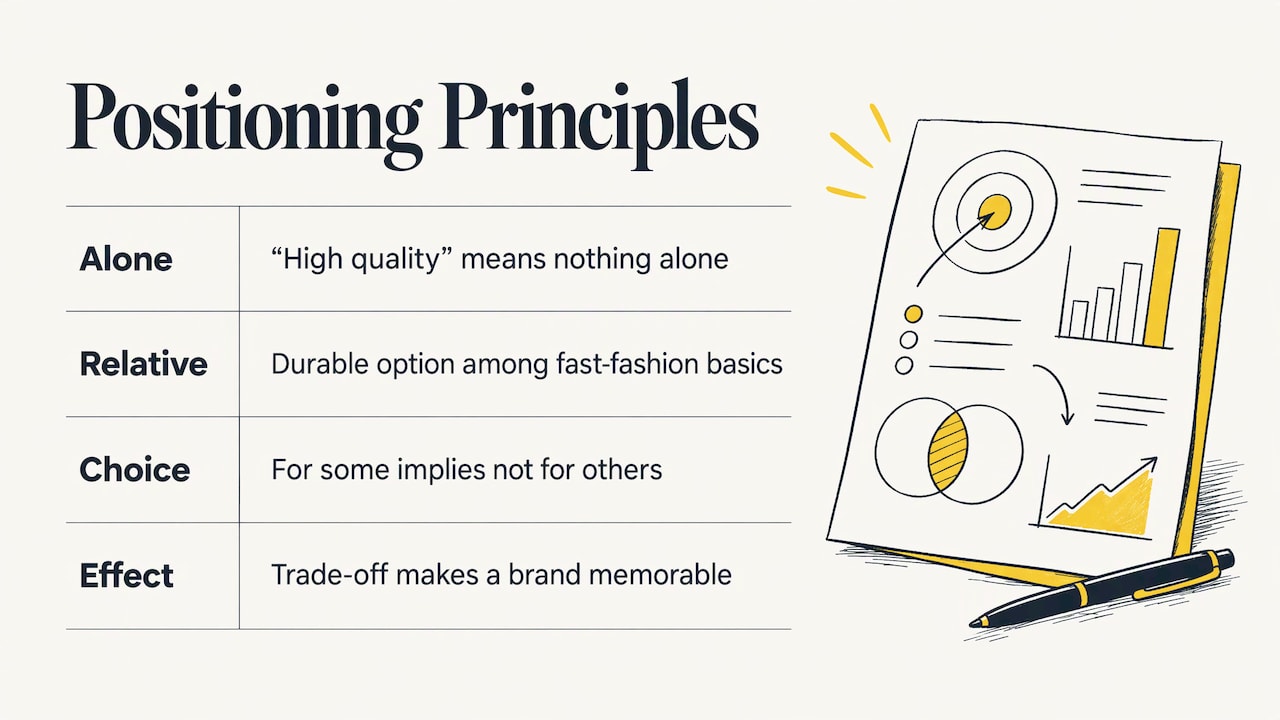
First, positioning is relative. “High quality” means nothing alone. “The durable option among fast-fashion basics” means something because it names what you are compared with.
Second, positioning is a choice, and choices have costs. Saying who you are for implies saying who you are not for. That trade-off is what makes a brand memorable.
Positioning, brand identity and marketing strategy
These terms get blurred, so here is a working split:
| Term | What it decides | Example question |
|---|---|---|
| Segmentation | Which groups of customers exist | Who buys in this category, and why? |
| Targeting | Which segment you serve first | Which group can we serve profitably? |
| Positioning | How you want that segment to see you | What do we want to be known for? |
| Marketing mix and campaigns | How you deliver and communicate it | Which channels, offers and creative carry it? |
A Springer Nature chapter on the marketing mix notes that segmentation does not stand alone as a strategy. It goes hand in hand with positioning and competition, and positioning aims for a product to be perceived as distinctly different from competing products and in line with segment needs.
The STP model: segment, target, position
STP is the standard sequence behind positioning work. Skipping a step is the most common reason positioning ends up generic.
Step 1: Segment
Group customers by what they need and how they buy, not only by age or location. For an ecommerce brand, useful cuts include first-time versus repeat buyers, gifting versus self-purchase, and price-sensitive versus quality-led shoppers. Your order data and customer reviews are the cheapest starting point.
Step 2: Target
A course note on target market selection describes evaluating each segment’s attractiveness and choosing one or more to enter, with the objective of maximizing profit. That means weighing demand, the competitive environment and your own strengths together.
For a DTC brand, profit is the filter that matters. A segment that buys cheaply but never returns may look large and still be a poor target once acquisition cost and lifetime value are counted (both defined below).
Step 3: Position
Only now do you decide the claim. Harvard Business School Online advises understanding who your brand serves, and how it is similar to or different from competitors, before crafting a value proposition. It starts with audience research: needs, purchasing habits, life stages and similar factors.
For the research stage, a practical guide to audience research methods covers ways to learn what your audience values before you commit to a claim.
How to write a positioning statement
A positioning statement is short and structured. The Wiley text on brand strategy lists four parts: a target, a frame of reference, a point of difference and a reason to believe. It also describes the statement as an internal document that aligns consumer-facing decisions. Marketing, Unlocked makes the same point: customers never see it, so it is not ad copy.
eCornell gives this template:
For [target market], the [brand] is the [point of difference] among all [frame of reference] because [reason to believe].
What each blank has to do
- Target: a specific buyer, described by needs and behavior, not “everyone who likes coffee.”
- Frame of reference: the set of alternatives the customer compares you against. Choose it on purpose, because it controls what your difference is measured against.
- Point of difference: a benefit that matters to the target and that you can own. eCornell says it must be meaningful, important and convincing to customers.
- Reason to believe: concrete proof behind the claim, such as a material, a process, a guarantee you actually offer or a third-party result.
A hypothetical example
This is an invented example for illustration only, not a real brand or client result.
For busy parents who want fewer, better kitchen tools, Hearthline is the cookware set that lasts a decade among all mass-market cookware because every piece is made from one material with a lifetime repair program.
Notice what it leaves out. It does not claim to be cheapest, most stylish and most innovative. One difference, one proof.
Types of positioning strategies
Most positions fall into a handful of families. Pick the one your evidence supports.
| Approach | Core claim | Works best when |
|---|---|---|
| Quality or premium | Better materials, craft or results | Customers will pay more and can see the difference |
| Price or value | Lowest cost or best value | You have a real cost advantage |
| Niche or specialist | Built for one group | A segment is underserved by generalists |
| Use-case | The best choice for one situation | Buying is triggered by a specific need |
| Emotional or values-led | Shares the customer’s beliefs | Identity drives purchase in the category |
| Head-to-head | Better than a named rival on one attribute | You have clear proof on that attribute |
OpenStax illustrates the head-to-head approach with a pretzel kiosk that stresses making dough from scratch while competitors use processed frozen dough. It works because the claim is concrete and checkable.
Price-led positioning deserves a caution for growth-minded brands: it is hard to defend if a larger competitor can cut prices further. Differences rooted in product, audience or experience are usually easier to hold.
Perspective
In our work with established ecommerce brands, we see positioning decisions show up in the ad account long before anyone calls them positioning. When the message is vague, ads get clicks that do not convert, landing pages try to say everything, and emails sound like every other brand’s.
At Rozee Digital we treat positioning as the thread through acquisition, conversion and retention. Our Ecommerce Acceleration System™ is designed to address all three together, so the promise made in an ad is the one kept on the page and in the inbox. Strategy on our accounts is led by senior strategists, and we keep our client roster small so that each brand’s position gets real attention.
If you cannot state your point of difference in one sentence, scaling spend will usually make the gap more expensive, not smaller. Fix the claim first, then put budget behind it.
Tom
How positioning drives profitable growth
Positioning is not a branding exercise separate from performance. A marketing strategy note by Robert Dolan describes strategy as selecting a target market and the desired position in those customers’ minds, then planning activities to achieve it. It also states that customer acquisition and retention strategies drive a firm’s profitability.
Here are the metrics that connect the two, defined plainly:
- CAC (customer acquisition cost): total sales and marketing spend to win new customers, divided by the number of new customers.
- ROAS (return on ad spend): revenue attributed to an ad channel divided by the spend on that channel.
- MER (marketing efficiency ratio): total revenue divided by total marketing spend across all channels, which avoids platform attribution disputes.
- LTV (lifetime value): the revenue or gross profit a customer generates over their relationship with you.
- Conversion rate: the share of visitors who buy.
Acquisition
A sharp position tells you who to target and what to say. Creative that speaks to a defined segment’s actual need tends to make the same budget work harder. If you run paid search or paid social, your position should shape the keywords, audiences, hooks and offers, not just the logo. If you want a structured way to see how rivals present themselves in paid social, this competitor analysis walkthrough is a practical place to start.
Conversion
Square’s guide to positioning links positioning to conversion across the customer journey, from first awareness to the decision to buy. On a product page, that means the headline, proof and offer repeat the reason to believe from your statement rather than introducing a new story.
Retention and lifetime value
Customers return when the experience matches the promise. Post-purchase emails and SMS are where you reinforce why they chose you: the same point of difference, expressed through onboarding, replenishment and loyalty. Higher repeat rates raise LTV, which in turn lets you afford a higher CAC while staying profitable. For a deeper look at brand and loyalty, see how a D2C branding agency builds customer loyalty.
A five-step process to define your position
- Audit your current perception. Read reviews, support tickets and post-purchase survey answers. Note the words customers use unprompted.
- Map your competitive set. List the real alternatives customers consider, including doing nothing and buying from a marketplace. Our guide to DTC branding positioning and messaging goes deeper on messaging.
- Choose the target segment. Use profit, not size alone, as the filter.
- Draft the statement and pressure-test the proof. Each claim needs a reason to believe you can show. If you cannot show it, narrow the claim.
- Translate it into assets. Brief your creative with a clear set of questions. A list of creative brief questions helps keep ads, pages and emails consistent with the position.
Be wary of trade-offs. A worked STP example from Ficilcom cautions that promising extensive custom work to every industry changes the economics of a focused offering. The same is true for products: every extra audience you promise to serve dilutes the claim.
How to tell if your positioning is working
Perceptual maps
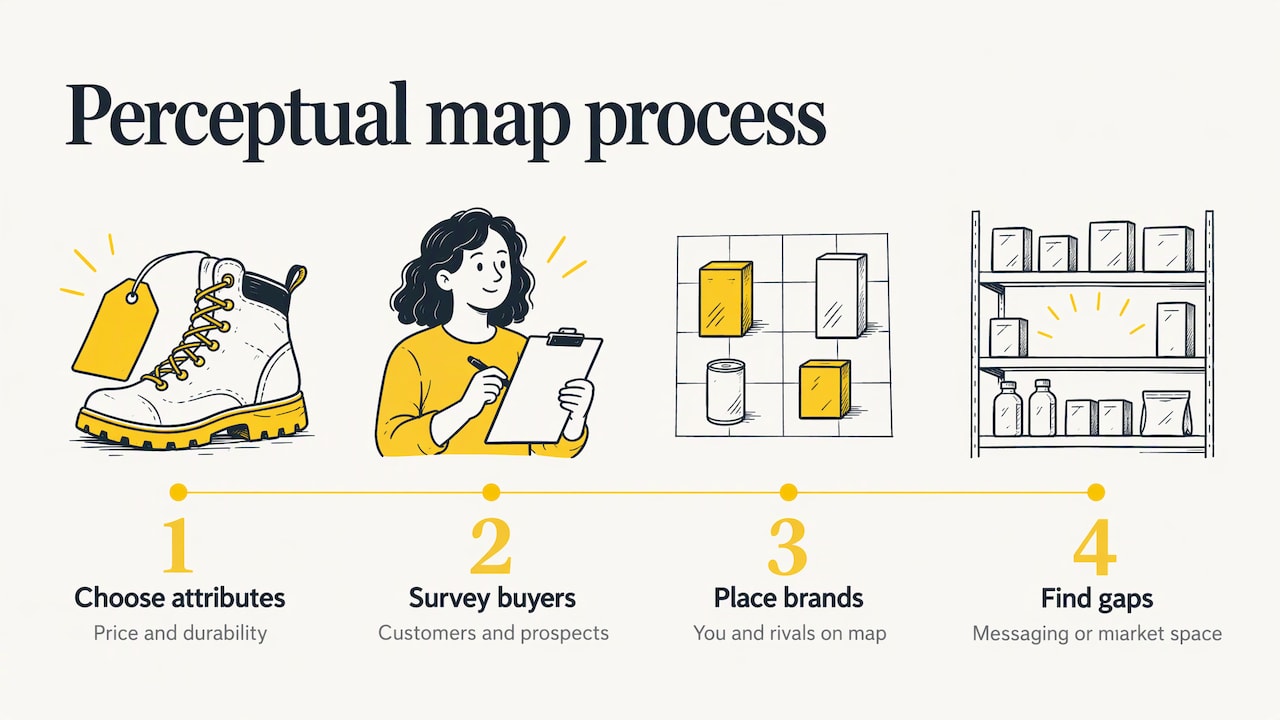
OpenStax describes a perceptual map as a chart showing how the average target consumer perceives products versus competitors, using attributes that reflect purchase decisions. Pick two attributes your customers really weigh, such as price against durability, and survey customers and prospects to place you and your rivals. If their view differs from your intended position, you have a messaging gap. Open space on the map may reveal a gap in the market.
Business signals
Track these over a few months after you sharpen the message:
- Conversion rate on landing pages that carry the new claim versus the old one.
- Click-through and cost per acquisition in paid campaigns using the new creative angle.
- Repeat purchase rate and LTV of customers acquired under the new message.
- Blended MER, to confirm that growth is not just shifting credit between channels.
Change one variable at a time where you can, so you know what moved the numbers.
Common positioning mistakes
- Claiming everything. “Best quality, lowest price, fastest shipping” is not a position.
- Choosing a frame of reference by accident. Customers compare you to something, and it is better that you pick it.
- No proof. A difference without a reason to believe reads as marketing talk.
- Treating the statement as ad copy. It is an internal guide. Write the customer-facing language separately.
- Changing it every quarter. Positioning takes repetition to stick. Refine it with evidence, not mood.
For more ideas on building a brand around a clear position, see these DTC brand marketing ideas and our look at ecommerce branding.
Turning your position into growth with Rozee Digital
Rozee Digital works with established Shopify, WooCommerce and Magento brands on paid media, creative, conversion and retention. Our approach connects those channels through the Ecommerce Acceleration System™, so the position you choose carries from the first ad to the repeat order. Services include paid search, paid social campaign management and Klaviyo setup and optimisation.

If you are weighing agency support, start with our questions to ask an ecommerce marketing agency before signing, then talk to Rozee Digital about where your positioning and your numbers stand today.
FAQ
What is an example of market positioning?
OpenStax uses a pretzel kiosk that stresses dough made from scratch against competitors’ processed frozen dough. The claim is specific, it differs from the alternatives and customers can verify it. Strong positions usually share those three traits.
What is the difference between market positioning and market segmentation?
Segmentation divides the market into groups with similar needs. Positioning decides how you want your chosen group to perceive you compared with competitors. In the STP model, segmentation and targeting come first, and positioning follows.
Is a positioning statement the same as a tagline?
No. It is an internal strategic document that aligns teams, and customers never see it. A tagline or headline is customer-facing copy written to express the position.
How often should we revisit our positioning?
Revisit it when your customer base, competitors or product line change meaningfully, and check the supporting data regularly. Avoid rewriting it because of a single weak campaign. Consistency is part of how a position takes hold.
Sources
- Brand Positioning, Monash Business School
- 5.6 Product Positioning, OpenStax Principles of Marketing
- What is positioning?, Product Marketing Alliance
- Step 9: Customising the Marketing Mix, Springer Nature Link
- Module Note: Market Segmentation, Target Market Selection
- How to Craft the Perfect Brand Positioning Statement, Harvard Business School Online
- Thinking Strategically about Your Brand, Wiley
- How to Write Market Positioning Statements, eCornell
- Segmentation, Targeting & Positioning, Marketing, Unlocked
- Note on Marketing Strategy, Robert Dolan
- What is Positioning?, Square
- STP Analysis: A Worked Example and Positioning Template, Ficilcom
- Top audience research methods to boost campaign performance
- 12 Creative Brief Questions Every Marketer Needs