A bigger agency is not automatically the better growth partner. When comparing a boutique ecommerce agency with a large network holding company, focus on the resources your growth plan requires, who will own the work, and how success will be measured. A focused team may offer closer senior involvement; a large network may provide broader capabilities and capacity.
Both models have trade-offs, and a persuasive pitch is no substitute for effective delivery. Compare the scope and responsibilities, assess the expertise of the people accountable for growth, and check whether reporting supports commercial decisions.
The right fit depends on your operating needs, not the agency’s size. This comparison explains when a boutique partner may suit your business and when a network’s scale may be useful, with profitable ecommerce growth as the measure.
Key Takeaways
- Assess the people who will handle the work day to day, not only the team involved in the pitch.
- Compare agency costs against the full operating workload, including management, production, approvals, and handover.
- Match agency capacity to your growth plan: a focused partner may suit specialized needs, while a network can support broader, multi-market execution.
- Judge performance measurement by whether reporting connects media activity to commercial outcomes and supports timely decisions.
Evaluating account staffing and performance measurement
For ecommerce teams, agency performance depends on more than media buying. Compare who owns delivery, how reporting supports decisions, and what happens when account staff change.
Account Ownership and Reporting
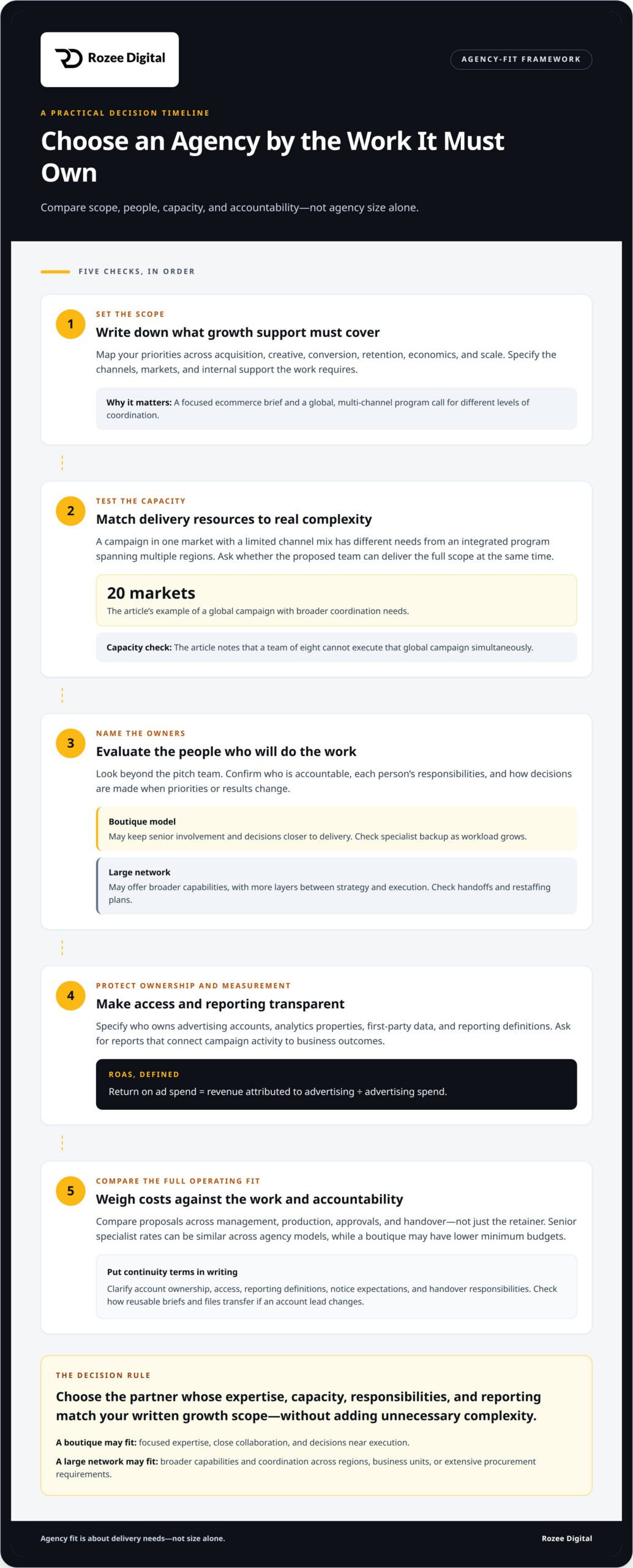
Account ownership defines who controls advertising accounts, analytics properties, first-party data, and reporting definitions. A boutique may keep those decisions close to delivery; a large network may spread them across departments. Either model needs clear access and transparent reporting. Specify who owns each asset, how ROAS is calculated, and how reports connect campaign activity to business outcomes. ROAS, or return on ad spend, is revenue attributed to advertising divided by advertising spend.
Leadership Access and Team Continuity
Senior involvement in a pitch does not guarantee senior expertise throughout the relationship. Ask who will be accountable for the work, what each person’s responsibilities are, and how decisions are made. Rozee Digital is a senior-only ecommerce growth agency, with senior-level consultants delivering its services. Its Growth Accountability™ model takes ownership of growth rather than managing campaigns.
Contract risks include unclear account ownership, restrictive access, undisclosed conflicts, and vague staffing-change terms. Set ownership, reporting definitions, notice expectations, and handover responsibilities in writing. For example, require reusable briefs and file access to transfer when an account lead changes.
When reviewing proposals, ask who owns growth, how performance is assessed, and how decisions adapt when results or priorities change. For a product launch or a creative test that misses the mark, clarify who decides the next step and how it connects to your commercial goals.
| Agency model | Leadership access | Reporting and ownership | Continuity risk |
|---|---|---|---|
| Boutique | Potentially closer to delivery | May keep decisions close | Check specialist backup |
| Large network | May involve more layers | May span departments | Check handoffs and restaffing |
Choose the partner whose expertise, responsibilities, and reporting approach fit your growth priorities.
Boutique vs Large Digital Agency: Which Is Better for Your Business?
Agency fit depends on your growth goals, operational complexity, and the expertise you need. A brand focused on ecommerce growth may value direct strategic involvement; a global advertising program may require broader cross-market capacity.
Choosing by Business Size and Budget
Business size can indicate the support model a brand needs. Boutique agencies may suit smaller and medium-sized companies, including businesses with fewer than approximately 500 employees. Their lower minimum budgets can make specialist marketing support more accessible. However, senior specialist rates can be similar across agency models.
Compare the work and accountability, not just the retainer. Map your priorities across acquisition, creative, conversion, retention, economics, and scale. A specialist ecommerce partner may suit a brand seeking focused growth support, while a large organization with multiple stakeholders may need more formal coordination.
Choosing by Complexity and Timeline
Complexity matters more than headcount alone. A campaign across one market and a limited channel mix can need different coordination from an integrated global campaign spanning 20 markets. A team of eight cannot execute that global campaign simultaneously. Match the agency’s delivery capacity to the actual scope.
Consider how the agency’s structure supports your decision-making. Fewer organizational layers may help keep decisions close to the work, while a larger network may coordinate broader capabilities across departments. Define priorities, dependencies, and approval responsibilities before choosing.
Choosing for Growth and Business Fit
A boutique may fit a growing brand that needs focused expertise, close collaboration, and decisions near execution. That model can also suit enterprise teams seeking a specialist partner alongside internal marketing capabilities. The trade-off is potential limits in capacity or specialist coverage as the workload expands.
A large network may suit brands coordinating multiple regions, business units, or extensive procurement requirements. Its breadth can support complex programs, while additional layers may separate strategy from execution. A brand entering new markets should assess whether it needs centralized coordination or faster decisions within individual channels.
Choose against a written scope: growth priorities, required channels, markets, and internal support. The better fit is the partner whose capabilities and accountability match those demands without adding unnecessary complexity.
Big agency scale, resources, and costs
A large agency’s potential advantage is capacity across specialized teams. That scale can also introduce additional coordination and reporting layers.
Agency Scale and Resources
Large agencies can bring research, media buying, analytics, creative, and production capabilities together. That breadth can support campaigns spanning channels, markets, and business units. A partner coordinating several regions may need those resources under one operating structure. For a narrower ecommerce brief, however, some capabilities may sit outside the work’s actual requirements.
Map each deliverable to the people accountable before comparing proposals. Separate strategy, paid media, creative, and measurement. This helps reveal whether the proposed structure addresses a genuine need or adds coordination without advancing your growth priorities.
Overhead and Retainer Costs
Large-agency retainers can include overhead for offices, management layers, and global coordination. A boutique may have less corporate infrastructure, but its senior specialist time can still carry comparable rates. Compare the people and work assigned, rather than assuming agency size determines value.
Project minimums vary with scope and complexity. Boutique agencies generally have lower minimum budgets; large agencies may suit complex, high-budget programs. There is no single project minimum or contract term that applies across both models. Proposals should define scope, billing basis, renewal and exit terms, and included reporting.
Assess the total cost of fulfilling the work, not just the retainer. Consider internal approval time, creative production, paid media, and coordination. A lower fee may require more internal involvement or separate production support; a higher fee may include capabilities your business does not need.
Before signing, compare proposals against the same written scope. Identify paid media responsibilities, creative requirements, reporting, and any additional charges. Review account access, data ownership, renewal, termination, and transfer of working files. These details affect continuity if the relationship ends or your priorities change.
Independent agencies versus holding-company networks
An agency’s structure shapes how strategy connects to execution. A boutique may keep decisions close to the work; a holding-company network may coordinate capabilities across affiliated teams. Neither structure guarantees better business results. What matters is how the partner takes accountability for growth.
For an independent agency, map the work from brief to launch. Identify who shapes strategy, develops creative, manages media buying, and interprets reporting. Fewer organizational layers can make decisions faster, especially when a campaign needs a focused adjustment. The trade-off is that a smaller team may have less capacity or specialist coverage for simultaneous work.
A holding-company network may offer capabilities such as creative, paid media, analytics, public relations, and production. That breadth can help when a brand needs coordinated activity across markets or channels. But services within one corporate group do not necessarily mean one integrated team. Establish who owns each decision and deliverable.
Test the structure against a real ecommerce scenario. For a product launch, trace the process from approved claims and creative through paid media and performance review. Identify each team involved, each approval point, and who is accountable for resolving delays. This reveals whether the structure supports the launch or adds dependencies.
Then assess how the model handles change. Ask how a weak creative test moves into a revised brief, who approves the replacement, and how quickly media buying can respond. An independent team may make those decisions closer to execution. A network may coordinate specialized support across departments. The right process links those decisions to customer acquisition cost (CAC), the cost of acquiring a customer, and contribution to revenue.
Choose a boutique when focused expertise and direct strategic involvement fit the brief. Choose a network when your requirements genuinely call for extensive cross-market capacity or several coordinated disciplines. In either case, define responsibilities, deliverables, and commercial measures before work begins. Organizational scale is useful only when it meets a real business need.
Rozee Digital: Ecommerce ads agency
Rozee Digital supports ecommerce and D2C brands through its ecommerce advertising services and Growth Accountability model, taking ownership of growth rather than managing campaigns.
Rozee Digital’s paid media services include Google Ads, Meta Ads, Pinterest Ads, and TikTok Ads. Its senior-only team focuses on growth priorities such as revenue, customer acquisition cost, contribution margin, and profitability.
If you’re considering agency support for your growth priorities, contact Rozee Digital to discuss your needs.
Set the Next Agency Partnership Up for Growth
Make the agency decision serve the business you are building, not just the work already in motion. The choice between a boutique ecommerce agency and a large network holding company should result in a clear growth mandate: define the priorities, the decisions the partner owns, and how its work supports profitable expansion.
Rozee Digital supports ecommerce brands through ecommerce advertising, Google Ads, and Facebook Ads. That focus can suit teams seeking paid media support tied to their commercial priorities, rather than a broader agency structure.
Bring your goals and current challenges into a focused conversation. Contact Rozee Digital about your agency needs and explore a practical next step for your growth plan.
Frequently Asked Questions
Boutique vs Big Agency vs Freelancer: Which Agency Model Fits Your Brief & Budget?
Choose a freelancer for a tightly defined task, a boutique for specialist work requiring ongoing collaboration, and a large agency for complex coordination across disciplines or markets. For example, a one-off feed audit may suit an individual specialist, while ongoing acquisition strategy may need an agency team. Compare the expected workload, internal oversight, and need for backup coverage before choosing.
Scalability: Can a Boutique Agency Grow With You?
A partner is a good fit when its capabilities and approach can support your growth requirements. If you are adding channels, assess how the work will connect paid media, creative, reporting, and decision-making. For a seasonal launch, clarify how priorities will be set and who owns decisions if requirements change. Sustainable growth depends on an operating approach that supports the business, not just an initial fit.
What Is a Large Network Digital Marketing Company?
A large network digital marketing company has broad capabilities and teams that may support substantial, multidisciplinary programs. A holding company may own or coordinate several agency businesses with distinct expertise. For an ecommerce brand, the value depends on whether those capabilities work together to support the business, not simply whether they sit within one corporate group.
What is the difference between a boutique ecommerce agency and a large holding company network?
The choice between a boutique ecommerce agency and a large network holding company often comes down to how the work is organized. An independent boutique typically operates as a focused business; a holding-company network may draw on a wider group of specialist teams. For a brand entering a new market, assess who sets priorities and resolves tensions between local needs and central strategy.
What ecommerce services do boutique agencies and holding company networks offer?
Service scope varies by agency and may include paid search, paid social, creative, analytics, or retention marketing. Rozee Digital provides paid media, creative, conversion-focused landing pages, and email and SMS retention services. Its focus is marketing, not ecommerce website development or software platforms. Define the business problem first, then map each required capability to a clear responsibility.
How do boutique ecommerce agency fees compare with large network agency pricing?
There is no universal fee comparison; scope, channel mix, markets, creative needs, and reporting requirements shape the proposal. Compare total work and internal coordination, not the retainer alone. A useful proposal makes responsibilities, deliverables, and billing terms clear.