Loyalty program engagement is the share of your members who actually do something: earn points, redeem a reward, complete a profile, leave a review, open the app. Enrollment alone proves nothing. The programs that improve post-purchase retention and lifetime value are the ones where members keep taking part after the first order, and where you can show that the extra spending would not have happened anyway.
This guide is for founders and marketing leaders at established DTC and ecommerce brands. It covers what to measure, which features move participation, how to use post-purchase communication, and how to check that engagement is producing profit rather than discounting purchases you would have won regardless.
TL;DR
- Engagement means members completing actions that earn rewards. Judge a program by active members and redeemers, not by sign-ups.
- The first 30 to 60 days after sign-up decide whether a member stays active, so build the post-purchase flow around that window.
- Points toward discounts, free shipping, choice of reward and personalization are the features consumers say matter most.
- Track activation, redemption rate, repeat purchase rate and LTV, then test against a holdout group to prove incrementality.
- Keep the program simple enough to explain in one sentence, and cheap enough that margin survives redemption.
Table of Contents
- What loyalty program engagement actually means
- Which features and rewards get members to participate
- Use the first 60 days after sign-up
- Personalization, tiers and seamless redemption
- Metrics that show whether engagement is working
- Is engagement incremental, or are you paying for orders you’d have won anyway?
- Keep the program relevant without making it confusing
- Our perspective
- Next step: turn engagement into a retention channel
- FAQ
- Sources
What loyalty program engagement actually means
A member is engaged when they complete an activity that earns a reward. LoyaltyLion defines this as things like following the brand on social media, signing up for a newsletter or downloading an app, alongside purchases. Those low-effort actions matter because they build momentum that can lead to higher-effort behavior, including repeat orders.
The distinction between enrolled and engaged is where most programs leak money. McKinsey observed in 2021 that members who redeem spend 25% more than enrolled but inactive members, while typical active members spend 10% more than inactive ones. It also argued that programs should be measured on active participation and the redeemer rate rather than aggregate enrollment.
That is the working definition for the rest of this article: engagement is active participation that changes buying behavior.
Why it matters for retention and LTV
LTV (customer lifetime value) is the total gross profit a customer generates over their relationship with you. Because acquiring a customer through paid media costs money up front, every repeat order lifts the return on that spend. If your CAC (customer acquisition cost, meaning total acquisition spend divided by new customers) keeps rising, retention is the lever you still fully control.
The consumer side supports the effort. Retail Dive reported in July 2024 that 70% of surveyed U.S. consumers said loyalty programs were a key factor in deciding which businesses to frequent, and 75% said they would spend more as loyalty members. Deloitte’s 2025 U.S. survey found that 72% of members say programs make them more likely to spend with their preferred brand, and 56% say they increase spending because of the program. These are stated intentions, not your results, so treat them as a reason to test rather than a forecast.
Which features and rewards get members to participate
The Retail Dive survey found the top feature was earning points toward discounts, bonuses or exclusive merchandise. Customers also wanted member-only discounts and perks such as free shipping. Choice mattered too: 90% of those interested in loyalty gifts wanted to choose the gift, and the same share wanted a birthday gift.
Other surveys point the same way on shipping and redemption flexibility. A 2020 premium loyalty study cited by Ebbo found free shipping (66%), instant discounts (60%) and free giveaways (56%) were the strongest motivators for joining premium programs. Ebbo also reports that 67% of consumers want more redemption options than simple discounts, with branded merchandise and sweepstakes entries among the choices. Note that some of these figures come from non-U.S. or older studies, so use them as directional input.
A practical reward menu
Stripe’s 2025 guide lists the mechanics that encourage enrollment and ongoing participation. Sorted by the job each does:
| Job | Mechanic | Margin risk |
|---|---|---|
| Get the sign-up | Sign-up bonus, birthday gift | Low if capped |
| Build the habit | Points for reviews, referrals, profile completion | Low, since rewards are non-monetary or small |
| Drive the next order | Points toward discounts, free shipping thresholds | Medium, so set minimum order values |
| Reward the best customers | VIP tiers, early access, exclusive products | Low to medium |
| Keep momentum | Visible progress tracking, challenges | Low |
The order matters. Start with actions that cost you little, such as a review or a profile update, and let points accumulate so the first redemption feels close. Reserve margin-heavy rewards for behaviors you want more of: higher order values, second purchases, referrals.
Use the first 60 days after sign-up
Post-purchase retention is mostly decided early. Marigold’s 2024 optimization guide says the first 30 to 60 days after sign-up are critical, because that is when members decide whether to engage. A benchmark cited by Australia Post in 2026 is that 50% to 70% of new members activating within 30 days marks a well-designed program. It is an Australian source and an industry rule of thumb, so use it as a rough yardstick for your own baseline, not a target to copy.
Put the program inside your post-purchase email
Your order confirmation and shipping emails already get opened. Klaviyo recommends using post-purchase emails and order confirmations to remind customers they can redeem rewards, and tailoring messages around points balance, tier and VIP status. A simple sequence looks like this:
- Order confirmation: show points earned on this order and what they are worth.
- Delivery follow-up: invite a review for bonus points, a low-effort action.
- Day 14 to 21: show the points balance and the distance to the next reward.
- Replenishment or cross-sell window: suggest the next product with points attached.
- Lapsing members: remind them of an expiring or unredeemed balance, within the terms you state.
If you want the full flow architecture, our guides on lifecycle email marketing for ecommerce and using email for customer retention go deeper. LoyaltyLion reports loyalty emails average a 20% click-through rate versus a 5.4% ecommerce benchmark, a figure from a vendor’s own data, so check your own numbers before you plan around it.
Personalization, tiers and seamless redemption
Generic programs fade. EY’s 2025 Loyalty Market Study highlights that 70% of consumers rank personalization, such as choosing rewards and getting tailored recommendations, as moderately to highly important. The same study notes that behavioral science techniques like the endowment effect and present bias (valuing immediate rewards) are effective for enrollment and short-term engagement.
Salesforce’s 2025 view is that instant rewards and data-informed personalization reinforce the link between an action and its benefit, while generic or delayed rewards can reduce participation. Deloitte adds that brands must move past enrollment and make redemption seamless and effortless.
Segment before you personalize
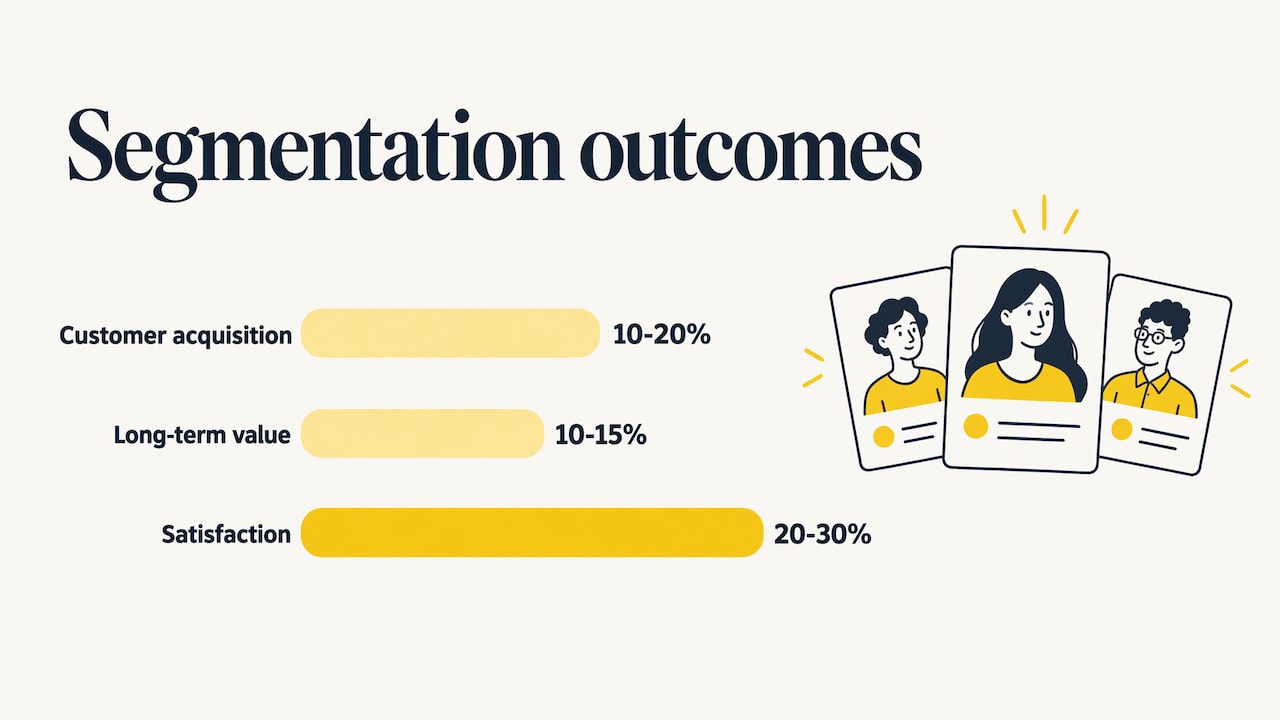
Personalization needs segments. McKinsey’s 2021 research reports that behavioral segmentation in loyalty programs can yield increases of 10% to 20% in customer acquisition, 10% to 15% in long-term value and 20% to 30% in satisfaction. Those are ranges from the firm’s observations, not guarantees for any one brand.
Start with three behavioral groups:
- Enrolled, never purchased again: needs a low-effort action and a reason to come back.
- Active, mid-spend: needs a visible path to the next tier or reward.
- Top redeemers: needs recognition, early access and exclusives rather than more discounts.
Our guides to ecommerce segmentation and ecommerce personalization show how to build these groups from the data you already have. For a broader view of how member data turns into relevant offers, this step-by-step approach to fostering customer loyalty is a good companion.
Omnichannel and gamification
If you sell in stores or through marketplaces as well as online, members should earn and redeem in every channel. Mastercard’s 2024 guidance lists personalized offers, exclusive products, free expedited shipping and returns, stored order and payment details, and gamified elements such as competitions and leaderboards as ways to add financial, emotional, convenience and engagement value. Use gamification sparingly. A challenge that is hard to explain will cost you more in confusion than it earns in activity.
Metrics that show whether engagement is working
Most brands track the outcomes and skip the behavior behind them. EY’s 2024 study found many brands track retention (59%), increased sales (56%) and customer lifetime value (52%), while engagement metrics such as member utilization are tracked less often.
A working dashboard has two layers.
Engagement metrics (leading indicators):
- Activation rate: share of new members who earn or take an action within 30 days.
- Active member rate: share of members with any qualifying action in the past 90 days.
- Redemption (redeemer) rate: share of members who have redeemed at least once.
- Points liability: the cost of unredeemed points on your balance sheet, which your finance lead should review.
Business metrics (lagging indicators):
- Repeat purchase rate and time between orders for members versus comparable non-members.
- LTV: gross profit per customer over a fixed window, such as 12 months.
- ROI of the program: Klaviyo gives the formula as net profit of the loyalty program divided by total cost, times 100.
- MER (marketing efficiency ratio): total revenue divided by total marketing spend. It shows whether rising retention revenue is lowering your blended cost of growth.
- ROAS (return on ad spend): revenue attributed to an ad campaign divided by its spend. Keep it in view, because loyalty audiences and lookalikes built from them can change paid media efficiency.
Tracking churn signals in your support and email data also helps. These email metrics that flag churn can sit alongside your program dashboard as early warnings that a segment is drifting away.
Is engagement incremental, or are you paying for orders you’d have won anyway?
This is the question that separates a profitable program from an expensive one. Members are often your best customers to begin with, so higher spending among members is not proof the program caused it. EY notes that companies track incremental spending by members versus non-members, though less often than other measures, and recommends a holistic view of program impact. It also found that 41% of companies struggle to quantify the overall impact of their programs on long-term preference and brand affinity.
Three checks help:
- Holdout test. Randomly withhold program messaging or a reward from a small share of eligible customers for a fixed period, then compare repeat rate and profit per customer. Random assignment is what removes the self-selection bias.
- Before-and-after by cohort. Compare customers’ behavior before they joined with the same period after, against a cohort that did not join.
- Reward cost against margin. Count the full cost of every reward, including shipping subsidies, against the incremental gross profit, not revenue.
A hypothetical example
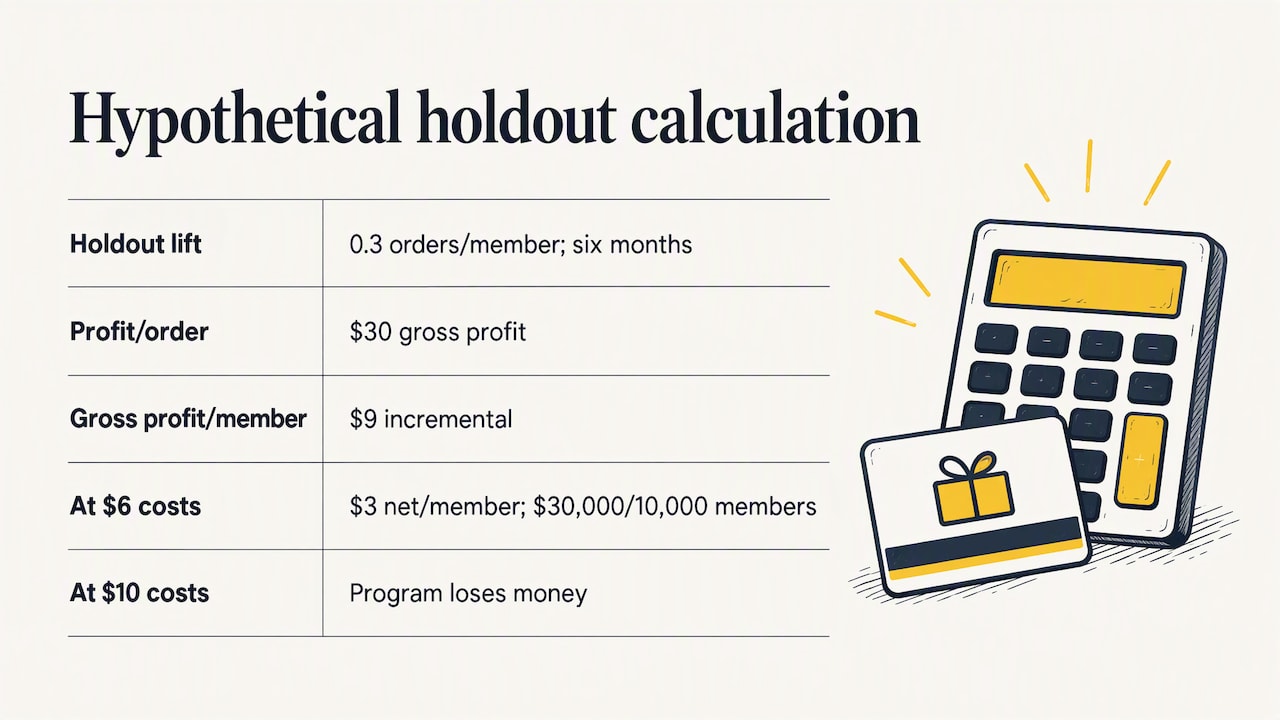
This is an illustration, not a client result. Say a brand has 10,000 members. In a holdout test, members who received program messaging placed 0.3 more orders over six months than the holdout group, at $30 gross profit per order. That is $9 of incremental gross profit per member. If rewards and program costs average $6 per member, the program earns $3 per member, or $30,000 in total. If costs were $10, it would lose money despite looking busy. Your numbers will differ, and the method is the point.
Keep the program relevant without making it confusing
Marigold’s advice is to review programs continuously, use segmentation to tailor offers, and keep the program flexible enough to scale as participation grows. In practice:
- Explain it in one sentence. If new customers cannot say how they earn and what they get, simplify.
- Set a quarterly review. Check activation, redemption rate and reward cost, and retire rewards nobody uses.
- Protect margin with structure. Use minimum order thresholds for free shipping, cap high-value redemptions and put tier benefits on non-discount perks where you can.
- Connect the program to the rest of retention. For subscription brands, tie rewards to renewal. Our subscription ecommerce email playbook covers how.
A loyalty program also works best when acquisition, conversion and retention are planned together. Our view of building beyond the first sale and the customer value journey lays out that thinking.
Our perspective
We see the same pattern in brands that come to us with a loyalty program that looks healthy on paper. Enrollment is up, the points page is polished, and yet repeat rate has barely moved. The program has been treated as a feature to launch, not a retention channel to run.
At Rozee Digital, we work from the idea that acquisition, conversion and retention should be planned as one profit system, which is what our Ecommerce Acceleration System™ is built around. For loyalty, that means the program is judged by what it does to blended efficiency and contribution margin, not by member counts.
It also means the work sits in the channels where members actually hear from you: post-purchase email and SMS, paid social audiences built from your best customers, and the landing pages that bring them back. Our work is led by senior strategists, and we keep our client roster deliberately small, so the person who designs the retention flow is the one watching whether it is paying back.
Our advice is simple: measure redeemers, test against a holdout, and spend your reward budget where it changes behavior.
Tom
Next step: turn engagement into a retention channel
If your program has members but not momentum, the fastest gains usually sit in the post-purchase flows and in how member data feeds your segments and ad audiences. Rozee Digital helps established Shopify, WooCommerce and Magento brands set up and optimize Klaviyo email and SMS programs built around lifetime value and profit, and connect them to paid media through paid social management.
If you want senior-level input on your own program, start from the Rozee Digital homepage and tell us where retention is stalling.
FAQ
What is a good loyalty program engagement rate?
There is no universal number. One published benchmark is that 50% to 70% of new members activating within their first 30 days indicates a well-designed program, but it comes from an Australian retail source. Set your own baseline for activation, active member rate and redemption rate, then improve it quarter over quarter.
How does a loyalty program improve post-purchase retention?
It gives customers a reason to come back and a way to see progress toward a reward. Post-purchase emails that show points earned and remaining distance to the next reward keep the program visible during the 30 to 60 days when members decide whether to engage.
Which rewards work best for repeat purchases?
In U.S. survey data, earning points toward discounts or merchandise, member-only perks and free shipping rank among the most wanted features. Choice of reward and birthday gifts also scored strongly. Test them against your margins, because the most popular reward is not always the most profitable.
How do I know the program isn’t just rewarding sales I’d have made anyway?
Run a holdout test. Withhold program messaging or rewards from a randomly selected group of eligible customers, then compare repeat rate and profit per customer against members who received them. If the gap in gross profit does not cover reward and program costs, change the structure.
Sources
- Stages of brand loyalty and how to win over customers
- Next in loyalty: Eight levers to turn customers into fans (McKinsey)
- Customers want rewards and exclusive perks from loyalty programs (Retail Dive)
- Reshaping customer loyalty programs (Deloitte Insights)
- Types of Loyalty Program Benefits (Ebbo)
- 11 Features That Drive the Best Loyalty Programs (Ebbo)
- How loyalty programs work for businesses (Stripe)
- Loyalty Optimization Guide (Marigold, 2024)
- eCommerce Guide: How to create a customer loyalty plan (Australia Post)
- A complete guide to customer loyalty programs for B2C (Klaviyo)
- 2025 EY Loyalty Market Study
- The 2024 EY Loyalty Market Study
- How to Redefine the Loyalty Program Value Exchange (Salesforce)
- How to Build a Customer Loyalty Program (Mastercard)
- How to Foster Customer Loyalty: Step-by-Step
- Six Support Email Metrics to Spot Churn Early