Site speed changes sales because every paid click lands on a page that either loads fast enough to convert or loses part of that traffic you already paid for. Across independent studies, even tenths of a second move conversion rate, order value and bounce rate, and the effect is largest on mobile and at checkout. For a brand spending heavily on ads, a slow store raises your effective customer acquisition cost without showing up in any ad platform report. Rozee Digital treats speed as part of conversion work, because acquisition, conversion and retention have to be fixed together for growth to stay profitable.
TL;DR
- A 0.1-second mobile speed gain was linked to an 8.4% higher retail conversion rate and a 9.2% higher average order value in a 2023 Deloitte study of 37 brands.
- Slowdowns hurt most late in the journey. Checkout is where shoppers are least patient.
- Start with the pages in the paid-traffic funnel: landing pages, category pages, product pages and checkout. Measure them with field data, not a single lab score.
- Third-party scripts and unoptimized images are the usual culprits, so every new app or pixel should justify its cost.
- Prove the result in revenue per session and blended efficiency (MER), not in a page speed score.
Table of Contents
- Why speed is a sales lever and not just a tech metric
- What the evidence says about speed and revenue
- Which pages to fix first
- The metrics to track
- Why mobile deserves its own line in the plan
- What usually slows a store down
- Fixes that protect discovery and checkout
- How to prove a speed gain paid off
- Where speed fits in ecommerce optimization
- Perspective
- Turning faster pages into profitable growth
- FAQ
- Sources
Why speed is a sales lever and not just a tech metric
A few definitions first, since the rest of the article leans on them:
- CAC (customer acquisition cost): total marketing spend divided by new customers won.
- ROAS (return on ad spend): revenue attributed to ads divided by ad spend.
- MER (marketing efficiency ratio): total revenue divided by total marketing spend, across all channels.
- LTV (lifetime value): the gross profit a customer generates over their relationship with your brand.
Speed touches all four. A slower page converts fewer of the visitors you paid for, so CAC rises and ROAS falls. Shoppers who have a slow experience are also less likely to come back, which pulls down LTV. Because speed acts on conversion rather than on traffic, it can lift every channel at once without adding budget.
This is why a speed project belongs in the same conversation as bid strategy and creative. If your ad account looks healthy but blended efficiency is sliding, the page those ads point to is a prime suspect.
What the evidence says about speed and revenue
The numbers below come from different eras, platforms and methods. Treat them as a range of effects, not as a promise for your store.
The most recent large study: tenths of a second
Deloitte’s 2023 Milliseconds Make Millions report analyzed 37 retail, travel, luxury and lead-generation brands in Europe and the US over four weeks. It found that a 0.1-second improvement in mobile speed raised retail conversions by 8.4%, and retail average order value rose 9.2%. The same improvement cut product-listing-page bounce rates by 5.7% in retail.
Order value matters as much as conversion. It means faster pages do not only close more sales, they appear to support bigger baskets.
Academic work on real transactions
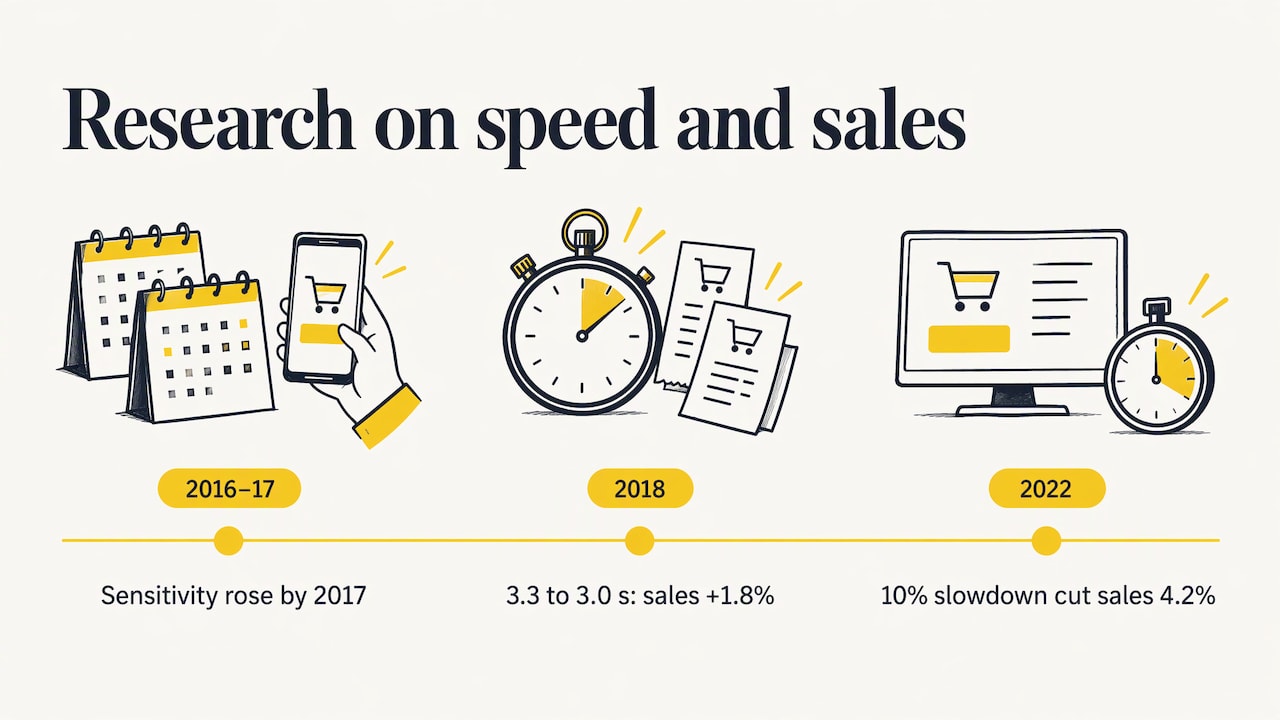
A conference study presented at MSOM in 2018 analyzed more than 8 million online transactions across multiple retailers. It found that cutting average time-to-interactive from 3.3 to 3.0 seconds increased online sales by 1.8%, and that shoppers were more sensitive to slowdowns in 2017 than in 2016. Expectations only tighten.
A peer-reviewed study in Operations Research (2022) used retail transaction data and speed measurements to show that customers are most sensitive to delays at the checkout stage, with different abandonment effects at landing, product and checkout pages. Wharton professor Santiago Gallino, one of the researchers, put the finding this way: most sites are already fast, so the real question is whether fractions of a second matter, and his team found that a 10% slowdown cut sales by 4.2%. His practical advice is to weigh each added tracking script or feature against what it costs in speed, especially at checkout.
Older but still instructive retail data
Akamai’s Spring 2017 retail performance report is dated, and mobile has changed since. It still shows the shape of the curve. In its data, desktop pages loading in 1.8 seconds had the peak conversion rate of 12.8%, a 100 ms delay cut conversions 2.4% on desktop and 7.1% on smartphones, and a two-second delay cut desktop conversions by almost 37%. The lesson is that the penalty is steeper on phones, which is where most paid social traffic arrives.
What this means for a paid-media brand
None of these studies is a forecast for your store. They agree on direction: faster pages convert better, and the damage from slowness is larger on mobile and near purchase. For a brand spending, say, six figures a month on ads, even a small conversion lift compounds across every dollar spent.
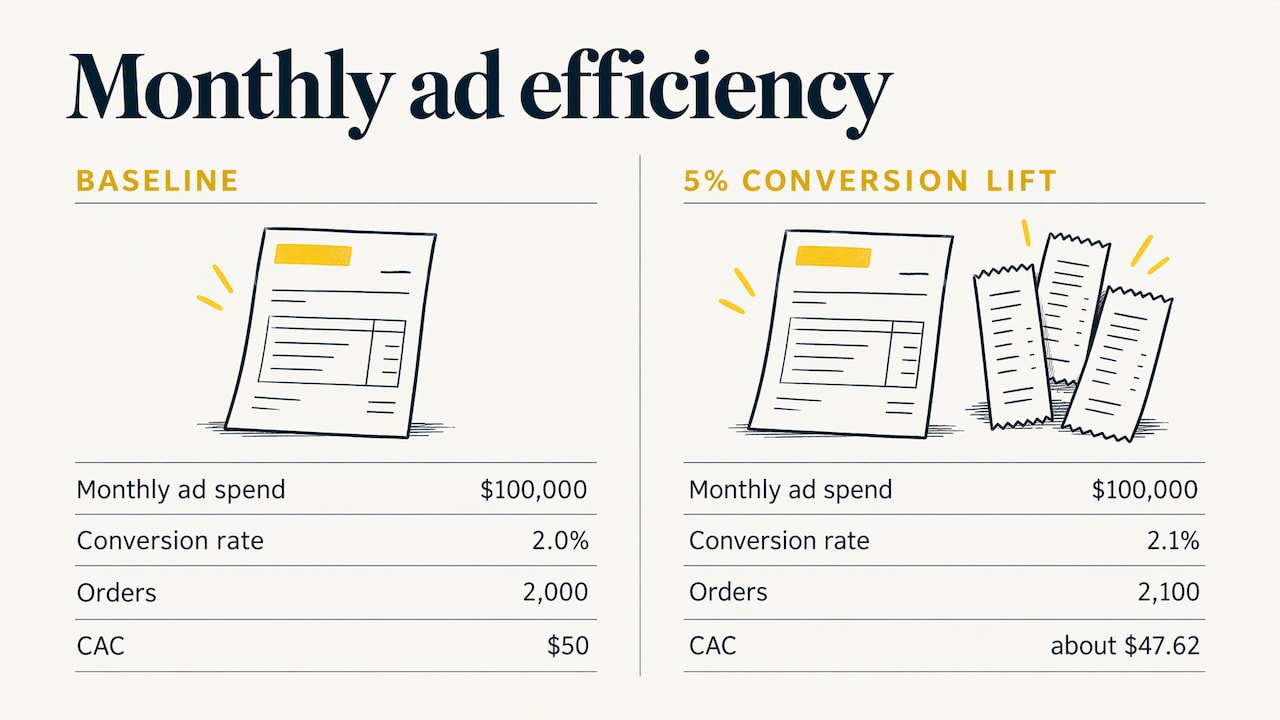
A hypothetical example (not a client result): a store spends $100,000 a month on ads and gets 2,000 orders at a 2.0% conversion rate, so CAC on those orders is $50. If speed work lifted conversion by a relative 5% to 2.1%, the same traffic would produce 2,100 orders and CAC would fall to about $47.62. Nothing changed in the ad account, yet the efficiency gain is real. Run the same arithmetic with your own numbers before deciding how much a speed project is worth.
Which pages to fix first
A full-site audit is rarely the best start. Google’s web.dev guidance says to prioritize pages in the conversion funnel, which for ecommerce means category pages and product pages, with checkout as the revenue-critical step. Pick a relatively slow, high-traffic page and fix that first, because the payoff is largest there.
For a paid-media brand, add one more group: the landing pages your ads point to. Slow landing pages waste the most expensive visits you buy. If you run paid search or paid social, list your top ten destination URLs by spend and test those before anything else.
| Page type | Why it matters | What usually breaks |
|---|---|---|
| Ad landing pages | Every visit is paid for | Heavy hero images, video, tracking scripts |
| Category pages | Where shoppers browse and filter | Image-heavy grids, filter lag |
| Product pages | Where the buying decision happens | Large galleries, review and upsell apps |
| Cart and checkout | Shoppers are least patient here | Third-party payment, fraud and tracking scripts |
The metrics to track
Start with Google’s Core Web Vitals. They measure three things, and web.dev publishes the thresholds for a good experience:
- Largest Contentful Paint (LCP): how fast the main content appears. Good is within 2.5 seconds.
- Interaction to Next Paint (INP): how quickly the page responds when someone taps or clicks. Good is 200 milliseconds or less.
- Cumulative Layout Shift (CLS): how much the page jumps around while loading. Good is 0.1 or less.
Web.dev advises measuring at the 75th percentile of real visits, so most of your shoppers hit the target and not just the average one. Use field data (what real visitors experienced) alongside lab tests, because lab scores run on a fast connection and a single device.
Then pair those with business metrics. Web.dev recommends tracking conversion rate, add-to-basket rate, bounce rate and average session duration alongside the speed metrics, so a technical change can be tied to a commercial one. If you already have a reporting setup, our guides on ecommerce marketing analytics and marketing reporting show how to build the dashboard around profit and not vanity numbers.
Why mobile deserves its own line in the plan
Most paid social clicks happen on phones, and phones are where slowness is penalized hardest in the data above. Mobile fixes are mostly about weight: smaller images, fewer scripts, simpler layouts above the fold. For a deeper look at how this ties to ad performance, see our piece on mobile optimization for ecommerce PPC and our mobile commerce playbook. A broader view of how mobile performance links to organic visibility is in this overview of mobile optimization and ecommerce SEO.
What usually slows a store down
Most slow stores share the same few problems. In order of how often they cost real revenue:
- Third-party scripts. Each review widget, chat tool, popup, heatmap and ad pixel adds requests and JavaScript. They accumulate over years, and nobody owns the total.
- Unoptimized images. Oversized hero banners and product galleries are the usual cause of a slow LCP. Compressing and resizing images and serving modern formats such as WebP or AVIF is standard advice.
- Heavy themes and apps. On platforms like Shopify, WooCommerce and Magento, apps and plugins inject code on every page, including pages where they do nothing.
- Slow server response. Cheap hosting or poorly configured caching delays everything that follows.
- Layout shifts. Banners, late-loading fonts and injected widgets push content around, which frustrates shoppers mid-tap.
To find your own causes, run your top pages through Google’s PageSpeed Insights, which reports field data for the pages that have enough traffic, and then look at the waterfall of requests for the slowest template. Ask of every script: what revenue does this earn, and what does it cost in load time?
Fixes that protect discovery and checkout
Speed work goes wrong when it removes the features that sell. A safer order of operations:
- Remove what nobody uses. Retire old pixels, abandoned apps and duplicate analytics tags. This costs nothing in functionality.
- Fix images. Compress, resize to display dimensions, use WebP or AVIF, and lazy-load images below the fold. Never lazy-load the main hero image, since that is usually your LCP element.
- Defer non-essential scripts. Load chat and review widgets after the page is usable.
- Keep checkout lean. Because the research points to checkout as the most delay-sensitive step, keep third-party code there to what payment and compliance require.
- Set a page-speed budget. Deloitte advises introducing a page-speed budget for project teams, so performance is never traded away for an aesthetic or functional addition. In practice that means a new feature has to fit within an agreed weight and load time or something else comes out.
Page layout and design choices decide much of this up front, which is covered in our guide to ecommerce website design built for scale and ROI.
How to prove a speed gain paid off
A faster Lighthouse score is not a business result. To show that speed work earned its cost:
- Record a baseline. Capture two to four weeks of conversion rate, revenue per session, average order value and bounce rate for the pages you will change, split by device.
- Change one thing at a time where possible. Bundled changes make attribution impossible.
- Compare like with like. Seasonality, promotions and ad mix can swamp a small speed effect. Compare the same weekdays, and where traffic allows, run an A/B test that serves a faster version to a share of visitors.
- Read blended numbers. Check MER and new-customer CAC across the whole account, not just platform-reported ROAS, which depends on each platform’s attribution.
- Watch retention. Repeat purchase rate and returning-visitor conversion take longer to move, but they are where speed compounds into LTV.
The benefit is often a series of small lifts rather than one jump. That is why it helps to fold speed into a broader conversion rate optimization program and not run it as a one-off technical fix.
Where speed fits in ecommerce optimization
Ecommerce optimization is the ongoing work of getting more profit from the traffic and customers you already have. It covers the offer and merchandising, product page content, the checkout flow, ad creative and landing pages, email and SMS retention, and the technical performance that holds all of it together. Speed is the foundation layer: a persuasive page that loads slowly loses visitors before the persuasion starts, and a fast page with a weak offer wastes the speed. That is why speed gains show up most clearly when paired with sound Shopify conversion strategies and clear measurement.
Perspective
Most brands we talk to treat speed as a developer ticket and ad performance as a media-buyer problem. They are the same problem. When customer acquisition costs rise, the first instinct is to adjust bids, audiences and creative. Those levers matter, but if the landing page loses shoppers on the way in, you are optimizing the cheap half of the funnel.
That is why Rozee Digital works across acquisition, conversion and retention through our Ecommerce Acceleration System™, and why our work is led by senior strategists on a deliberately small client roster. Speed is a good example of a decision that needs someone who reads the ad account, the landing pages and the retention flows together, so a script added for one team does not quietly tax the others.
Our advice is simple: pick the pages your ad spend lands on, measure them with real-visitor data, tie every change to profit and keep a budget for what gets added. Do that consistently and speed stops being a one-time cleanup.
Tom
Turning faster pages into profitable growth
If you are already investing in paid media and your conversion rate or CAC has stalled, Rozee Digital can look at the whole picture: how your traffic is bought, what it lands on and what happens after the first order. We offer paid search and paid social management, conversion-focused landing pages and retention marketing through email and SMS, all aimed at profitable growth rather than traffic for its own sake. You can see the full range on the Rozee Digital site and get in touch there to discuss where your funnel leaks.

If you want the wider context first, our performance marketing guide for ecommerce explains how acquisition, conversion and retention fit together.
FAQ
How much does site speed affect ecommerce sales?
The size varies by store, device and starting speed. Deloitte’s 2023 study linked a 0.1-second mobile improvement to an 8.4% rise in retail conversions, while the 2018 MSOM transaction study found a 0.3-second gain in time-to-interactive raised sales by 1.8%. Treat those as evidence of direction and measure your own effect.
What is a good load time for an ecommerce site?
Google’s guidance for a good experience is an LCP within 2.5 seconds, INP of 200 milliseconds or less and CLS of 0.1 or less, measured at the 75th percentile of real visits. Faster is better, especially on product pages and checkout.
Which page should I speed up first?
Start with a slow, high-traffic page in the conversion funnel. For paid-media brands that is usually the top ad landing pages, followed by product pages and checkout. Web.dev recommends this prioritization.
Does speed matter more on mobile?
In Akamai’s 2017 data, a 100 ms delay cost conversions of 7.1% on smartphones versus 2.4% on desktop. Since much paid social traffic arrives on phones, mobile is the sensible place to focus first.
Sources
- Milliseconds Make Millions, Deloitte (2023)
- Need for Speed: The Impact of In-Process Delays on Customer Behavior, Operations Research (2022)
- Need For Speed: The Impact of Website Performance, MSOM conference abstract
- Why Online Retailers Have a Need for Speed, Wharton Magazine (2022)
- The State of Online Retail Performance, Spring 2017
- Site speed and business metrics, web.dev
- Web Vitals, web.dev