The right MuteSix alternatives for ecommerce paid media are the providers that make measurement and first-party data central to campaign decisions, not just those that manage the same channels. The best fit depends on how clearly an agency connects paid media to business outcomes such as customer acquisition cost, repeat purchases, and profit. A larger channel mix alone doesn’t settle the comparison.
Clear reporting is a reasonable expectation from a paid media partner. But platform-reported return on ad spend (ROAS) is only one measure of performance; it does not show the full business picture. Compare providers by how they measure results, use data, and approach channel coverage, then consider what those differences mean for your brand.
Assess the options against your brand’s growth stage and look for signs that a change may be warranted. The goal is to choose a partner whose reporting supports commercial decisions, not just channel-level activity.
Key Takeaways
- Compare providers by how they connect campaign reporting to business outcomes, not by channel coverage alone.
- Assess ecommerce and DTC specialization against your growth priorities, including customer acquisition, repeat purchase, and data use.
- Separate paid social platform metrics from the broader view needed to evaluate campaign contribution and profitability.
- Use changes in reporting quality, account continuity, and strategic alignment to recognize when a provider review may be due.
What are the best alternatives to MuteSix for ecommerce paid media in the United States?
There is no single best replacement for every U.S. ecommerce brand. A practical shortlist might include Lunar Solar Group, New Engen, Hawke Media, Blue Light Media, and Y’all. Compare them against your measurement needs, channel priorities, and account structure. Treat these names as candidates, not a universal ranking, and let your immediate growth constraint guide the review.
Start by defining what you need a provider to own. If acquisition efficiency is the priority, assess how its approach connects media decisions to CAC and contribution margin. If leadership needs better data interpretation, look at how reporting reconciles platform results with business performance. For paid social, clarify how creative testing and strategic decisions fit the proposed scope.
An agency’s name reveals little about how an account will work. For each candidate, document the proposed team, its responsibilities, and how strategic decisions will be shared with your stakeholders. Compare how the provider reviews performance, acts on findings, and maintains continuity when responsibilities change. These are operating details, not presentation polish.
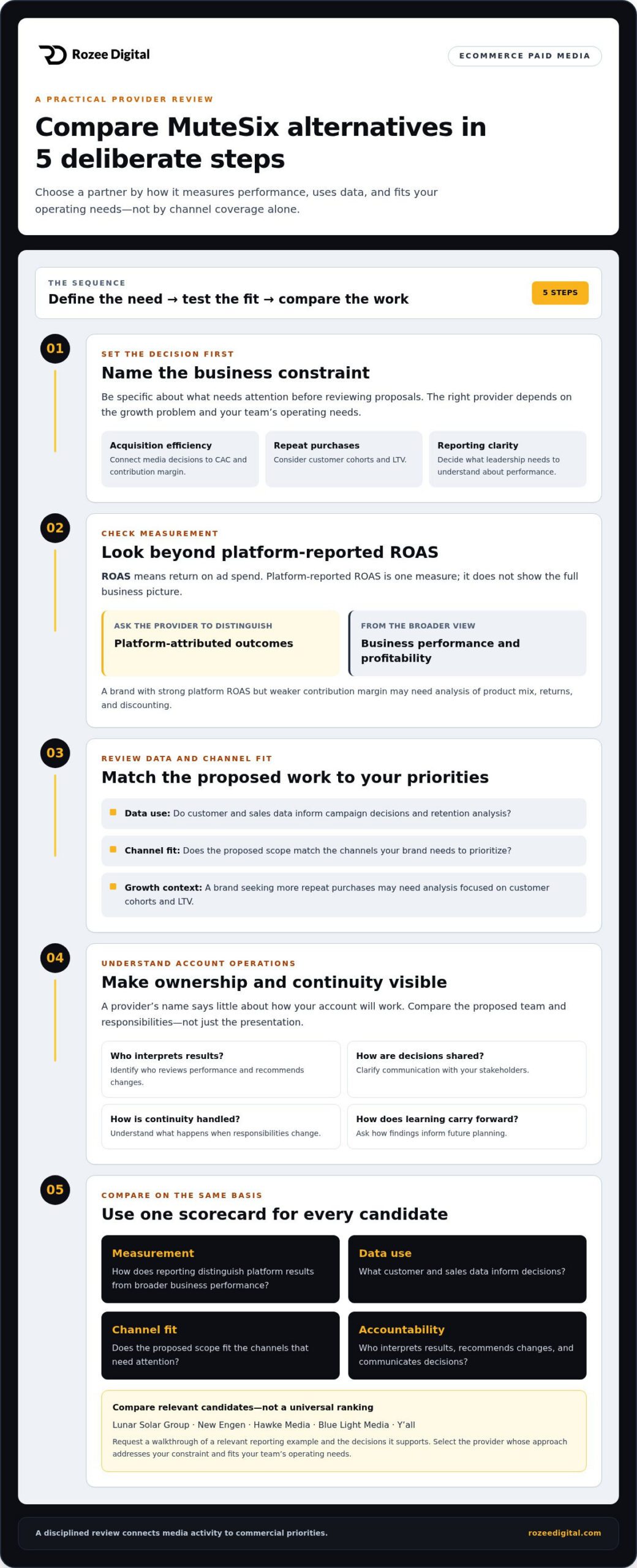
Use a consistent scorecard for every provider:
- Measurement: Review how reporting distinguishes platform-attributed outcomes from broader business performance.
- Data use: Assess whether customer and sales data inform campaign decisions and retention analysis.
- Channel fit: Match the proposed work to the channels your brand needs to prioritize.
- Accountability: Identify who interprets results, recommends changes, and communicates those decisions.
For example, a brand with strong platform ROAS but weaker contribution margin needs a provider that can investigate product mix, returns, and discounting. A brand with efficient acquisition but limited repeat purchases needs a different analysis, focused on customer cohorts and LTV. One agency may not be the best fit for both challenges. Define the business question before reviewing proposals.
Compare Lunar Solar Group, New Engen, Hawke Media, Blue Light Media, and Y’all against that question. Request a walkthrough of a relevant reporting example and the decisions it supports. Look for an explanation that connects media activity to your commercial priorities, rather than presenting channel metrics in isolation.
The strongest alternative is the provider whose approach addresses your actual constraint and fits your team’s operating needs. Define the questions leadership needs answered, the channels requiring attention, and the outcomes that matter. This brief makes the comparison more disciplined and helps distinguish strategic fit from a broad service list.
Which MuteSix competitors specialize in ecommerce brands and DTC growth?
A useful comparison set includes Lunar Solar Group, New Engen, Hawke Media, Blue Light Media, and Y’all. Treat these names as candidates to assess, not a definitive ranking. Their relevance depends on your growth priorities, channel needs, and internal capabilities. Look beyond broad ecommerce or DTC positioning to the specific work each proposes for your business.
Start with the growth problem. A brand expanding customer acquisition may need closer coordination between channel plans and product priorities. A business seeking more repeat purchases may need acquisition decisions considered alongside retention activity. A team with limited internal marketing capacity may prioritize clear ownership and communication. Define which situation applies before comparing providers.
For each candidate, map the proposed scope to your operating needs. Identify the channels covered, how strategic recommendations are developed, and who will communicate decisions to your team. Ask how learning informs future planning. A provider’s label or portfolio alone will not show whether its proposed structure fits your business.
- Lunar Solar Group: Assess its proposed approach against your brand’s strategic priorities and preferred account structure.
- New Engen: Examine how its proposal connects channel activity with your commercial objectives.
- Hawke Media and Blue Light Media: Compare the proposed team responsibilities and communication model for your engagement.
- Y’all: Evaluate whether the proposed scope aligns with your channel requirements and internal resources.
Ask every provider the same questions. What business objective does the proposed work address? Which internal data informs recommendations? Who interprets results and communicates next steps? How will the provider use what it learns to shape future decisions? Consistent questions make it easier to compare proposals on substance rather than presentation.
For example, a DTC brand preparing to launch a product may need an agency to coordinate media priorities with launch timing and inventory. A brand with established demand might instead prioritize structured testing and clearer communication about budget decisions. These needs differ, so the right provider depends on the work required.
Shortlist the agencies whose proposed scope directly addresses your priority. Then compare their approaches to strategic ownership, data inputs, team communication, and ongoing learning. This disciplined review gives founders and marketing leaders a clearer basis for choosing an ecommerce partner, without relying on generic claims about specialization or scale.
Paid social
Paid social decisions should reflect the products being promoted, not just the platform receiving spend. Before launching, align product selection with inventory, margin, promotional terms, and the landing page. This helps prevent creative from generating demand for an offer the business cannot support and gives the team a clearer basis for reviewing results by product group.
Build a creative testing plan around distinct customer motivations. For example, a fashion brand could test fit, styling, and material messages for the same product category. Keep the offer and destination consistent while changing the message being tested. If several variables change at once, it becomes harder to tell what influenced the response.
Use a simple operating sequence for each test:
- Set the decision: State what the test should help the team decide, such as which product benefit deserves more creative investment.
- Define the comparison: Identify the audience, product, offer, and creative variable under review.
- Record the outcome: Capture results alongside relevant context, including changes to promotions or product availability.
- Apply the learning: Document whether the next action is to develop a new variation, revise the offer, or stop the test.
Keep paid social connected to the customer journey after the click. A strong ad concept can lose impact if the landing page highlights a different benefit or offer. Review the path from creative to product page as one experience. For a collection launch, align the ad’s styling message with the imagery and product details shoppers see next.
Coordination with merchandising matters, too. If a featured item becomes unavailable or a promotion changes, establish a process for updating the related creative and destination. Clear ownership across marketing and ecommerce helps prevent outdated messages from remaining active. Record key changes so later reviews reflect what shoppers actually saw.
Maintain a decision log for creative and audience tests. Record the business question, what changed, and how the next action was chosen. Over time, this creates a useful record of which messages fit particular products and customer needs. Treat paid social as a connected commercial process, from product selection through the post-click experience, not as a series of isolated ads.
Rozee Digital: Ecommerce ads agency
Rozee Digital is an ecommerce ads agency for brands assessing paid media management against commercial priorities. Its work includes Google Ads, Facebook Ads, and PPC campaign management. Consider this fit when your team needs paid campaign support aligned with acquisition goals and clearer performance decisions, rather than another channel report without business context.
Before evaluating an engagement, define the decisions your reporting must support. Specify which campaigns need management, how your team assesses customer acquisition cost, and how paid media performance connects to broader revenue and margin. That gives the discussion a practical focus and helps establish whether the agency’s offering aligns with your priorities.
Contact Rozee Digital to discuss your ecommerce paid media priorities.
Make the next provider decision operational
Before changing providers, define what needs to improve and how leadership will recognize progress. Set clear ownership for measurement, data interpretation, and strategic decisions. Then document the reporting gaps your current process leaves unresolved. This gives the next provider discussion a commercial purpose, rather than turning it into a comparison of presentations.
Evaluating MuteSix alternatives for ecommerce paid media is most useful when your team can connect provider responsibilities to the decisions it needs to make. Consider whether the priority is better visibility into customer acquisition, clearer ownership of growth, or stronger alignment between media activity and business performance. That focus keeps a potential transition grounded in operational needs.
Rozee Digital can be part of that evaluation if you’re considering a different approach to paid media management. Share the priorities your team wants to address and use the conversation to assess fit. Contact Rozee Digital to compare options and take the next step with a clearer decision framework.
A considered provider choice starts with the questions your business needs answered. Keep them central as you compare options, and choose a partner whose approach fits your priorities.
Frequently Asked Questions
How Do These Agencies Compare?
Providers differ in account structure, channel emphasis, and how insights inform business decisions. Compare how each handles data access, reporting ownership, and continuity when team members change. For example, establish who retains access to campaign history and customer-level insights if an engagement ends. This operational detail can determine whether your team keeps learning or has to rebuild its knowledge base.
How should an ecommerce brand evaluate and choose a paid media agency?
Start by defining the business decision the agency must improve, such as allocating spend across product categories or supporting a new market. Map the data and internal teams involved, then identify who will own strategy, analysis, and implementation. Consider how the agency’s work connects with existing retention and conversion efforts. Choose an operating model that fits your team’s capacity and growth priorities.
What client reviews and case studies are available for MuteSix and its alternatives?
Compare providers’ proposed channel coverage and reporting against your priorities; the material gives no agency-by-agency comparison across Meta, Google, TikTok, and Amazon.
Which MuteSix alternatives suit small ecommerce businesses versus enterprise brands?
The article names Lunar Solar Group, New Engen, Hawke Media, Blue Light Media, and Y’all as candidates but does not assign them to business sizes. For brands at $5 million to $30 million, channel efficiency and creative are common constraints; at $30 million to $100 million, LTV measurement and contribution margin clarity matter more. Brands above $100 million need P&L-level accountability and a team able to run multiple functions.