More attributed revenue doesn’t automatically mean more profitable growth. Choosing a paid social agency for ecommerce brands means assessing whether its media decisions drive incremental sales, not just claim credit for purchases that might have happened anyway.
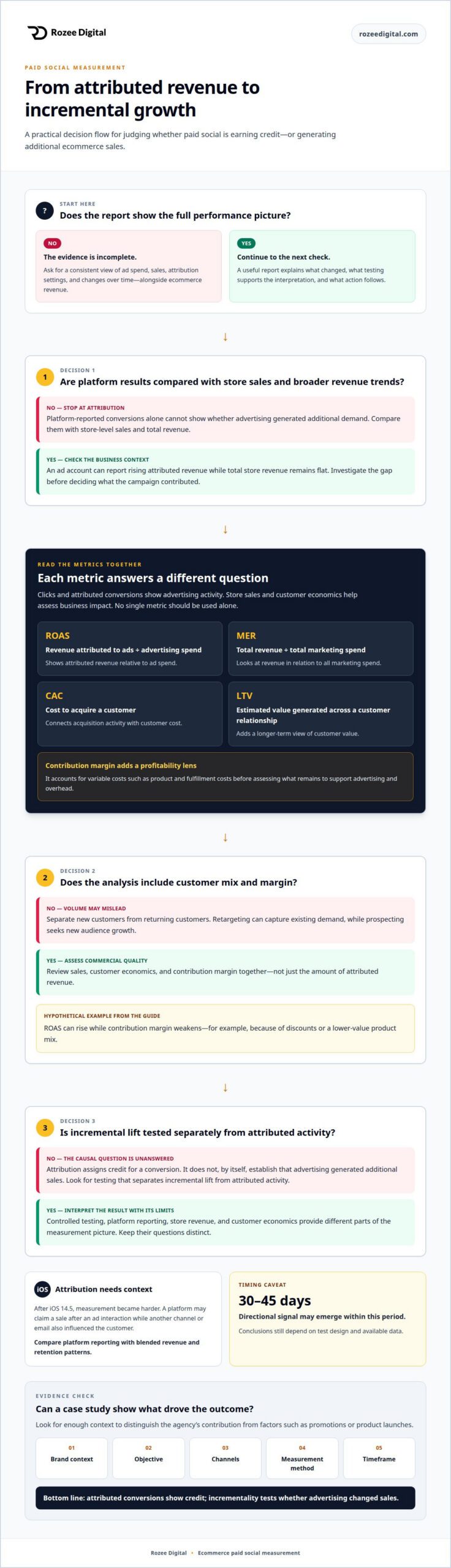
The distinction comes down to measurement and commercial discipline. ROAS is revenue attributed to advertising divided by ad spend; MER compares total revenue with total marketing spend; CAC is the cost to acquire a customer; and LTV estimates the value a customer generates over time. Each metric answers a different question, so none should be used alone to judge performance.
This guide explains what strong agency services include, how to assess creative testing and campaign management, and how to evaluate attribution alongside incrementality. You’ll also learn what evidence to look for, how to align services with growth priorities, and when an agency relationship is the right fit for your ecommerce brand.
Key Takeaways
- Assess campaign management across Meta, TikTok, and Pinterest by the quality of its testing and optimization process, not platform coverage alone.
- Use sales, ROAS, CAC, and LTV reporting to connect campaign activity with commercial outcomes.
- Separate attributed conversions from incremental impact to understand whether advertising is generating additional demand.
- Choose services around your growth priorities and the role paid social needs to play alongside other marketing channels.
What Sets the Best Paid Social Agencies Apart?
Strong agencies connect platform activity to ecommerce economics. An experienced paid social agency for ecommerce brands tests creative, measures sales, and explains how advertising relates to commercial outcomes.
Cross-Platform Campaign Management
Meta, TikTok, and Pinterest each call for distinct audience, creative, and budget decisions. A capable team coordinates platform roles and testing rather than copying the same ad everywhere. Assess how the strategy adapts creative formats to each channel and uses performance insights to shape the next decision. Platform coverage without a defined testing process can scatter spend without a clear purpose.
Campaign Metrics and Business Outcomes
Clicks and platform-attributed conversions show advertising activity; store sales and customer economics indicate business impact. Review both views together. For example, an ad account may report rising attributed revenue while total store revenue remains flat. A strong agency investigates the gap and explains whether advertising supports the brand’s commercial objectives.
Ecommerce Results and Client Stories
Relevant case studies identify the brand context, objective, channels, measurement method, and outcome. These details help distinguish an agency’s contribution from other factors, such as promotions or product launches. Creator and influencer content also needs clear evaluation. Compare creator assets with other formats against campaign objectives and sales signals, not views or engagement alone.
Ecommerce Agency Specialization
In the United States, a paid social agency for ecommerce brands should demonstrate an ecommerce-specific approach across Meta, TikTok, and Pinterest. Look for relevant examples, a clear creative testing process, and reporting that connects platform activity to store performance. Specialization means understanding how product margins, purchase cycles, and customer priorities shape decisions, not simply listing platforms.
Common hiring risks include choosing an agency based on platform coverage alone, accepting case-study headlines without context, and overlooking who owns reporting. Clarify the agency’s process, evidence, and responsibilities before agreeing on scope.
How does a paid social agency measure whether campaigns are actually incremental?
Incrementality means determining whether advertising generated sales beyond what would have happened without it. Strong measurement combines platform reporting with store revenue, customer economics, and controlled testing.
Sales and Customer Value Reporting
Sales reporting should connect advertising activity to ecommerce revenue and customer quality. ROAS means revenue attributed to ads divided by advertising spend. CAC is the cost of acquiring a customer; lifetime value estimates the value generated across that customer relationship. These measures answer different questions, so reporting should show them together.
Contribution margin adds a profitability lens. It accounts for variable costs associated with sales, such as product and fulfillment costs, before assessing what remains to support advertising and overhead. A hypothetical campaign can report rising ROAS while contribution margin weakens because of discounts or a lower-value product mix. Volume alone does not settle the question.
Reports should also distinguish new customers from returning customers. Retargeting can capture existing demand, while prospecting seeks new audience growth. Pinterest or another platform may claim conversions, but store-level revenue and customer mix provide essential context.
Reporting Access and Transparency
Reporting access should let the brand see ad spend, sales, attribution settings, and changes over time. Ask for a consistent view of advertising performance alongside ecommerce revenue, not screenshots that omit context. A useful report explains what changed, what testing supports the interpretation, and what action follows.
Attribution became harder after iOS 14.5, so platform-reported conversions should not stand alone. Compare platform results with store sales and broader revenue trends. A reported case study should name its objective, audience, channel, measurement method, and timeframe. Without those details, a headline outcome cannot show whether the campaign caused incremental growth.
Look for testing that separates incremental lift from attributed activity, alongside clear explanations of limitations. Directional signal may emerge within 30 to 45 days, but conclusions depend on the test design and available data. A structured paid social measurement approach can connect campaign reporting to commercial decisions.
Attribution and incrementality measurement
Attribution assigns credit for a conversion; incrementality tests whether advertising generated additional sales. A sound approach keeps those questions separate across social media and other channels.
Paid social agencies approach creative testing, attribution, and reporting by comparing campaign variations, applying consistent conversion definitions, and reviewing results alongside store data. The goal is not simply to identify which ad received credit, but to assess whether advertising changed business outcomes.
Tracking should connect ad interactions with ecommerce conversions and revenue. An agency can align conversion events, campaign naming, and reporting windows, then review how each platform records results. This creates a clearer basis for comparing Meta, TikTok, Pinterest, and other channels. It also helps expose gaps between platform-reported conversions and actual store sales.
After iOS 14.5, measurement became harder, so attribution needs context. A platform may claim a sale after an ad interaction, while another channel or an email may also have influenced that customer. Agencies should compare platform reporting with blended revenue and retention patterns, rather than treating any single attribution model as definitive.
Incrementality testing looks for change beyond attributed activity. An agency can compare exposed audiences with suitable comparison groups, then assess differences in conversions or revenue. Test design matters: audience overlap, timing, promotions, and other campaigns can affect the result. Contribution margin adds another layer by showing whether sales support profitable growth after variable costs.
Reporting should explain the method, test conditions, limitations, and resulting decisions. Directional signal may emerge within 30 to 45 days, depending on the test and available data. Creative testing should identify which messages or formats merit further investment, while measurement tracks the effect on conversion, margin, and retention. Clear reporting connects those findings to the next campaign decision.
Paid social and ecommerce marketing services
Paid social works best as part of an ecommerce marketing system, not as an isolated channel. Map advertising to awareness, consideration, conversion, and loyalty. Each stage has a distinct job: introduce the product, build intent, support purchase, or encourage retention. The target audience and business objective should shape the strategy.
Service scope can include audience planning, campaign setup, creative testing, budget allocation, and ongoing optimization. For example, a brand launching a new product may use prospecting to reach new customers, then retargeting to reconnect with interested shoppers. Strong execution links each campaign to a clear objective and reporting that shows how performance changes.
First-party data and CRM integrations can inform custom audiences, while product feeds support ecommerce advertising. A coordinated plan can connect paid social with email marketing and paid search. For example, social advertising can introduce a product, while email supports retention after purchase. The channels should reinforce the customer journey rather than compete for disconnected targets.
Scaling takes more than increasing ad spend after a strong week. Review acquisition cost, conversion quality, product margin, inventory, and repeat purchasing before expanding. In a hypothetical example, a high-volume campaign with low-margin orders may contribute less profit than a smaller campaign attracting repeat customers. Reporting should make that distinction visible.
Agency services differ in the scope of growth support they provide. Some focus on campaign execution; broader ecommerce growth work can coordinate paid media with search and retention priorities. Define the scope around the constraint: audience growth, creative capacity, measurement, or channel coordination. That keeps the strategy tied to business needs.
For support connecting paid media with ecommerce priorities, explore an integrated ecommerce advertising approach that aligns campaign management with growth objectives.
Rozee Digital: Ecommerce ads agency
Rozee Digital is an ecommerce ads agency. For established brands evaluating paid media and retention support, the key question is how those activities relate to commercial goals.
Before choosing an agency, clarify which growth areas matter to your business, including acquisition, creative, conversion, retention, economics, and scale. Compare potential partners’ published information and discuss how their approach would address your priorities.
If you are considering agency support, contact Rozee Digital to discuss your growth objectives.
Set the Next Growth Decision
Choosing an agency is a commercial decision, not just a channel assignment. Before committing, align leadership on the business constraint paid social should address, the trade-offs the team can accept, and how performance will inform future investment. That clarity gives an agency a defined mandate and gives your team a basis for evaluating its work over time.
Also establish who owns creative approvals, inventory context, and commercial reporting internally. A growth plan depends on timely decisions about products, promotions, and business priorities. When responsibilities are clear, the agency can work against an operating brief instead of disconnected requests. This creates a stronger foundation for a focused partnership.
For founders choosing a paid social agency for ecommerce brands, fit depends on the scope of support required. Rozee Digital offers ecommerce advertising, Google Ads, and Facebook Ads services for brands whose acquisition strategy spans social and search. Keep the decision anchored to your growth priorities rather than adding channels without a clear role.
Bring your objectives and current marketing priorities into the next conversation. Contact Rozee Digital to discuss an approach aligned with your ecommerce business.
Frequently Asked Questions
Are Meta ads still good for ecommerce?
Yes, Meta can support ecommerce customer acquisition when its audience and creative fit your offer. Judge performance against your store’s sales, customer mix, and contribution margin, not engagement alone. For example, a campaign driving first purchases may serve a different purpose than one reaching existing customers. Set the objective before launch, then assess whether the result supports it.
How do you pick the right agency for your store?
Choose an agency whose ecommerce experience and operating model fit your business. Review relevant case studies for the brand context, work performed, measurement approach, and outcomes, rather than relying on a headline result. Clarify who owns strategy, creative decisions, and reporting. Also align on how the agency will work with your internal team, especially around promotions, inventory, and product priorities.
How long before an agency shows results?
Look for early indicators before judging sustained business impact. The timing depends on conversion volume, sales cycles, changes in activity, and how reliably your store tracks purchases. For example, a promotion can create a short-term sales lift without proving repeatable acquisition. Agree on what the agency will report at each stage, and separate initial learning from evidence that supports ongoing investment.
How much creative should a scaling ecommerce brand produce?
Develop enough varied creative to test distinct customer motivations without overwhelming your team or diluting spend. Start with a structured pipeline: different hooks, product benefits, demonstrations, and formats. For example, test a product-in-use video against a static image focused on a specific benefit. Record the hypothesis and outcome for each test, then develop stronger concepts from what the results reveal.
How much should I spend on paid social advertising?
Set spend according to your acquisition economics, testing needs, and ability to fulfill demand. Start with the customer acquisition cost your margins can support, then consider how much volume is needed to assess performance. A budget should also account for product availability and cash flow. Avoid choosing an amount solely because it matches an industry benchmark or competitor estimate.
Should ecommerce brands prioritize ROAS or profitability?
Prioritize profitability; use ROAS as one diagnostic, not the final decision. A campaign can show attractive attributed revenue while discounts, product costs, or customer mix weaken its contribution. For example, a lower-ROAS campaign may still support better economics if it attracts customers who purchase again. Evaluate advertising alongside margin and retention so budget decisions reflect business value, not revenue attribution alone.