
The right ecommerce paid search agency connects advertising decisions to your margins, measurement and growth priorities. Platform expertise matters, but it is not enough: you also need clear reporting and a strategy guided by business performance, not clicks alone.
An agency’s Google Ads expertise can help connect Shopping, Search and Performance Max with commercial goals. These channels create value when measurement is reliable and the strategy accounts for what your products can profitably support.
This guide shows you how to assess agency fit, evaluate Google Shopping and Performance Max expertise, and judge reporting and data-driven insights. You’ll also see what operational clarity looks like, so you can distinguish a capable partner from a team that simply manages campaign settings.
Key Takeaways
- Assess whether an agency connects Google Ads and Shopping management to your product economics, not just campaign activity.
- Look for practical expertise in Google Shopping and Performance Max, including how campaigns are structured and evaluated.
- Use reporting to understand what is driving performance and where budget decisions can improve business outcomes.
- Choose a partner with clear responsibilities, communication and a strategy aligned with your growth priorities.
1. What makes an ecommerce paid search agency the right fit?
A paid search strategy covers decisions such as keyword research, ad messaging, bidding and landing page relevance. It should connect Google Ads activity to commercial priorities rather than treat clicks as the outcome. Effective planning also considers measurement, implementation and how decisions support growth.
Start with search intent. Someone searching for a specific product has a different need from someone exploring a broad category. Ad messaging and landing pages should reflect that difference, while Google Shopping presents product listings to shoppers looking to buy. An ecommerce paid search agency should explain how these elements work together.
Budget management must account for campaign performance and business constraints. In paid search, advertisers set a maximum amount they are willing to pay for each click and a budget for the campaign. A responsible strategy adjusts bids and budgets in response to conversion data, product margins, inventory and changing priorities. Scaling spend without those inputs can increase revenue while weakening profitability.
Google Ads includes ecommerce campaign types such as Performance Max and Demand Gen. The right mix depends on the products, customer journey and quality of conversion tracking. Measurement matters: without reliable conversion signals, optimization decisions can steer spend toward activity that appears productive but does not support sales.
Evaluate whether the agency connects advertising decisions to business results. ROAS, or return on ad spend, compares attributed revenue with advertising spend, but it does not show profit by itself. Consider it alongside contribution margin, customer acquisition cost and conversion data. A strong ecommerce paid search agency uses these measures to inform growth decisions, not to treat platform performance as the whole picture.
2. Google Shopping and Performance Max expertise
Google Shopping relies on accurate product information to match listings with relevant searches. Review feed content, product eligibility and the shopping experience together. For example, a mismatch between a product listing and its landing page can create friction before purchase. Product data and the destination page should support the same customer need.
Performance Max is Google’s AI-driven campaign type, with placements across Search, Shopping, Display, YouTube and Gmail. Its reach makes strategic direction important. Ask how it fits into the broader Google Ads approach, which conversion actions inform optimization, and how business results are assessed. Automation does not replace commercial judgment.
Product feed issues can limit Shopping campaign relevance. Incomplete or inaccurate details may create a mismatch between an ad and its destination. Trace potential issues from the feed to the product page, then prioritize fixes according to their likely customer impact. Product titles, descriptions and landing pages should address consistent search intent.
Effective Google Ads strategy requires ongoing analysis, not just initial setup. Review search terms, product performance and conversion signals, then use the evidence to inform targeting and investment decisions. If a product attracts clicks but few purchases, investigate query relevance and the landing page experience before increasing spend.
Google Ads and Bing Ads reach different search environments, so demand and account structure can affect where investment belongs. Evaluate each platform against the brand’s goals and available conversion data. Do not assume the same keyword, budget or structure will perform identically across platforms.
For brands that need dedicated support with campaign setup and ongoing management, explore Google Ads management.
3. Performance reporting and data-driven insights
Useful reporting connects search activity to commercial outcomes, not just traffic. It shows which queries attract qualified visits, which products convert, and where investment does not generate purchases. Keyword research informs the strategy, while ongoing monitoring shows when actual search behavior differs from expectations.
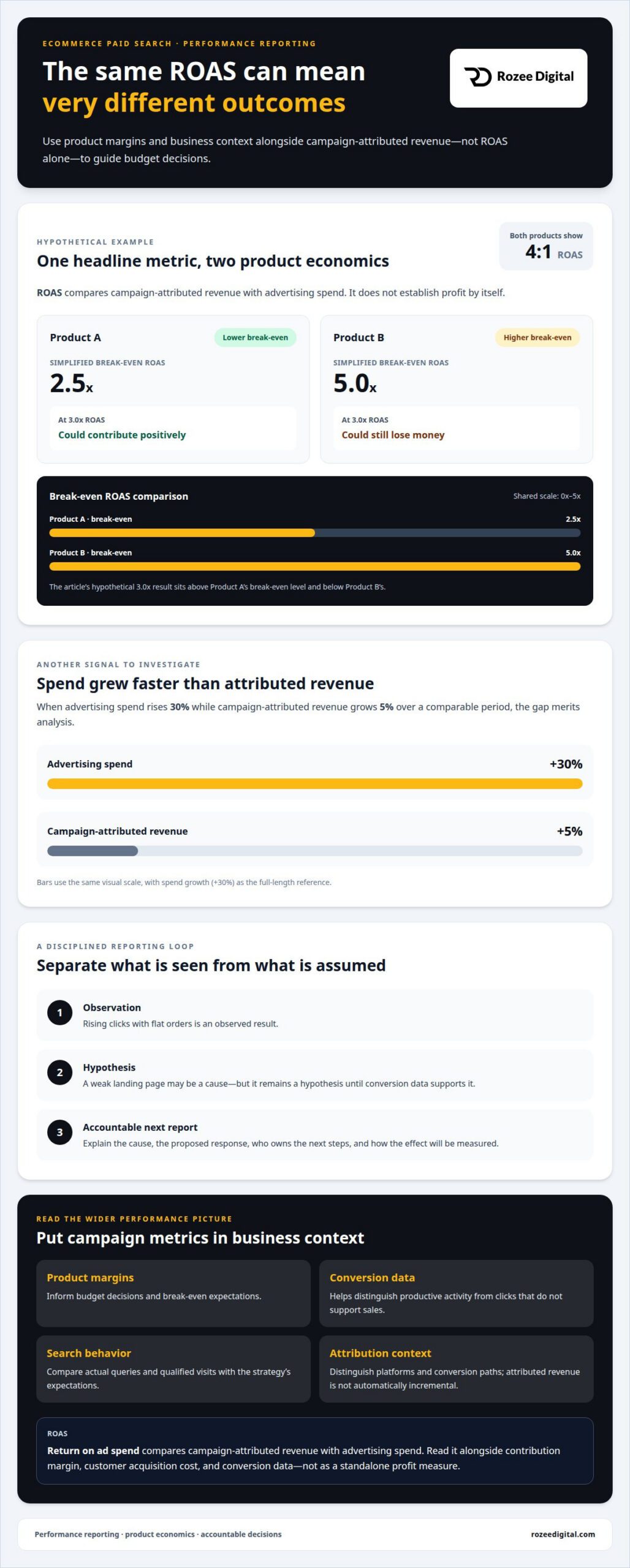
Reports should distinguish observed results, working hypotheses and demonstrated changes. Rising clicks with flat orders are an observation; a weak landing page is a hypothesis until conversion data supports it. This distinction keeps analysis disciplined and makes recommendations accountable. Reports should also make responsibilities for next steps clear.
ROAS compares campaign-attributed revenue with advertising spend, but it does not establish profit on its own. In a hypothetical example, two products each show a 4:1 revenue-to-ad-spend ratio. The same headline metric can mask different economics.
Break-even ROAS can clarify that difference. In the same hypothetical example, Product A has a simplified break-even ROAS of 2.5x, while Product B’s is 5.0x. A 3.0x ROAS could contribute positively for Product A and still lose money for Product B. Product margins must inform budget decisions.
Platform reporting needs careful interpretation. Performance Max can appear across Search, Shopping, Display, YouTube and Gmail, while Microsoft Ads reaches another search environment. A useful analysis distinguishes platforms and conversion paths rather than assuming attributed revenue from each source is automatically incremental.
Look for monitoring that prompts specific decisions: refine a keyword, investigate a product’s conversion rate, or shift budget based on margin and demand. If advertising spend rises 30% while campaign-attributed revenue grows 5% over a comparable period, the gap merits analysis. The next report should explain the cause, the proposed response, and how its effect will be measured.
4. Choosing an ecommerce paid search agency
Choose an agency that links advertising decisions to revenue quality, product margins and operational priorities. Look for ecommerce campaign experience, clear ownership of account work, and reporting that distinguishes attributed sales from broader business performance. A strong fit explains how search campaigns support your channel mix, not just how they generate traffic.
In the United States, client feedback can offer useful context when assessing an agency’s ecommerce search expertise. A high star rating alone cannot show whether an agency understands product feeds, landing page conversion or profit constraints. Consider the substance of reviews alongside its approach and examples relevant to your business model.
Ask who will be accountable for growth, what access they need, and which approvals your team must provide. Then ask how they set targets, assess search terms and respond when revenue or conversion trends change. A useful answer explains the decision process, reporting cadence and responsibilities for implementation.
Clarify how success will be measured before work begins. ROAS compares attributed revenue with ad spend, but does not prove that revenue is profitable or incremental. Ask how analysis accounts for product margins, returns, promotions and other sales channels. Those details help determine whether reported improvement supports the business.
Common risks include unclear responsibilities, unreliable conversion measurement and increasing spend based on attributed revenue alone. Another pitfall is treating every product or search query as equally valuable. A campaign can attract qualified traffic yet lose money if product economics or the landing page do not support purchases.
Favor transparent plans over confident promises. A growth partner should distinguish observations from hypotheses, explain proposed actions and connect decisions to business outcomes. When assessing paid search support, discuss your priorities and the operational inputs that shape profitable growth.
Rozee Digital: Ecommerce ads agency
Rozee Digital provides paid-media services for established ecommerce and DTC brands. When assessing paid media, consider how acquisition, creative, conversion, retention, economics and scale connect to profitable growth, not campaign management alone.
Its paid-media services include Google Ads and Facebook Ads.
Contact Rozee Digital to discuss your growth priorities.
Make your next agency decision a commercial one
Turn your evaluation into a clear operating brief. Define the business outcome paid search should support, the constraints that shape investment, and the growth decisions you expect an agency to own. This gives both sides a practical basis for assessing fit before work begins.
A strong ecommerce paid search agency connects its proposed actions to your priorities, explains trade-offs and makes responsibilities clear. The right partnership is not measured by activity alone. It should strengthen your ability to make informed decisions about acquisition and sustainable growth.
Rozee Digital supports ecommerce brands through ecommerce advertising, Google Ads and Facebook Ads. If you’re ready to discuss how paid media management could fit your business priorities, contact Rozee Digital. Start with the outcomes you need, and build the conversation around what will move the business forward.
Frequently Asked Questions
What makes an ecommerce paid search agency the right fit?
Fit depends on whether the agency can translate your store’s commercial constraints into a coherent growth approach. For a brand with seasonal launches, discuss how launch calendars, stock availability and product performance inform priorities. A useful conversation should surface decisions and dependencies specific to your merchandising cycle, rather than offer a generic channel plan. This shows whether collaboration extends beyond advertising platforms.
What is the difference between paid search and PPC?
Paid search describes advertising shown in search engine results, while PPC means pay-per-click, a model where advertisers pay when someone clicks an ad. The terms overlap because paid search commonly uses PPC pricing, but PPC can also apply to other ad formats. The distinction matters when reviewing a proposal: the channel describes where ads appear, while the pricing model explains what triggers a charge.
How do you measure whether paid search is incremental?
Use a controlled comparison designed to estimate sales that might not have occurred without advertising. For example, compare similar geographic markets while keeping promotions and product availability consistent. Set the comparison period and primary outcome in advance, then account for differences in demand between markets. This can provide useful evidence, but conclusions depend on how well the test accounts for other influences.
How long should an agency pilot run?
A 30-day pilot can establish an operating baseline, validate measurement and approval processes, and assess implementation quality. Treat it as an early checkpoint, not a definitive verdict on long-term performance. A broader 90-day period can support learning and prioritization. Define beforehand what evidence will justify continuing, changing direction or expanding the work, so the decision follows agreed criteria rather than an arbitrary deadline.
How should I compare agency fees?
Assess the agency fee as part of fully loaded customer acquisition cost, or CAC, the total cost of acquiring a customer. Compare that cost with the contribution left after product and fulfillment expenses, rather than judging the fee in isolation. This keeps the decision focused on sustainable customer economics. Use consistent assumptions across proposals, including the markets, products and sales period being evaluated.
How much do ecommerce PPC agencies charge?
Agency fees depend on the account’s complexity, strategic scope, channel mix and level of support. Ask agencies to explain how their fee is structured. To understand a proposal, distinguish professional fees from advertising spend and consider the work required across your products, markets and reporting needs. Avoid treating an industry-wide figure as a reliable estimate for your business.