TikTok Shop charges US sellers a per-sale referral fee and no listing fee or monthly subscription. TikTok Shop’s US fee table lists 6% for most categories and 5% for select jewelry and pre-owned items. Seller publications report that the standard rate rose to 8% for most non-food categories on August 4, 2026. The referral fee is only part of your cost. Creator commissions, fulfillment, ads and refunds usually decide whether a TikTok Shop order makes money.
This guide is for founders and marketing leaders at established ecommerce and DTC brands. It covers what the fees are, how they are calculated, how they differ by market, and how to fold them into the metrics you already manage.
TL;DR
- TikTok Shop charges a per-sale referral (commission) fee, with no listing fee and no monthly fee.
- The US rate has been reported at 6% for most categories and 8% for most non-food categories since August 4, 2026. Check your own settlement statement for the rate that applies to you.
- Shipping, creator commissions, ads and refunds sit on top of the referral fee, so model contribution margin per order, not the fee alone.
- Fees change by country, category and date. Never reuse a US rate for a UK, EU or Southeast Asian market.
- Work out your break-even ROAS and your allowable CAC after fees before you scale spend.
Table of Contents
- What TikTok Shop charges you
- The US referral fee: 6% or 8%?
- How the fee is calculated on a real order
- Costs sellers often underestimate
- Metrics to use: ROAS, MER, CAC and LTV
- How fees differ by country
- How to protect margin without hurting sales
- Get help turning TikTok traffic into profit
- FAQ
- Sources
What TikTok Shop charges you
Start with the structure. TikTok Shop uses a per-sale model rather than a monthly subscription, and fees apply when an order is placed and paid. Several guides also state there is no listing fee and no monthly fee. The main charge is the referral fee, which is deducted from your payout on each sale.
In the US, the referral fee covers all TikTok Shop fees except shipping and tax. The fee page shows no separate payment processing charge. Older guides that mention one describe earlier US orders. Other fees that can appear:
| Cost | What it is | Who sets it |
|---|---|---|
| Referral fee | Percentage of each completed order, deducted from payout | TikTok Shop |
| Refund administration fee | 20% of the refunded referral fee, capped at $5 per SKU | TikTok Shop |
| Shipping | Label or fulfillment costs, depending on how you ship | Carrier or fulfillment provider |
| Creator (affiliate) commission | Percentage you agree to pay creators who drive the sale | You |
| Ad spend | Paid promotion of products and videos | You |
| Sales tax | Collected and handled according to your state’s rules | Tax authority |
The first two rows are platform fees. The rest are costs of operating on the channel. Brands often judge TikTok Shop by the referral fee alone and then wonder where the margin went.
The US referral fee: 6% or 8%?
You will see both numbers in search results, and both are in circulation for a reason. TikTok’s US fee table lists 6% for most categories and 5% for select jewelry and pre-owned items. Seller-focused publications then report the standard rate rising from 6% to 8% for most non-food categories on August 4, 2026, with jewelry and pre-owned staying at 5%.
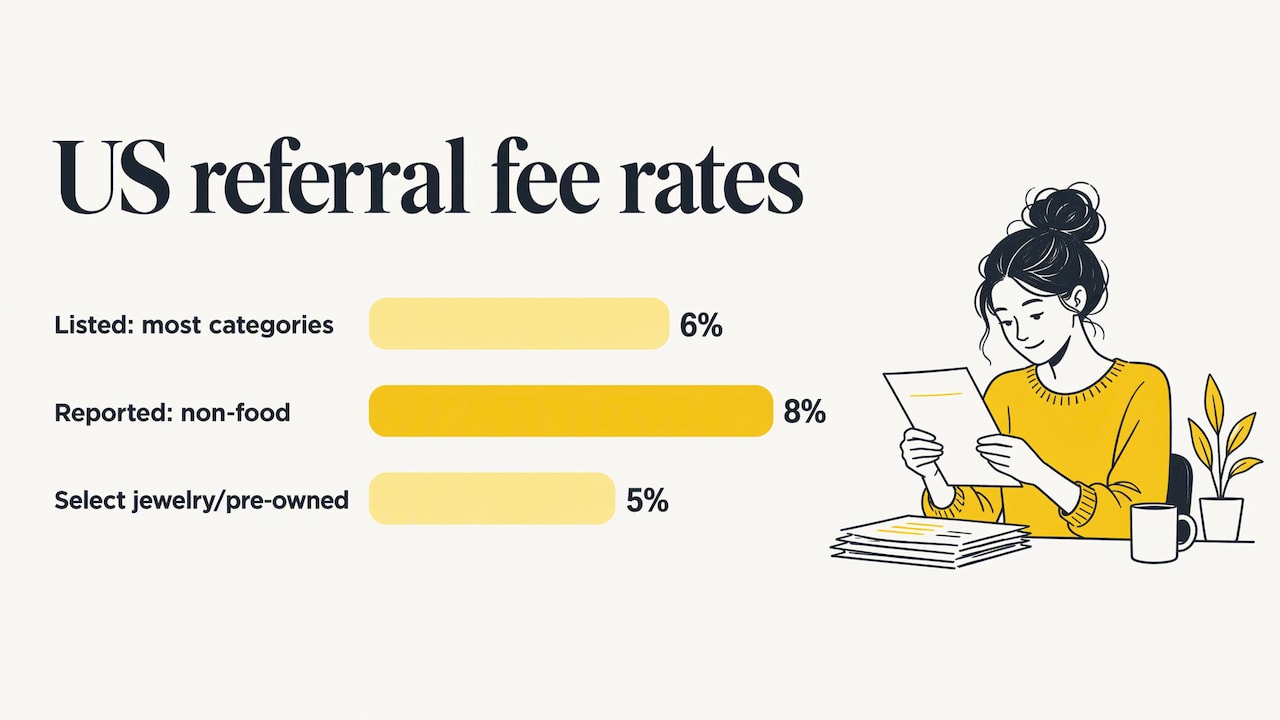
The practical rule: treat the rate on your own Seller Center settlement statement as the truth. Model your margins at 8% if you sell in a non-food category, and treat any lower rate as upside. Pricing off a 6% assumption when your orders settle at 8% is an easy way to turn a profitable test into a loss.
Two details matter for the base the fee is applied to:
- TikTok Shop describes the platform commission as a percentage of the customer payment plus platform subsidy, minus refunds. The official Seller Learning Center states the formula and the settlement calculation.
- That means a voucher that TikTok funds can still sit inside the fee base. Check how your settlement lines treat platform discounts before you assume a promotion lowers the fee.
How the fee is calculated on a real order
The settlement logic is simple. Settlement equals net sales, minus TikTok Shop shipping fees, minus fees, plus adjustments. The fee comes out of the payout, so you never invoice it or pay it separately.
A worked example (hypothetical)
The numbers below are illustrative, not client data and not a benchmark. A brand sells a $40 product in a non-food category at an 8% referral rate.
| Line | Per order |
|---|---|
| Selling price | $40.00 |
| Product cost (COGS) | $10.00 |
| Referral fee (8%) | $3.20 |
| Creator commission (15%) | $6.00 |
| Fulfillment and shipping | $4.00 |
| Contribution before ads | $16.80 (42%) |
| Ad cost to acquire the order | $12.00 |
| Profit after ads | $4.80 (12%) |
From this table you can derive the numbers that decide whether to scale:
- Break-even ROAS is 1 divided by your contribution margin before ads. Here, 1 / 0.42 is about 2.38. Below that return on ad spend, each order loses money.
- Allowable CAC is the most you can pay to acquire a customer. On a first order, it is $16.80 if you only want to break even.
- The ROAS at $12 of ad spend per order is $40 / $12, about 3.3. That clears break-even, but only just in a business that also carries overhead.
Now change one input. If the creator commission were 25% instead of 15%, contribution before ads would drop to $12.80 (32%) and break-even ROAS would rise to about 3.1. Creator terms move your economics as much as the platform fee does.
Costs sellers often underestimate
The referral fee is visible. These are the costs that quietly erode margin.
Creator commissions
Most TikTok Shop volume runs through affiliates and creators, so the commission you set is a real cost of sale. One seller publication estimates that when affiliates, fulfillment, ads, content and returns are added, the total cost of selling runs 35% to 55% of revenue. Treat that as a rough range reported by one publication, not a rule. Your own range depends on category, creator mix and scale.
Refunds and returns
A refund gives back revenue, and the refund administration fee can add a cost on top. It is 20% of the refunded referral fee, capped at $5 per SKU. For low-priced items the cap rarely bites. For higher-priced items it limits the damage. Either way, your return rate belongs in the model.
Ads
TikTok Shop sales come from organic video, live streams, creators and paid ads. If you run paid media, count every dollar against the orders it drives. Our guide to TikTok advertising costs, CPC and CPM gives context for what a paid budget typically needs to cover.
Not double counting
Sellers who build profit dashboards sometimes subtract the same fee twice. Build unit economics from the applicable referral rate and base, creator commissions, fulfillment, advertising, product costs and refunds, and do not subtract fees that settlement has already deducted. On a settlement basis, fees already taken from the payout are not subtracted again.
Metrics to use: ROAS, MER, CAC and LTV
Fees only make sense against the metrics that run your growth plan. Here is each one in plain terms.
- ROAS (return on ad spend): revenue attributed to ads divided by ad spend. A ROAS of 3 means $3 of revenue per $1 of ads. It ignores fees, COGS and creator payouts, so a healthy-looking ROAS can hide a loss.
- MER (marketing efficiency ratio): total revenue divided by total marketing spend across all channels. It is harder to game than channel-level ROAS, and useful when TikTok Shop sales overlap with your own site.
- CAC (customer acquisition cost): total acquisition spend divided by new customers. On TikTok Shop, include creator commissions you pay on first orders.
- LTV (lifetime value): the gross profit a customer generates over their relationship with you. It tells you how much CAC you can afford.
The link between them is the point. If TikTok Shop fees and creator payouts take a big share of a first order, your first-order margin is thin, and you are betting on LTV to make the channel pay. That bet works only if you can bring customers back through email, SMS and your own store. Marketplace buyers do not automatically become your customers, so retention planning matters from the first order.
How fees differ by country
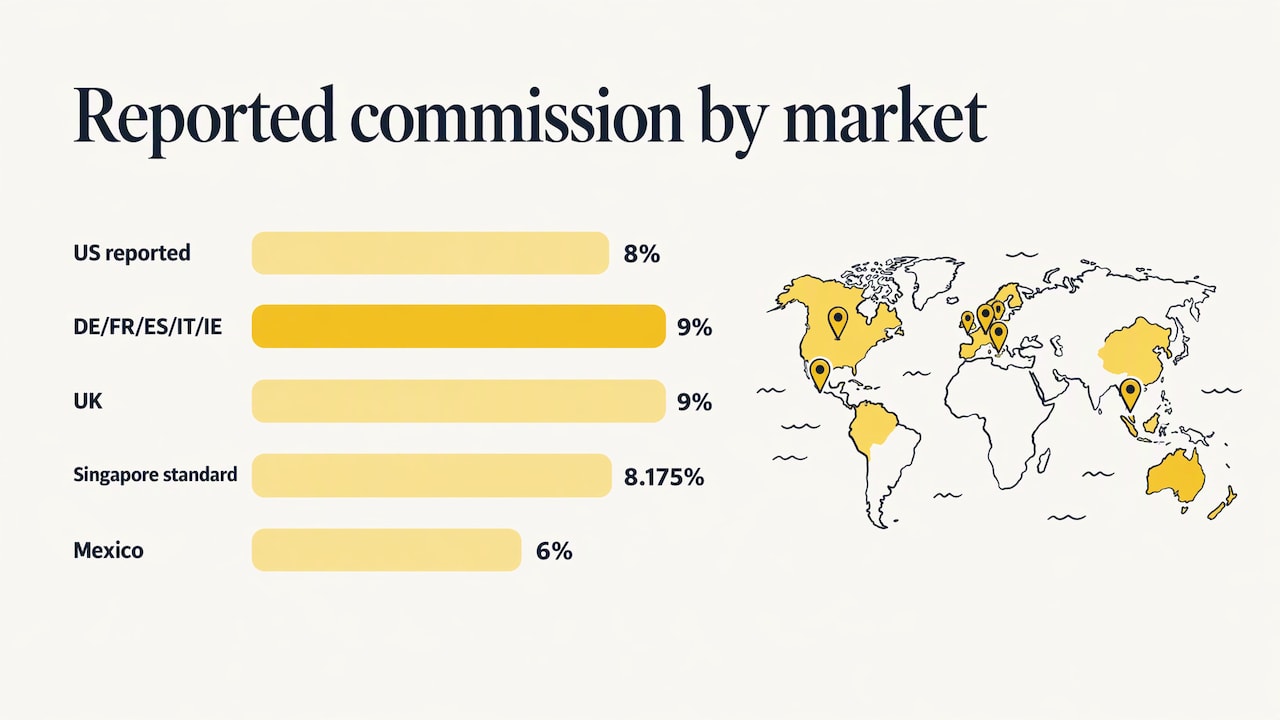
The keyword attracts readers from many markets, and the fees are not the same everywhere. Use the table as orientation, then confirm in your own Seller Center.
| Market | Reported commission | Notes |
|---|---|---|
| United States | 6% on most categories in the fee table; 8% reported for most non-food categories from August 4, 2026 | Referral fee covers all fees except shipping and tax |
| Germany, France, Spain, Italy, Ireland | 9% from 8 January 2026, up from 5%, with 7% for specified electronics and beauty electronics | Qualifying new sellers can get a 4% rate for up to 60 days |
| United Kingdom | 9% inclusive of applicable taxes, per one seller operations guide | Base can include customer-paid shipping |
| Singapore | 8.175% for standard sellers and 7.085% for BXP sellers on most categories, plus a 3.27% transaction fee, from 1 April 2026 | GST-inclusive |
| Mexico | 6% platform commission including VAT | New-seller reward periods apply |
Some markets add separate transaction, service or per-order fees on top of commission, so the headline rate is not always the full picture. Tax treatment also varies. In the EU, a business established in Ireland pays commission that is VAT-inclusive, while one in another EU country pays VAT-exclusive commission and accounts for VAT by reverse charge. If your finance team works across markets, build a separate fee line per market rather than one blended rate.
Promotional rates for new sellers exist in several markets, but they expire and distort early margins. Build your plan on the standard rate, then treat any intro rate as a short-term bonus.
How to protect margin without hurting sales
Cutting costs by cutting the wrong things lowers sales and conversion with them. These levers keep demand intact.
- Price from contribution margin, not from list price. Work backward from break-even ROAS and decide whether the product can carry affiliate and ad costs at all. Bundles and higher average order value often fix thin per-unit margins.
- Negotiate creator terms by role. Pay more for creators who prove they drive orders and less for those who only generate views. Keep a record of commission by creator so you can see which ones are profitable.
- Reduce refunds at the source. Clear product videos, accurate sizing and honest claims lower returns, and every avoided refund protects both revenue and fees.
- Improve conversion before adding spend. A product page and offer that convert better lower CAC without touching the platform fee.
- Use creative that sells at a lower cost. Strong video creative lifts click-through and conversion, which brings down the ad cost per order.
- Plan the second order. Capture the customer on your own channels where policy allows, and invest in email and SMS so LTV, not the first order, pays for acquisition.
- Watch regional programs. Some markets offer fee incentives tied to ad participation. For example, in Thailand, non-Mall sellers whose GMV Max spend exceeds 3% of platform revenue over 30 days can receive a 1.07% reduction in commission. Check what your market offers in Seller Center.
Our view on TikTok Shop economics
We start every channel conversation with margin, not reach. A platform fee of 6% or 8% is rarely what sinks a brand. What sinks it is launching on a channel without knowing the contribution margin per order, the break-even ROAS and the CAC the business can carry.
At Rozee Digital, our Ecommerce Acceleration System™ treats acquisition, conversion and retention as one profit system. For TikTok, that means building creative that earns attention at an acceptable cost, landing pages and offers that convert it, and email and SMS that turn a thin first order into a profitable customer relationship.
Work is led by senior strategists, and we keep our client roster deliberately small, so the person who sets the plan is the person who reads your numbers. If you sell on TikTok Shop or are weighing it, bring us your unit economics and we will show you where the margin is and where it leaks.
Tom
Get help turning TikTok traffic into profit
If your brand already invests in paid media and you want TikTok to contribute at a margin you can defend, our TikTok ads agency team plans creative, targeting and measurement around profit, not just ROAS. For the wider picture of how acquisition, conversion and retention fit together, see how we approach customer generation. You can also read our guide to TikTok advertising for ecommerce and net profit.

To discuss your brand, start from rozeedigital.com and tell us your current channels, your margin per order and your growth target.
FAQ
Do you pay fees on TikTok Shop?
Yes. TikTok Shop charges a per-sale referral (commission) fee that is deducted from your payout. Guides report no listing fee and no monthly fee. You also carry costs outside the platform fee, such as shipping, creator commissions and ads.
What is the TikTok Shop referral fee in the US?
TikTok’s US fee table lists 6% for most categories and 5% for select jewelry and pre-owned items. Seller publications report an increase to 8% for most non-food categories on August 4, 2026. Your settlement statement in Seller Center shows the rate applied to your orders.
Is there a separate payment processing fee?
In the US, the referral fee covers all TikTok Shop fees except shipping and tax, and the fee page lists no separate processing charge. Other markets may list transaction fees or include processing within commission. Check the settlement lines for your country.
How do I know if TikTok Shop is profitable for my brand?
Calculate contribution margin per order after COGS, referral fee, creator commission, fulfillment and refunds. Divide 1 by that margin to get break-even ROAS, then compare it to your actual ROAS and CAC. If the numbers only work with strong repeat purchases, plan your email and SMS retention before scaling.
Sources
- TikTok Shop Fees: What US and UK Sellers Actually Pay
- TikTok Shop Fees 2026: US and UK Rates, With a Calculator
- TikTok Shop Fees Explained: What Sellers Actually Pay
- TikTok Shop Seller Fees Explained: The True Cost of Selling
- TikTok Shop Seller Learning Center: platform commission and settlement
- TikTok Shop True Profit: Formula, Fees, COGS and Ads
- Profit and Loss, Dashboardly Help Center
- EU TikTok Shop commission update notice
- How to Sell on TikTok Shop UK
- TikTok Shop Fees Singapore 2026
- Mexico platform commission policy
- Thailand TikTok Shop fee rule changes