An agency isn’t automatically cheaper than an in-house hire. Choosing a Klaviyo agency partner vs hiring an in-house specialist is a capacity decision as much as a cost decision: one employee brings daily brand context, while an agency may bring a broader mix of expertise. Compare the workload, skills required, and accountability, not just a retainer against a salary.
It’s understandable to choose a hire for control or an agency for broader expertise, but neither model is right by default. An in-house specialist can stay close to your brand and customers; an agency can provide access to different skills without requiring separate hires for every function.
This comparison explains the costs and trade-offs, when a hybrid model can work, and where each approach creates risk. You’ll have a clearer basis for choosing the structure that supports your retention workload and growth priorities.
Key Takeaways
- Compare the full cost of employment with an agency’s scope, then judge both against the retention workload and business needs.
- Assess the skills your program requires. An agency may combine strategy and execution, while an in-house hire offers closer day-to-day brand context.
- Consider a hybrid model when the brand needs internal ownership and additional specialist capacity; define who leads decisions and delivery.
- Reduce execution risk by planning for documentation, onboarding, continuity and clear accountability, whichever model you choose.
Is a Klaviyo agency cheaper than hiring in-house?
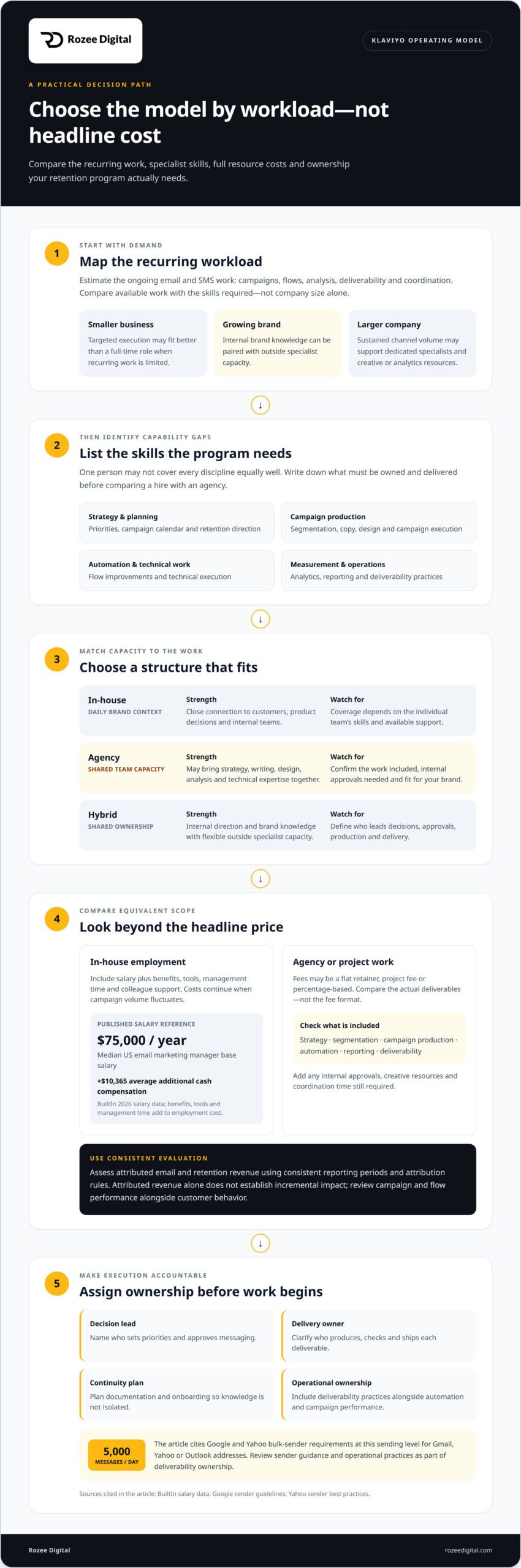
Neither option is automatically cheaper. Compare the full employment cost with the expertise, workload, and execution your retention program requires. A smaller business may not have enough recurring work for a dedicated hire; a growing ecommerce brand may need added capacity; a larger company may be able to support an internal team.
In-House Salaries and Employer Costs
BuiltIn’s 2026 salary data lists a median US email marketing manager base salary of $75,000 per year and average additional cash compensation of $10,365. Benefits, tools, and management time add to the employment cost. An in-house specialist develops daily knowledge of the brand and customer data, but one person may not cover strategy, copy, design, and analysis equally well.
When an In-House Team Makes Sense
An in-house team fits when email and SMS create enough ongoing work to keep dedicated specialists productive. It can coordinate campaigns with product decisions, customer service, and merchandising. Deliverability also requires operational ownership: Google and Yahoo bulk-sender requirements apply at 5,000 messages per day to Gmail, Yahoo, or Outlook addresses, according to Google’s sender guidelines and Yahoo’s sender best practices. Review sending practices alongside automation and campaign performance.
Options for Different Business Sizes
A smaller business may need targeted execution without a full-time role. A growing ecommerce brand can pair internal brand knowledge with outside specialist capacity. A large company with sustained channel volume may justify dedicated specialists, supported by creative and analytics resources. In each case, compare the available work with the skills required, not just company size.
| Option | Strategy | Campaign execution | Automation and analytics |
|---|---|---|---|
| In-house | Close brand context | Daily focus | Depends on team skills |
| Agency | Specialist input | Shared team capacity | Combined expertise |
| Hybrid | Internal direction | Flexible capacity | Shared ownership |
Choose the model that matches your recurring workload, required skills, and the level of control your team needs.
Agency retainer versus in-house hiring costs
Compare what each model covers, then identify which costs continue regardless of workload. A retainer pays for agreed services; an employee provides ongoing capacity that requires direction and internal support.
Agency Services and Retainer Costs
An agency may charge a flat retainer, a project fee, or a percentage-based fee. The fee structure matters less than the deliverables: clarify whether the work covers strategy, segmentation, campaign production, automation, reporting, and deliverability. Match those responsibilities to your calendar, and identify where internal approvals or creative resources are still needed.
A freelancer can help you test a defined workload before making a permanent hire. Scope a bounded assignment, such as reviewing a campaign calendar or documenting a flow improvement. Agree on outputs, access, and review criteria in advance. This helps you assess execution quality and recurring workload without assuming a market rate or letting the assignment run indefinitely.
Salary and Fully Loaded Employment Costs
An in-house retention manager creates an ongoing employment commitment. The employer’s total cost extends beyond base salary to benefits, tools, management time, and support from colleagues. Unlike a project fee, these costs continue when campaign volume fluctuates. Account for the internal resources needed to turn one specialist’s knowledge into reliable execution across the program.
Compare equivalent responsibilities, not job titles. If an employee needs separate design or analytics support, include that capacity in the hiring model. An agency’s scope may bring several functions together, but only work explicitly included belongs in the comparison.
Costs Against Attributable Revenue
Assess each option against revenue attributed to email and retention activity, using consistent reporting periods and attribution rules. Attributed revenue is sales assigned to a channel or campaign by the reporting method; it does not, by itself, establish incremental impact. Review campaign and flow performance alongside customer behavior before deciding whether the operating cost is justified.
Then compare the full resource requirement: fees or employment costs, internal approvals, creative support, and time spent coordinating delivery. A lower headline cost can still require more internal capacity. The stronger choice is the one whose scope and accountability fit the program’s needs without duplicating existing work.
Does a hybrid in-house/agency model work?
Yes, a hybrid model can work when internal ownership and external delivery have clear boundaries. Choosing a Klaviyo agency partner or an in-house specialist comes down to which work needs daily brand context and which requires additional specialist capacity.
Agency Skills and Cross-Account Experience
An agency may bring together strategy, writing, design, analysis, and technical execution. Experience across accounts can help specialists spot useful patterns, but recommendations still need to fit each brand’s customers and economics. Ask for recommendations tied to your goals, with a clear explanation of the reasoning and how each idea would apply to your program.
The Hybrid Agency and Internal-Team Model
A hybrid model keeps brand voice, product knowledge, creative direction, and approvals in-house while assigning defined production or technical work externally. For example, an internal retention lead could set priorities and approve messaging while external specialists develop agreed flow improvements. This keeps strategic decisions close to the business without requiring every specialist skill to be on payroll.
Channel Ownership and Team Capacity
Assign one internal owner to coordinate channel priorities, even when execution is shared. Document who sets the calendar, approves writing, updates flow logic, and reviews performance. Then map the work across channels and identify where internal capacity is constrained. Clear ownership prevents duplicated effort and keeps retention connected to merchandising, customer insight, and wider marketing plans.
Agency Capabilities and Risks
An agency may add specialist depth and execution capacity, while internal staff contribute direct knowledge of products and customers. Neither model removes the need for governance. Define account access, documentation, approval routes, and escalation responsibilities before work begins. Experience across accounts is valuable when recommendations fit your brand, rather than being copied from another company’s playbook.
Risks of hiring in-house versus hiring an agency
Both models can underperform, but they concentrate risk differently. A dedicated hire may leave gaps in expertise; an agency may create dependency if responsibilities and account knowledge aren’t documented.
Underperformance by a Hire or Agency
A junior in-house retention manager may take 3-6 months to become productive. A poor hire can therefore delay an ecommerce email marketing program while the business covers salary and onboarding. Set measurable responsibilities early, including campaign delivery, flow improvements, and reporting, then review execution against agreed priorities.
An agency relationship can also miss expectations. One estimate puts the cost of a wrong agency at one month with a month-to-month contract, compared with six months for a wrong in-house hire. The practical difference is reversibility: defined scope and short review cycles make weak execution easier to identify and address.
Specialist Continuity and Backup Risks
If an in-house specialist leaves, undocumented customer knowledge, flow logic, and campaign decisions can leave with them. Keep process notes, change records, and Klaviyo access under business control. This reduces reliance on one person and gives a replacement a useful account history.
An agency can provide broader expertise, but continuity still depends on the team assigned to the account. Ask for clear ownership, documented processes, and a backup contact. An agency owner working directly on an account is not sufficient assurance if that owner has more than 6 clients.
Freelancers carry similar continuity risks, with added capacity constraints during peak periods. Coordinating five separate freelancers or specialists can consume ten to fifteen hours per week for a company without a marketing leader. Consolidated accountability may reduce handoffs, but only when roles, approvals, and escalation paths are explicit.
Before choosing, map critical workflows, access, decision owners, and coverage during absences. Then compare the recovery plan for a departing employee with the agency’s account-transition process. Discuss your retention program’s needs to assess where specialist support could fit.
Rozee Digital
Rozee Digital helps ecommerce and DTC leaders connect acquisition investment with broader growth priorities. If you’re weighing retention capacity against paid media needs, consider how channel spending, customer acquisition cost (CAC), and customer lifetime value (LTV) inform the decision. This makes the agency-versus-hire choice part of a wider profitability plan, not an isolated staffing decision.
Turn to ecommerce advertising support when paid acquisition needs clearer strategic ownership or more focused execution. Rozee Digital can help assess the role of paid media in your growth mix, without treating it as a substitute for internal Klaviyo expertise.
Contact Rozee Digital to discuss your growth priorities.
Set the operating model before you scale
Choosing between a Klaviyo agency partner and an in-house specialist starts with defining the ownership your business needs next. Map the work across retention strategy, campaign planning, execution, analysis, and approvals. Assign a clear decision-maker and agree on how performance will be reviewed. That structure makes the next hiring or agency decision more accountable.
Then connect retention planning to the wider growth mix. Rozee Digital provides ecommerce advertising across Google and Meta, helping eligible brands connect paid acquisition with their internal retention priorities. The right fit depends on where your team needs additional capability and how those channels contribute to profitable growth.
Bring your current priorities, team structure, and growth objectives into the discussion. Contact Rozee Digital to discuss your needs and identify a practical next step for your marketing mix.
Frequently Asked Questions
Can I start with a freelancer before hiring?
Yes. Use a freelancer for a defined pilot before committing to a permanent role. Scope specific outputs, such as reviewing a welcome flow, preparing a campaign calendar, or documenting audience segments. Keep account access and working files under business control. At the end, assess delivery quality, communication, and whether the recurring workload justifies an employee or broader support.
How does the agency vs in-house decision change for a $50M+ brand?
At this scale, organize around workload, brand complexity, and decision speed, not revenue alone. A brand with several product lines or markets may need internal owners close to merchandising and customer insight, plus external specialists for defined projects. Map responsibilities by brand and channel, then identify gaps in strategy, creative, technical execution, and analytics before deciding which roles belong internally.
What Questions Should You Ask Before Hiring?
Ask how the specialist will prioritize work, document changes, and connect campaign results to business goals. Request a practical walkthrough of how they would diagnose a stalled welcome flow or weak repeat-purchase performance. Clarify who approves copy and offers, how results are reported, and what knowledge stays with the business. These answers reveal operating discipline beyond a polished portfolio.
What Red Flags Should You Avoid?
Watch for broad revenue promises without a measurement plan, unclear ownership of account access, or reporting limited to opens and clicks. A candidate or agency should explain how they evaluate flow performance, list health, and customer behavior. Avoid arrangements where critical logic exists only in one person’s memory. Require documented workflows and a clear process for addressing mistakes or missed deliverables.
What is the average U.S. salary and total employment cost for a Klaviyo email marketing specialist?
BuiltIn’s 2026 salary data lists an average US email marketing manager base salary of $79,911 per year. Treat these as broad email marketing role benchmarks, not a guaranteed salary for a Klaviyo-specific specialist.
How do response times and day-to-day availability compare between an agency and an in-house Klaviyo specialist?
An in-house specialist is embedded in daily planning and can respond within the company’s working rhythms. An agency coordinates work through its team and agreed communication processes, rather than providing uninterrupted access to one person. Set expectations for urgent requests, approvals, and routine updates at the outset. The useful comparison is dependable coverage for your workflow, not assumed instant availability.