The management fee is only part of the paid social budget. Paid social media management services pricing is commonly structured as a flat fee or a percentage of ad spend, while the budget paid to platforms is separate. The right model depends on the work required, not just the amount spent on ads.
It’s reasonable to expect a clear link between management costs and the work involved. Strategy, campaign execution, creative needs, platform coverage, and reporting all shape the scope. A low fee may leave out essential work; a higher fee makes sense only when it meets the business’s needs.
This guide explains the common pricing models, the factors that affect costs, and what professional management may include. It also clarifies when a freelancer or an agency is the better fit, so you can assess the investment against your growth objectives.
Key Takeaways
- Choose between a freelancer, agency, in-house team, or DIY based on the expertise and operational capacity your campaigns require.
- Compare pricing models by the work they cover, not just the billing format; management fees and platform ad spend are separate costs.
- Platform coverage, creative production, campaign complexity, and reporting all influence the management scope and investment.
- Assess full-service support by how well strategy, execution, and performance reporting align with your growth goals.
Is it cheaper to hire a freelancer or an agency?
A freelancer may charge less than an agency, but a lower fee can come with a narrower scope. The right fit depends on the expertise, channel coverage, and operating capacity your business needs.
Freelancer and Agency Cost Differences
A freelancer typically provides direct support, while an agency can offer broader specialist expertise. A freelancer may suit a focused Meta campaign; a business working across Meta and LinkedIn may need coordinated creative, optimization, reporting, and community support. Compare the fee with the specific capabilities required, not just the provider type.
Costs Across Hiring Options
Hiring options trade direct cost against internal workload and expertise. A freelancer takes on agreed tasks; an agency may offer broader expertise; an in-house team requires salaries and management time. DIY avoids an external fee, but founders or marketers must handle setup, testing, reporting, and ongoing changes. For a DTC brand using several channels, that work can compete with time for conversion and retention.
Monthly Retainers and Agency Fees
Freelancers and agencies may charge monthly retainers, flat fees, or a percentage of ad spend. The fee depends on the model and scope, including channel coverage, campaign complexity, and reporting. It is separate from the budget paid to platforms such as Meta or LinkedIn, so assess both costs together.
Freelancer Charges and Agency Setup Costs
Freelancers may bill by the hour or charge a monthly retainer; the amount depends on expertise and agreed scope. Setup fees, minimum commitments, and onboarding costs are contract terms that can reflect tasks such as reviewing account access, tracking, campaign structure, and creative plans. Compare these deliverables with ongoing work, not just the initial charge. A single-channel engagement has a different scope from coordinated work across several channels.
Hourly, per-platform, per-post, and project pricing
Paid social media management services pricing can reflect time, channel coverage, individual deliverables, or a defined project. Compare what each model includes before assessing its value.
Common Pricing Models
Hourly billing ties the fee to time worked. Per-platform billing defines scope by channel, while per-post billing covers specific creative deliverables. A project fee applies to a defined task, such as an account audit or launch planning. Similar billing labels can conceal different responsibilities and outputs, so review the scope closely.
For example, an Instagram post may include a caption and adapted asset, but not campaign setup or performance analysis. Launch planning may end before ongoing optimization begins. Clarify whether creative revisions, audience planning, and reporting are included. This makes it easier to compare proposals by the work delivered, rather than by billing format alone.
Platform Count and Workload
The number of platforms affects the work required for creative adaptation, campaign structure, and performance review. Prioritize channels according to audience fit, available creative, and each platform’s role in the marketing plan. Broader coverage is useful only when every channel has a clear purpose and sufficient operational support.
For example, adding Instagram to an existing TikTok program may call for different creative formats, campaign decisions, and reporting. A shared content calendar can coordinate timing, but assets still need to suit each channel. The workload and objectives attached to each platform matter more than the platform count alone.
A practical comparison of paid social media management services pricing starts by matching each platform’s deliverables to your growth priorities. Rozee Digital’s paid social approach is one option for brands considering coordinated channel support.
Factors that affect management pricing
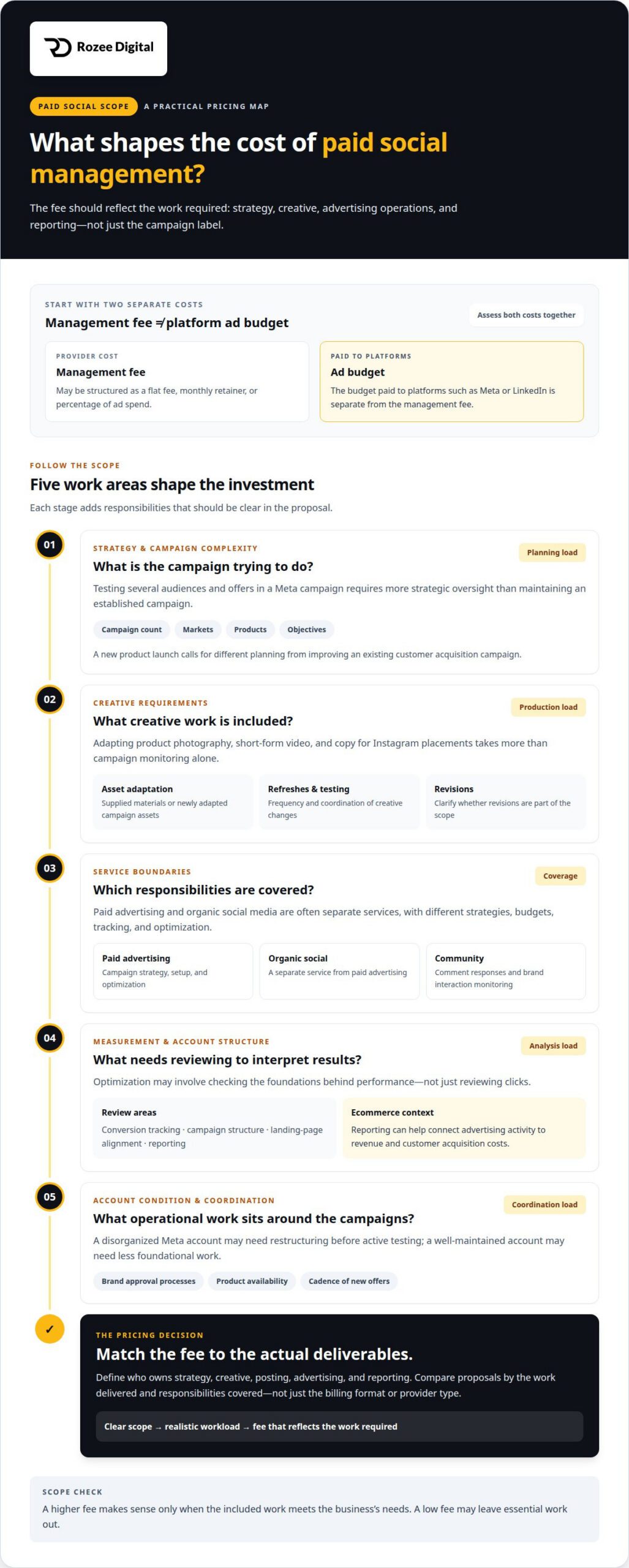
The work included in the scope shapes the fee more than a campaign label does. Strategy, creative production, advertising operations, and reporting determine what a provider is responsible for delivering.
Campaign complexity matters. Testing several audiences and offers in a Meta campaign requires more strategic oversight than maintaining an established campaign. The fee may also reflect the number of campaigns, markets, products, and objectives in scope. A new product launch calls for different planning from efforts to improve an existing customer acquisition campaign.
Creative requirements add work. Adapting product photography, short-form video, and copy for Instagram placements takes more than campaign monitoring alone. Frequent creative refreshes, revisions, and testing also require coordination. The scope should distinguish between working with supplied assets and producing or adapting new campaign materials.
Service boundaries matter, too. Paid advertising and organic social media are often separate services, with different strategies, budgets, tracking, and optimization. Community management adds responsibility for responding to comments and monitoring brand interactions. A proposal for paid advertising alone is not equivalent to one that also includes organic posting and community activity.
Measurement and account complexity shape the work involved in optimization. A provider may need to review conversion tracking, campaign structure, landing-page alignment, and reporting before interpreting results. For ecommerce brands, reporting can help connect advertising activity to revenue and customer acquisition costs. Clear measurement supports better decisions than click volume alone.
Finally, account condition and coordination affect the scope. A disorganized Meta account may require restructuring before active testing; a well-maintained account may need less foundational work. Brand approval processes, product availability, and the cadence of new offers also influence campaign operations. Define these responsibilities clearly so the fee reflects the actual strategy, posting, advertising, and reporting required.
Services included in full-service management
Paid social management pricing typically covers strategy, campaign setup, audience planning, optimization, and reporting. Platform ad spend is separate; content creation, scheduling, community management, and organic posting depend on the agreed scope.
A full-service engagement may begin with advertising strategy. A provider aligns Facebook or TikTok activity with business goals, audience priorities, product offers, and the customer journey. Account and tracking reviews can identify operational gaps before launch. This foundation connects advertising decisions to business measures such as return on ad spend (ROAS), which compares attributed revenue with advertising spend, rather than treating clicks as the end goal.
Creative work may include developing concepts, writing ad copy, adapting brand-supplied assets, and coordinating content creation. For example, a product demonstration may need different edits for Facebook Feed and TikTok placements. Confirm whether production, revisions, and creative testing are included. Managing existing assets is a different scope from producing original content.
Campaign operations cover implementation, audience and placement choices, budget allocation, ongoing optimization, and performance monitoring. Scheduling may apply to campaign launches and creative rotations. A full-service provider should explain how it manages engagement objectives, tests campaign elements, and responds to performance changes. The exact work depends on the platforms and objectives in the agreement.
Reporting should show what ran, what changed, and how results relate to commercial goals. For an ecommerce brand, a report might connect campaign spend and attributed revenue to ROAS, while noting measurement limits. Community management and organic posting are separate from paid advertising unless explicitly included. The same applies to responding to comments on Facebook or TikTok.
Before approving a scope, map each deliverable to a responsible party: strategy, creative, campaign management, reporting, and any community activity. This makes exclusions visible and prevents a paid-only engagement from being mistaken for broader social media operations. Discuss full-service paid social support when your team needs coordinated campaign strategy and management.
Rozee Digital: Paid Social Agency
Rozee Digital supports ecommerce and DTC brands with paid social services that connect paid media decisions to broader priorities such as customer acquisition, contribution margin, and profitability.
For brands assessing paid social alongside other acquisition channels, Rozee Digital offers ecommerce advertising, Google Ads, and Facebook Ads. The right scope depends on your objectives, advertising investment, and growth priorities.
Contact Rozee Digital to discuss your business goals and paid social needs.
Make the next investment decision with clarity
Start by defining what paid social should contribute to your business, then align ownership and measurement with that objective. A considered view of paid social media management services pricing starts with the commercial outcomes you need, not simply the number of tasks in a proposal. That keeps the investment connected to acquisition, conversion, and customer value.
For ecommerce teams, paid social is part of a wider acquisition mix. Rozee Digital offers ecommerce advertising, Google Ads, and Facebook Ads to help brands align channel decisions with their growth priorities. The appropriate scope depends on your objectives and operating needs.
Bring your priorities, current campaign setup, and measurement goals into the discussion. Contact Rozee Digital to discuss a paid social approach aligned with your business. Clear priorities create a stronger foundation for the next decision.
Frequently Asked Questions
Are ad costs included in management fees?
The advertising budget and provider’s fee are usually separate. The budget goes to platforms such as Meta or TikTok; the fee covers the agreed professional work. For example, a brand may pay a provider’s fee separately from the funds charged by Facebook. Include both amounts in financial forecasts so acquisition spending isn’t mistaken for the cost of external support.
How many platforms should a small business pay to manage?
Start with platforms that reach your target audience and suit the creative your business can supply consistently. A small retailer with product photography and short-form video might prioritize Instagram and TikTok rather than spread resources across every available channel. Expand only when another platform has a distinct audience or business role. That ties platform coverage to commercial purpose, not presence for its own sake.
What Factors Influence the Cost?
The scope depends on the work involved, including account condition, tracking needs, creative readiness, approval processes, and the number of products or markets. Launching a new product across several regions, for example, may require more coordination than maintaining an established offer in one market. Reporting requirements matter, too: revenue and customer acquisition analysis calls for different work than a basic delivery update.
What do paid social media management services typically cost per month in the United States?
There is no single monthly rate for the United States. The management fee varies with the scope, campaign complexity, creative responsibilities, and reporting expectations. A limited engagement focused on an existing campaign differs from work involving new market launches and ongoing creative development. Evaluate the deliverables and exclusions, then separate the management fee from platform spend when assessing the total investment.
Are paid social management fees flat-rate, percentage-of-ad-spend, or performance-based?
Flat fees and percentages of ad spend are common billing structures; performance-based terms depend on the agreement. A flat fee makes the management charge easier to forecast, while a percentage-based model links the fee to media investment. Performance terms need clear definitions of the result measured, attribution method, and reporting period. Without those details, proposals with similar labels may describe materially different obligations.
How do paid social management prices vary by platform, such as Meta, TikTok, LinkedIn, and Pinterest?
Platform names alone don’t determine the management fee. Meta, TikTok, LinkedIn, and Pinterest each involve distinct creative choices, audience planning, campaign structures, and measurement. For example, adapting video assets for TikTok and product-led ads for Pinterest calls for different work than focusing on one platform. Compare what is included for each channel rather than assuming a standard platform-specific rate.