Running an online store is harder than it looks. Global ecommerce sales hit $6.3 trillion in 2024 according to Statista. That’s a huge market. But most store owners struggle to grab their piece of this growing pie.
The winners aren’t just lucky. They use a growth engine for ecommerce that drives results consistently. This isn’t random marketing tactics or hoping for the best. It’s a complete system that brings in customers, converts them, and keeps them coming back.
This guide shows you exactly how to build your own growth engine. You’ll learn proven strategies, essential tools, and what actually works. No complicated theory or confusing jargon. Just clear steps you can follow starting today.
👉 Ready to build your own ecommerce growth engine? Book your free strategy call and start scaling smarter.
What is the Role of an Ecommerce Growth Engine in Online Business
A growth engine is more than running some ads or posting on social media. It’s the complete system powering your online business forward every single day. Think of it like the engine in your car. All the parts work together to move you forward.
Understanding the Core Components of a Growth Engine
A growth engine for ecommerce has several parts working together. Traffic generation brings visitors to your store. Conversion systems turn those visitors into paying customers. Retention keeps customers coming back for more. Analytics tracks everything so you know what’s working.
Each part depends on the others to work properly. Great traffic with poor conversion wastes your advertising budget. High conversion without retention means you’re always chasing new customers. Strong retention without new traffic means you stop growing eventually.
The best growth engines run automatically once you set them up right. Email sequences send themselves without you touching anything. Retargeting ads reach people who visited your site. Dashboards update in real-time showing you what’s happening. This automation helps small teams compete with bigger companies.
Most struggling stores don’t have systems in place. They try whatever marketing tactic sounds good this week. They stop things that seem slow without understanding how growth actually compounds. A proper growth engine eliminates all this randomness with proven processes.
Why Traditional Marketing Falls Short for Modern Ecommerce
Old marketing methods don’t work like they used to. TV commercials, radio ads, and newspaper advertising reached everyone broadly. But modern shoppers ignore traditional ads completely. They skip commercials, block banner ads, and trust recommendations over advertisements.
Digital marketing changed everything with targeting and measurement. You can reach people actively searching for your exact products. You can show ads to visitors who left your site. You can measure the exact return on every dollar spent. This precision was impossible before.
But many businesses still think in old-school terms. They create one-off campaigns instead of ongoing systems. They measure likes and followers instead of actual revenue. They focus on getting their name out there without paths to purchase. This outdated thinking burns through budgets fast.
Modern ecommerce growth strategies need different thinking completely. It’s about building relationships over weeks and months. It’s about optimizing every step from discovery to purchase. It’s about using data to improve constantly. A growth engine brings all this modern thinking together systematically.
The Difference Between Growth Activities and Growth Systems
Random marketing activities produce unpredictable results every time. You post on social media when you feel like it. You run ads when you remember to check them. You email your list once in a while. This scattered approach rarely builds real momentum.
Growth systems operate consistently no matter what’s happening day-to-day. Automated sequences nurture leads while you sleep. Retargeting campaigns run continuously bringing people back. Content published on schedule building your authority. Systems remove dependence on your memory and daily motivation.
The real power of systems is how they compound over time. Each improvement builds on everything you did before. Better conversion rates multiply the value of all your traffic. More happy customers create more reviews and word-of-mouth. Everything reinforces everything else creating exponential growth.
Building systems takes effort upfront but pays off forever. You create email sequences once and they run for years. You optimize landing pages once and every future visitor benefits. Time invested in systems delivers returns indefinitely instead of just once.
The 8 Core Ecommerce Growth Strategies That Actually Work
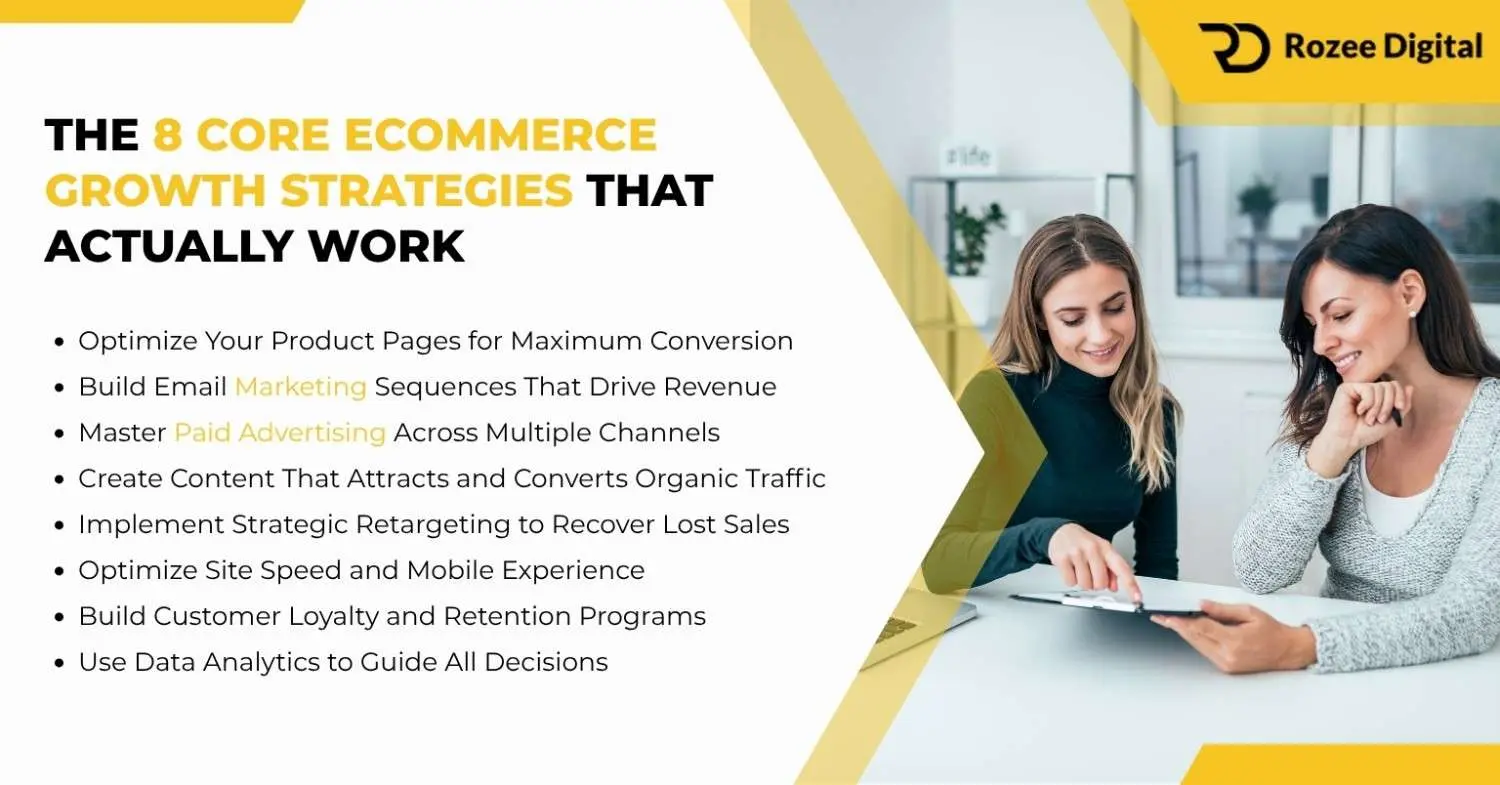
These strategies form the foundation of every successful growth engine for ecommerce. Master these basics before adding anything fancy. Simple systems done well beat complex systems done poorly every single time.
- Optimize Your Product Pages for Maximum Conversion
- Build Email Marketing Sequences That Drive Revenue
- Master Paid Advertising Across Multiple Channels
- Create Content That Attracts and Converts Organic Traffic
- Implement Strategic Retargeting to Recover Lost Sales
- Optimize Site Speed and Mobile Experience
- Build Customer Loyalty and Retention Programs
- Use Data Analytics to Guide All Decisions
1. Optimize Your Product Pages for Maximum Conversion
Product pages are where purchases actually happen or don’t happen. Most ecommerce stores convert around two to three percent of visitors. Top-performing stores convert five to ten percent. The difference almost always comes down to product page quality.
High-quality photos matter more than almost anything else. Show products from multiple angles so people can really see them. Include zoom features so shoppers can examine details closely. Show products being used by real people, not just sitting on white backgrounds. Poor photos kill sales immediately.
Product descriptions need to balance facts with feelings. List all the specifications for logical analytical buyers. Explain the emotional benefits and how products improve lives. Address common questions and worries directly in your description. Complete information reduces uncertainty that stops purchases.
Social proof builds trust faster than anything you can say about yourself. Customer reviews, star ratings, and photos from real buyers prove your products deliver. Display these prominently on every product page. Reviews dramatically increase conversion rates, especially for higher-priced items.
2. Build Email Marketing Sequences That Drive Revenue
Email remains one of the most profitable marketing channels you can use. Yet most businesses barely use email beyond sending order confirmations. This leaves massive money on the table every single day.
Welcome series for new subscribers sets your foundation. The first week after someone signs up is absolutely critical. Deliver value immediately with helpful content. Share your brand story so they know who you are. Then introduce products naturally after building some connection.
Abandoned cart emails recover sales that would otherwise disappear forever. Most people add items to cart then leave for various reasons. Send the first reminder within an hour while interest is hot. Follow up again twenty-four and seventy-two hours later with product images and easy checkout links.
Post-purchase sequences increase how much customers spend over time. Thank people immediately after they buy. Ask for reviews a week after products arrive. Recommend items that complement what they already purchased. Regular newsletters keep your brand remembered between buying occasions.
3. Master Paid Advertising Across Multiple Channels
Paid ads accelerate growth faster than waiting for organic traffic. But most businesses waste money on campaigns that don’t work. Smart paid advertising requires constant testing, careful measurement, and continuous improvement.
Google Shopping captures people actively searching for products right now. These searchers are ready to buy, not just browsing casually. Shopping ads convert much better than regular search ads. Your product feed needs accurate titles, descriptions, and high-quality images.
Facebook and Instagram ads work great for discovery and bringing people back. Visual platforms suit ecommerce products perfectly. Dynamic ads showing items people already viewed deliver much lower costs per purchase. Retargeting converts browsers into buyers systematically.
TikTok ads reach younger shoppers who actually have money to spend. The platform grew its shopping features dramatically recently. Most users discover products to buy while just scrolling for entertainment. Authentic native content outperforms polished professional ads on this platform.
4. Create Content That Attracts and Converts Organic Traffic
Content marketing builds long-term traffic without paying for every single click. Companies publishing blog posts regularly get way more traffic than those who rarely post. Consistent content compounds over months and years.
Blog posts targeting buyer keywords drive qualified traffic ready to purchase. “Best running shoes for flat feet” attracts people ready to buy. “How to choose running shoes” educates people earlier in their research. Create helpful content for every stage of the journey.
Product comparison content ranks well in search and converts highly. People searching “Product A vs Product B” are very close to buying. If you sell either product, these comparison posts capture valuable search traffic. Include honest comparisons with clear recommendations at the end.
Video content performs exceptionally well across all platforms now. Most people say they bought something after watching a brand’s video. Product demos, unboxing videos, and customer testimonials all drive purchases. Video builds trust faster than any amount of written text.
5. Implement Strategic Retargeting to Recover Lost Sales
Most visitors leave your site without buying anything at all. Only about three percent of first-time visitors actually make a purchase. Retargeting brings these people back systematically. It’s one of the highest return activities in ecommerce business scaling.
Tracking pixels on your website enables all retargeting. Facebook Pixel, Google Ads tag, and other platforms track what visitors do. This data powers campaigns showing ads to people after they leave. Install these tracking codes immediately if you haven’t already.
Segment audiences by behavior for personalized messaging. Cart abandoners need different messages than casual browsers. People who viewed one specific product see ads for that exact item. This personalization dramatically improves relevance and conversion.
Frequency capping prevents your ads from becoming annoying. Seeing the same ad ten times daily drives people crazy. Limit exposure to once or twice daily maximum. Balance staying remembered with respecting people’s attention and patience.
6. Optimize Site Speed and Mobile Experience
Technical performance directly impacts how much money you make. Slow websites lose more than half of mobile visitors. Every extra second of loading time costs you sales and revenue immediately.
Use free tools like Google PageSpeed Insights to find problems. Common issues include huge uncompressed images, too many plugins, and slow servers. Fix the biggest issues first for maximum impact with minimum effort.
Mobile optimization is absolutely required now, not optional. Mobile shopping represents more than half of all online sales. Sites that don’t work perfectly on phones lose most of their potential customers automatically.
Simplify checkout on mobile phones especially. Reduce form fields to only what’s absolutely necessary. Offer guest checkout without forcing account creation. Enable autofill and digital wallets like Apple Pay. Every removed friction point increases how many people complete purchases.
7. Build Customer Loyalty and Retention Programs
Getting new customers costs way more than keeping existing ones happy. Yet most businesses focus almost entirely on finding new people. A growth engine for ecommerce balances new customer acquisition with keeping current customers.
Loyalty programs give customers reasons to keep coming back. Points systems, tiers, or cashback rewards encourage repeat purchases. Most consumers say they’re more likely to continue with brands offering loyalty programs. Even simple programs work much better than nothing.
Post-purchase email sequences maintain engagement after the sale. Don’t abandon customers the second they buy something. Send usage tips, care instructions, and recommendations for items that go together. Keep your brand remembered for their next purchase decision.
Exceptional customer service creates loyal fans who tell everyone. Most people share good experiences with a few friends. But almost everyone shares bad experiences with lots of people. Every single interaction either builds or destroys future loyalty.
8. Use Data Analytics to Guide All Decisions
Gut feelings waste money fast in ecommerce. Data reveals actual truth about what works. Every decision should use real performance metrics. This analytical approach separates struggling businesses from thriving ones.
Google Analytics tracks visitor behavior and purchases for free. Set up goals for important actions like signups and sales. Monitor where traffic comes from. Analyze how users move through your site. This tool provides insights worth thousands in better performance.
Your store platform provides detailed sales information. Track average order value, repeat purchase rates, and customer lifetime value. These numbers reveal business health better than just looking at revenue. Stores monitoring these metrics consistently grow faster than those that don’t.
Testing removes guesswork from making improvements. Test different headlines, images, and page layouts systematically. Even small improvements multiply across thousands of visitors. Testing should happen continuously, not just once.
Essential Ecommerce Performance Tools for Your Growth Engine
The right tools make growth strategies actually possible at scale. You don’t need dozens of different tools. You need the right ones working together properly.
Email Marketing Platforms
Email software automates all your customer communication. Klaviyo specializes in ecommerce with powerful features for segmentation. Mailchimp offers affordable plans for businesses just starting out. ActiveCampaign provides advanced automation as you grow bigger.
Look for platforms offering abandoned cart recovery and post-purchase sequences. These features are essential specifically for ecommerce. Generic email tools lack the ecommerce-specific capabilities you actually need.
Integration with your store platform is absolutely critical. Data should flow automatically between all your systems. Manual exports waste time and cause errors constantly. Seamless integration enables sophisticated personalization that drives revenue.
Analytics and Tracking Tools
Beyond basic Google Analytics, specialized tools provide deeper insights. Hotjar shows heatmaps revealing exactly where people click and scroll. This visual data identifies confusing elements you’d never spot otherwise.
Lucky Orange combines analytics with actual session recordings. You can watch real users navigating your site. See exactly where they get confused or frustrated. This reveals problems that numbers alone completely miss.
Attribution tools show the full customer journey across platforms. They reveal true campaign performance beyond simple last-click models. This helps you invest budget in channels that actually work.
Advertising Management Platforms
Managing ads across multiple platforms gets messy really fast. Specialized tools help automate optimization across campaigns. They pause poor performers and increase budgets on winners automatically.
Google Ads Editor allows bulk changes and offline work. Managing large Shopping campaigns requires this efficiency. It saves hours every single week compared to the web interface.
Creative management platforms organize thousands of ad variations. This organization prevents total chaos as your campaigns scale up. You can see what’s working and quickly create more of it.
Conversion Optimization Tools
Landing page builders create high-converting pages faster than custom development. Templates get you started quickly with proven layouts. Customization makes everything match your brand perfectly.
Testing platforms enable sophisticated experiments across your entire site. Test multiple variations of pages simultaneously. Statistical analysis ensures your results are actually valid.
Popup tools capture emails before visitors leave your site. Properly designed popups increase email signups dramatically. The key is offering real value at the right time, not just annoying interruptions.
Benchmarks and Metrics for Measuring Growth Engine Success
Tracking the right numbers shows whether your growth engine actually works. These benchmarks guide where to focus optimization efforts and budget allocation.
Traffic and Acquisition Metrics
Monthly website visitors show your reach and awareness levels. Track trends over several months, not just day-to-day. Consistent growth indicates healthy acquisition. Flat or declining traffic signals problems needing immediate attention.
Traffic source breakdown reveals dependency and diversification. Relying heavily on just one source is risky. Aim for balance across organic, paid, and direct traffic. This balance provides stability when any channel changes.
Cost per click varies significantly by platform and competition. Track your actual costs against industry averages. This shows whether you’re paying reasonable rates or wasting money.
Conversion and Sales Metrics
Conversion rate is the percentage of visitors who actually buy. Average ecommerce stores convert around two percent. Top performers convert five percent or higher. Even small improvements here multiply revenue dramatically.
Average order value shows how much customers spend per transaction. Increasing this through bundles or upsells boosts revenue without more traffic. Track this metric monthly and test ways to increase it.
Cart abandonment rate reveals how many people start checkout but don’t finish. Most stores lose sixty to seventy percent at this stage. Every improvement here recovers significant lost revenue.
Retention and Lifetime Value Metrics
Repeat purchase rate shows what percentage of customers buy again. Healthy ecommerce brands see thirty to forty percent repeat rates. Low rates indicate problems with product quality or customer experience.
Customer lifetime value predicts total revenue from average customers. This number determines how much you can spend on acquisition. Higher lifetime value allows more aggressive growth spending.
Return on ad spend measures advertising efficiency. Calculate total revenue divided by total ad spend. Most profitable stores maintain three to five times ROAS. Lower returns indicate wasted budget or poor targeting.
Common Mistakes That Kill Growth Engine Performance

Even good systems fail when businesses make these critical errors. Avoiding these mistakes saves thousands in wasted budget and lost time.
- Spreading Budget Too Thin Across Too Many Channels
- Ignoring Mobile Optimization Completely
- Neglecting Email List Building and Nurturing
- Failing to Track and Optimize Continuously
Spreading Budget Too Thin Across Too Many Channels
New businesses often try advertising everywhere simultaneously. They run Google, Facebook, Instagram, TikTok, and Pinterest all at once. This spreads the budget so thin that nothing gets proper testing or optimization.
Focus on mastering one or two channels before adding more. Concentration allows proper learning and optimization. Once channels are profitable, then add another carefully. Depth beats breadth every single time.
Each platform requires different content, strategies, and management approaches. Spreading yourself thin means doing everything poorly. Focus enables doing fewer things excellently.
Start where your customers actually spend time. Research which platforms your target audience uses most. Win there first before expanding to secondary channels.
Ignoring Mobile Optimization Completely
Many businesses optimize only for desktop computers. They test everything on large monitors. But most customers shop on phones. Sites that don’t work on mobile lose more than half their potential sales.
Test your entire site on actual mobile devices regularly. Don’t just resize your browser window. Real phones reveal problems desktop testing misses. Buy from your own store on mobile to experience what customers do.
Page speed matters even more on mobile than desktop. Slow loading on phones causes immediate abandonment. Compress images and remove anything slowing down mobile experience.
Mobile checkout must be simpler than desktop checkout. Typing on phones is harder and more frustrating. Minimize required information. Enable autofill and digital wallets. Make it stupidly easy.
Neglecting Email List Building and Nurturing
Many stores focus entirely on getting sales right now. They ignore building their email list. This leaves money on the table because most visitors need multiple touches before buying.
Offer valuable lead magnets in exchange for email addresses. Discount codes, free guides, or exclusive content all work. Make the value clear and compelling. Grow your list constantly.
Nurture subscribers consistently with valuable emails. Don’t just send promotions constantly. Provide tips, stories, and useful content. Build relationships before asking for sales.
Segment your list based on behavior and interests. Send personalized relevant emails instead of generic blasts. Personalization dramatically improves open rates and sales.
Failing to Track and Optimize Continuously
Set-and-forget approaches kill growth potential. Markets change constantly. What worked last quarter might not work now. Continuous monitoring and optimization separates winners from losers.
Review key metrics weekly minimum. Look for trends and changes requiring attention. Catch problems early before they become crises. Regular reviews keep everything on track.
Test new approaches regularly while maintaining what works. Try new ad creative, email subject lines, and page layouts. Some tests will fail but winners more than compensate. Never stop testing.
Learn from both successes and failures. Analyze why things worked or didn’t work. Apply those lessons to future decisions. This learning compounds into expertise over time.
Real Success Stories of Growth Engines in Action
These examples show how businesses built effective growth engines. Each approached it differently based on their situation. But all used systematic approaches instead of random tactics.
Fashion Brand Grows from $500K to $3M Annually
A clothing brand struggled to break past half a million annual revenue. Their founder did all marketing personally. Growth stalled because one person maxed out capacity. They needed systematic approaches.
They built a complete growth engine starting with email marketing. Automated welcome series and abandoned cart recovery ran constantly. Post-purchase sequences encouraged reviews and repeat orders. These systems worked while the founder focused on strategy.
Paid advertising scaled systematically across Facebook and Google. They started small, found winners, then increased budgets on what worked. Retargeting brought back visitors who didn’t buy initially. This systematic scaling multiplied results.
Revenue grew from five hundred thousand to three million over eighteen months. The founder credited systematic approaches over hustle. Their growth engine operated efficiently without constant manual effort. Profits increased even more than revenue.
Home Goods Store Cuts Customer Acquisition Cost 60%
A home decor store spent heavily on ads but barely profited. Customer acquisition cost was too high for their margins. They needed better efficiency to become profitable.
They rebuilt their entire approach focusing on conversion optimization. Product pages got professional photography and detailed descriptions. They added extensive customer reviews. Simplified checkout reduced friction dramatically.
Email marketing recovered abandoned carts and increased lifetime value. The Welcome series built relationships with new subscribers. Post-purchase sequences drove repeat orders. These changes reduced dependence on expensive cold traffic.
Customer acquisition cost dropped sixty percent in six months. Conversion rate doubled from two percent to four percent. Average order value increased twenty-five percent through better merchandising. The business became highly profitable.
Supplement Brand Achieves 5x ROAS Consistently
A supplement company struggled with unpredictable advertising results. Some months delivered great returns. Other months I lost money. They needed consistency to grow confidently.
They implemented systematic testing across all campaigns. Every ad, landing page, and email got tested variations. Data guided all decisions instead of opinions. They killed losers fast and scaled winners aggressively.
Retention systems turned one-time buyers into subscribers. Automated sequences educated customers and cross-sold complementary products. The loyalty program rewarded repeat purchases. Customer lifetime value tripled.
They achieved five times return on ad spend consistently. Predictable performance enabled confident scaling. Revenue grew three hundred percent over twelve months. The growth engine delivered results systematically.
Key Takeaways for Building Your Growth Engine
Creating an effective growth engine transforms your ecommerce business completely. These principles guide successful implementation regardless of your specific situation.
Start by mastering the fundamentals before adding complexity. Product pages, email marketing, and basic ads form your foundation. Get these working well before trying advanced tactics. Simple done well beats complex done poorly.
Build systems that operate automatically without constant attention. Create email sequences once that run forever. Set up retargeting that works continuously. Develop processes that scale without requiring more of your time.
Use data to guide every decision instead of guessing. Track key metrics religiously. Test changes systematically. Learn from both successes and failures. Let evidence guide your strategy.
Focus on one or two channels initially before expanding. Master Facebook or Google completely before adding TikTok or Pinterest. Depth creates proficiency that spreads thin cannot match.
Balance acquisition with retention for sustainable growth. New customers fuel growth but repeat customers drive profitability. Build systems for both simultaneously, not just acquisition.
Remember that growth compounds over time with consistency. Small improvements multiply across thousands of transactions. Systems built today deliver returns for years. Patience and persistence win.
Ready to build a growth engine that drives consistent results? Rozee Digital specializes in helping ecommerce brands implement systematic growth strategies. Our data-driven approach optimizes every stage from traffic to repeat purchases for maximum ROI.
Call us at +447887880993 or book your free strategy call today to start scaling your ecommerce growth.
Frequently Asked Questions
Q.1: What is the role of an ecommerce growth engine in online business?
A growth engine is the complete system attracting, converting, and retaining customers systematically. It operates automatically driving consistent growth without constant manual effort.
Q.2: How long does it take to build an effective growth engine for ecommerce?
Basic systems take two to four weeks to set up. Full optimization takes three to six months as you collect data and improve based on results.
Q.3: What are the most important ecommerce growth strategies to start with?
Focus on product page optimization, email marketing automation, and one paid advertising channel first. Master these fundamentals before adding complexity.
Q.4: How much should I budget for ecommerce performance tools?
Essential tools cost between two hundred to one thousand dollars monthly depending on your size. Start with affordable options and upgrade as revenue grows.
Q.5: What metrics matter most for measuring growth engine success?
Track conversion rate, average order value, customer acquisition cost, and lifetime value. These numbers reveal whether your engine actually drives profitable growth.